
Watchlist screening checks customers and counterparties against government sanctions lists, PEP registries, adverse media databases, and enforcement records. It runs at onboarding and continues throughout the relationship as lists change.
In 2025, all four major sanctions regimes (OFAC, UN, EU, and UK) expanded their designation lists, with EU and UK activity accelerating year on year. Programs built on prior-year coverage assumptions are already behind, and a missed designation means the next transaction is a violation.
This guide explains what watchlist screening covers, how each list type shapes the response when a match is found, and how to keep false positive volumes manageable.
Key takeaways:
- Watchlist screening is broader than sanctions screening
A complete screening program draws from PEP registries, adverse media databases, criminal watchlists, enforcement records, and jurisdiction risk flags, each carrying a different legal obligation.
- The list type determines what happens when a match is found
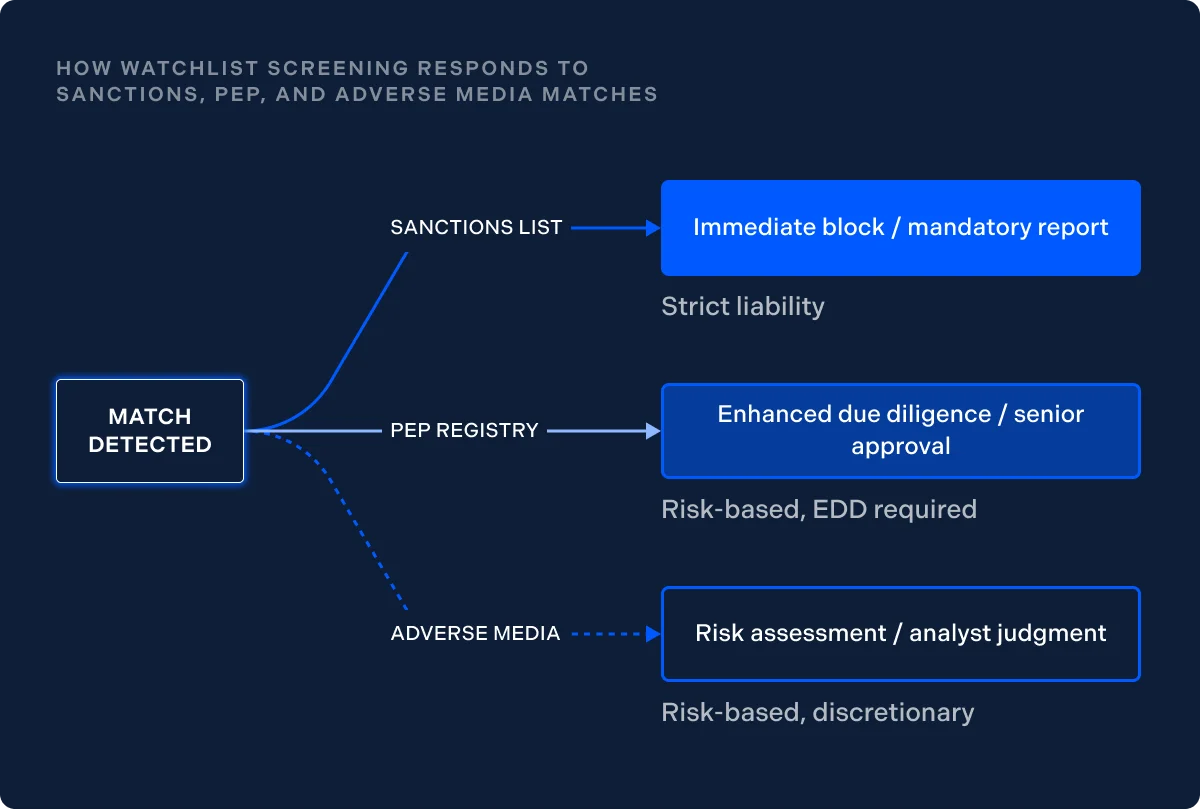
A sanctions hit requires a transaction block, a PEP match opens a due diligence workflow, and an adverse media result calls for a risk assessment.
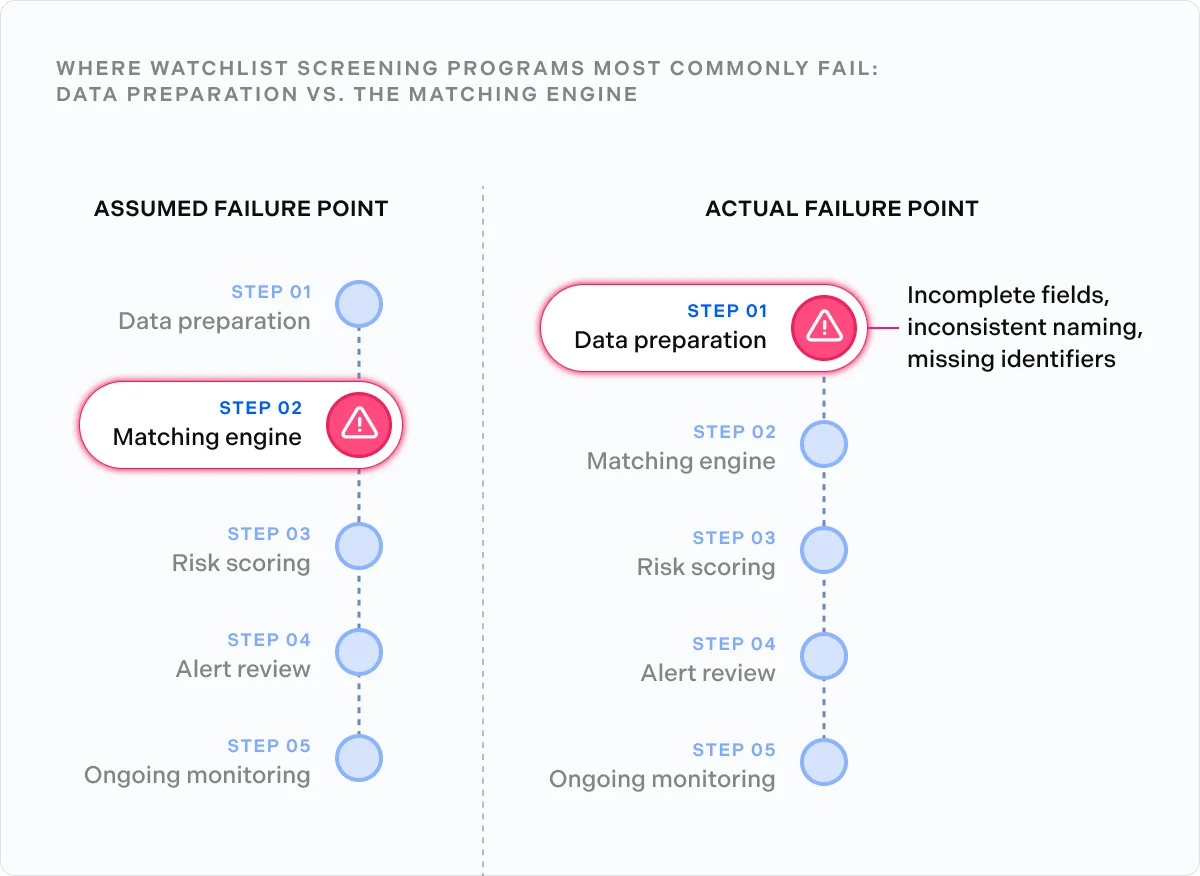
- Most missed matches trace back to data quality, not the matching engine
Incomplete records and inconsistent entity naming at the point of collection are where screening programs most commonly break down.
- High false positive volumes are structural, not a sign of misconfiguration
Fuzzy matching, common name collisions, and alias proliferation all produce near-matches that require human review to resolve.
- Sigma360 reduces manual screening workload by up to 90%
Sigma360 combines broad list coverage, AI-assisted match review, and audit-ready decision records to address the points where most watchlist programs run into trouble.
What watchlist screening covers
Watchlist screening is a core name-based risk control. Rather than assessing behavior or transaction patterns, it checks whether a customer or counterparty appears on a list of parties that regulators, governments, or law enforcement have already identified as high risk.
“The watchlist” is not a single list. Compliance programs draw from dozens of sources: government sanctions designations, PEP registries, adverse media feeds, criminal databases, and enforcement records, each maintained by a different authority and updated on a different schedule. Which source generates a match determines what the institution must do next.
Watchlist screening vs. sanctions screening
Sanctions screening is one component of watchlist screening, not a synonym. In practice, each operates under different legal standards and draws different scrutiny when a program is examined.
Sanctions screening is name-based matching against official government designations: the OFAC SDN list, the UN Security Council Consolidated List, EU restrictive measures, and the UK Sanctions List. The legal standard is strict liability, meaning a confirmed match requires an immediate block regardless of whether the institution knew about the designation at the time of the transaction.
Watchlist screening covers sanctions and six additional categories, each carrying a different legal obligation.
| List category | Example sources | Legal authority | What a match triggers |
| Sanctions list | OFAC SDN, UN Consolidated List, EU restrictive measures, UK Sanctions List | Strict liability; 31 CFR 501 | Transaction block; mandatory reporting |
| PEP registries | National PEP databases, commercial aggregators | FATF R.12; domestic AML frameworks | Enhanced due diligence; source of funds/wealth review |
| Adverse media | Global news sources, investigative reporting | Risk-based obligation; FATF R.10 | Risk assessment; case review; possible EDD |
| Criminal and law enforcement | Interpol Red Notices, FBI Most Wanted, national fugitive lists | Risk-based; no universal mandate | SAR consideration; relationship review |
| Enforcement and disciplinary records | FINRA, SEC, FCA enforcement registers | Risk-based; sector-specific | Risk scoring update; enhanced monitoring |
| Jurisdiction risk flags | FATF grey and black lists, EU high-risk third countries | FATF R.19; AMLD obligations | Enhanced due diligence; senior management review |
A sanctions program examination focuses on list coverage, update frequency, alert disposition, and the audit trail. Broader financial crime compliance reviews also cover PEP screening integration at onboarding, ongoing adverse media coverage, and whether the program design matches the institution’s risk profile.
How watchlist screening works
Watchlist screening runs at onboarding and continues throughout the relationship as lists change, moving through five stages.
1. Data collection and normalization
Customer and counterparty data (names, dates of birth, nationalities, and entity identifiers) is collected and standardized before any matching occurs. The system applies transliterations where needed, and flags any missing fields.
Most missed matches originate during data preparation, not in the matching engine.
2. Simultaneous matching across list categories
The screening engine runs normalized data against all relevant databases simultaneously. Rather than exact string matching, modern systems use fuzzy matching algorithms that account for aliases, alternative spellings, and deliberate variations.
The engine scores each match for confidence and list priority before routing to a reviewer.
3. Risk scoring and alert prioritization
A high-confidence match against an OFAC sanctions entry carries different weight than a partial name match on a disciplinary record. The scoring engine weighs match confidence, list category, and the entity’s existing risk profile to determine which alerts require immediate escalation and which enter a standard review queue.
4. Alert review and decision documentation
Compliance analysts review flagged matches to separate genuine hits from false positives. Every decision (clear, escalate, or block) is documented with the list version used, the match score, the reviewer’s identity, and the rationale. In a regulatory examination, this record is as important as the outcome itself.
5. Ongoing monitoring
Screening at onboarding captures risk at a single point in time, and lists keep changing after that. A clean result from six months ago carries no regulatory weight if the list has changed since.
Ongoing rescreening, prompted by each list update, closes the gap between a list change and the next customer scan.
Read more: 6 Best Practices for Effective Watchlist Screening
Why watchlist screening generates high false positive volumes
High false positive volumes are a structural feature of name-based matching. Each cause is built into how screening systems work, and reducing them requires understanding where each one originates.
Fuzzy matching is designed to catch near-misses
Any algorithm built to handle aliases, transliterations, and spelling variations will produce candidates that resemble a listed party without being one. The sensitivity threshold required to catch deliberate name alterations is the same one that flags legitimate customers with common surnames.
Common names collide across large customer populations
A bank screening millions of customers against a list containing thousands of entries will produce a predictable volume of name collisions, particularly for common names in Arabic, Chinese, or South Asian naming conventions, where a small set of names covers a large share of the population.
Name variations multiply entry points
Each listed entity carries multiple name variations: formal names, aliases, transliterations, and former names. A single SDN entry can generate dozens of matching candidates across a customer database.
Data quality problems at collection push the alert load higher
Incomplete date-of-birth fields, inconsistent entity naming across business units, and missing nationality data all reduce the system’s ability to confirm or rule out a match, pushing more unresolved cases into the manual review queue.
Most alerts resolve as false positives, requiring human review. A practical framework for reducing false positives in AML screening without increasing false-negative risk covers the approaches that work at each stage.
Adverse media screening creates a different kind of false positive. A customer who shares a name with someone mentioned in a financial crime article will generate a media alert with no sanctions or PEP relevance, and the judgment falls to the analyst.
Continuous monitoring adds to the problem in high-volume programs. Daily rescreening generates additional alerts on top of new customer intake, and institutions with large retail or correspondent banking books carry a sustained PEP monitoring alert load even when onboarding volumes are low.
Watchlist screening with Sigma360
Sigma360 is an AI risk intelligence platform built for Tier 1 banks, regulated corporates, global financial institutions, fintechs, payments firms, and asset managers. Its watchlist screening program addresses the three points where most programs run into trouble: list coverage, match quality, and the documentation standard examiners expect.
Key capabilities include:
- Coverage across all major list categories: 100B+ data points, 150+ corporate registries, and 4.5M articles are processed monthly across sanctions lists, PEP registries, adverse media, and proprietary derived intelligence (shared addresses, shared directors, and nominee relationships), with Sigma360 reporting 93% fewer false positives.
- AI-assisted match review: The Match Agent uses entity resolution to clear false positives confirmed through identifier mismatches, reducing manual match reviews by up to 90%, according to Sigma360, without raising the dismissal threshold.
- Audit-ready decision records: Full reasoning is provided for every recommendation, with analyst accept/dismiss/overwrite options, and each action logged with a timestamp and reviewer identity.
- Continuous monitoring: The platform rescreens against list updates as they occur, closing the window between a designation change and a customer rescan.
Speak to a compliance expert about how Sigma360’s list coverage, match quality, and monitoring frequency compare to what your current program delivers.
FAQ
What is the difference between watchlist screening and transaction monitoring?
Watchlist screening checks whether a customer or counterparty appears on a known risk list (sanctions, PEPs, adverse media, or enforcement records) before or during a relationship. Transaction monitoring analyzes payment behavior over time to detect suspicious patterns, running continuously in the background without depending on list matches.
Who is required to conduct watchlist screening?
Banks, fintechs, payment processors, insurers, and investment firms are the primary regulated categories, but the obligation extends to designated non-financial businesses and professions under FATF guidance, including law firms, real estate agents, accountants, and high-value goods dealers.
Does watchlist screening need to cover beneficial owners?
Screening the legal entity name alone is not sufficient, so effective programs screen beneficial owners, directors, and significant shareholders against the same list categories as the entity.
What is the difference between a sanctions match and a PEP match?
A confirmed sanctions match requires an immediate block and a report to the relevant authority. PEP matches trigger enhanced due diligence (source of funds review, senior management approval, and a documented risk decision), but the relationship can proceed with the right controls in place.
When does a watchlist match trigger a SAR?
A sanctions match generates a blocking report to OFAC, which under FinCEN guidance generally satisfies the SAR obligation for that specific transaction. For PEP or adverse media matches, a SAR is required if the review uncovers suspicious activity (for example, a transaction pattern inconsistent with the stated profile); the obligation is triggered by the facts, not the list category.
What documentation do regulators expect from a watchlist screening program?
Examiners look for the list version in use at the time of each decision, the match score, the reviewer’s identity, the rationale for clearing or escalating, and the timestamp. A program that screens correctly but cannot produce that record is treated as one that failed to screen.
Is watchlist screening required for occasional or one-off transactions?
OFAC strict liability applies to all transactions touching the US financial system regardless of frequency, and EU sanctions apply to any transaction by an EU-domiciled entity. A one-time wire carries the same exposure as a recurring payment, so institutions that screen at onboarding but skip occasional counterparties carry uncovered risk.

