
Regulatory examinations of watchlist screening programs consistently find that screening ran, but the decisions behind it were never documented. List selection, threshold calibration, and monitoring frequency were assumed rather than recorded.
A program built on assumptions cannot produce a documented rationale under examination.
With banks commonly assigning 10 to 15% of their full-time workforce to KYC/AML functions, according to McKinsey’s 2024 KYC/AML benchmark study, getting the configuration wrong is an expensive mistake. Program design determines whether that investment produces genuine compliance or documented activity.
This guide covers the best practices for effective watchlist screening, presented as program design decisions, each addressing a recurring failure mode and its potential solutions.
Key takeaways:
- Watchlist screening covers more than sanctions lists
PEP registries, adverse enforcement records, debarment lists, and FATF jurisdiction flags all fall within scope, and which ones apply depends on the institution’s specific risk profile.
- Beneficial owners require screening alongside the entity
Regulators expect the ownership layer to be checked, and a corporate entity that clears screening while its sanctioned owner goes unexamined is one of the most common examination findings.
- Monitoring cadence should be tiered by customer risk
High-risk counterparties need real-time or near-real-time screening, and applying the same frequency to every customer over-monitors low-risk relationships while under-monitoring the ones that carry genuine risk.
- Alert disposition records are regulatory evidence
Each decision requires the list version, match score, reviewer identity, rationale, and timestamp. A program that screens correctly but documents poorly cannot defend itself in an examination.
- Sigma360 is built for examination-ready screening programs
With configurable thresholds, beneficial ownership coverage across 150+ jurisdictions, and automated alert documentation, Sigma360 gives compliance teams the infrastructure examiners expect to find.
What watchlist screening actually covers
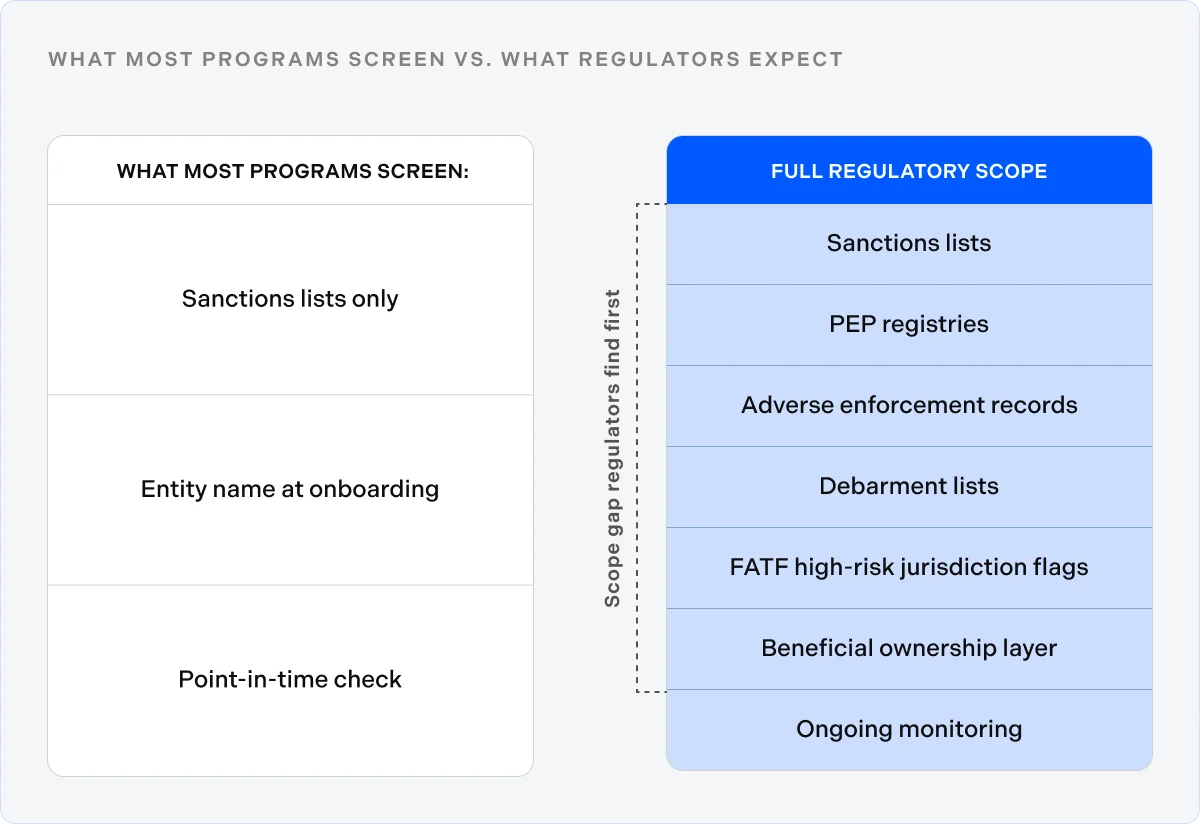
Watchlist screening is broader than sanctions screening, and the difference shapes every design decision that follows.
The list coverage varies by institution, jurisdiction, and risk profile, which is a core reason why deliberate list selection is one of the defining responsibilities of a financial crime compliance program.
Sanctions lists (OFAC’s SDN list, the UN Consolidated List, EU restrictive measures, HM Treasury’s financial sanctions register) are the highest-stakes category. Under US law, transacting with a designated entity is a violation regardless of intent. EU and UK frameworks carry similar prohibitions, though defenses vary by jurisdiction.
Unlike sanctions lists, PEP registries do not prohibit a relationship, but a PEP designation triggers mandatory enhanced due diligence under FATF Recommendation 12 and most domestic AML frameworks. The screening obligation is ongoing, since a customer who was not a PEP at onboarding may become one after a government appointment, and the program must catch that change.
Beyond sanctions and PEPs, a comprehensive screening program also covers adverse enforcement records, debarment lists, and FATF high-risk jurisdiction flags under Recommendation 19 (see FATF’s high-risk and monitored jurisdictions).
List selection needs to reflect the institution’s actual risk profile. Defaulting to whatever the platform vendor loaded as standard is a configuration choice, and one that examiners will scrutinize.
The 6 best practices for effective watchlist screening
Each practice below targets a layer of the program where examination findings most often point.
1. Calibrate match thresholds against your actual risk profile
Match threshold calibration determines how similar a name or entity record needs to be to a watchlist entry before generating an alert. It is the single most consequential configuration decision in a screening program, and in practice, one of the least revisited.
When thresholds are set too broadly, analysts spend most of their time clearing alerts on common names, transliteration variants, and partial matches with no compliance relevance. Thresholds set too narrowly carry the opposite risk, where genuine hits clear without any review at all. Neither configuration produces a defensible program.
The right calibration is institution-specific.
A payments processor screening high transaction volumes needs different sensitivity settings than a private bank with a concentrated, high-net-worth book. Effective programs document the rationale for their threshold settings, test them against a sample of historical data before going live, and revisit them when the institution’s risk profile changes or when OFAC’s Framework for Compliance Commitments is updated.
The Wolfsberg Group Sanctions Screening Guidance frames this as a programmatic obligation, requiring each institution to define the manner, extent, and circumstances of its screening based on its own assessed risks.
2. Screen beneficial owners, not just legal entities
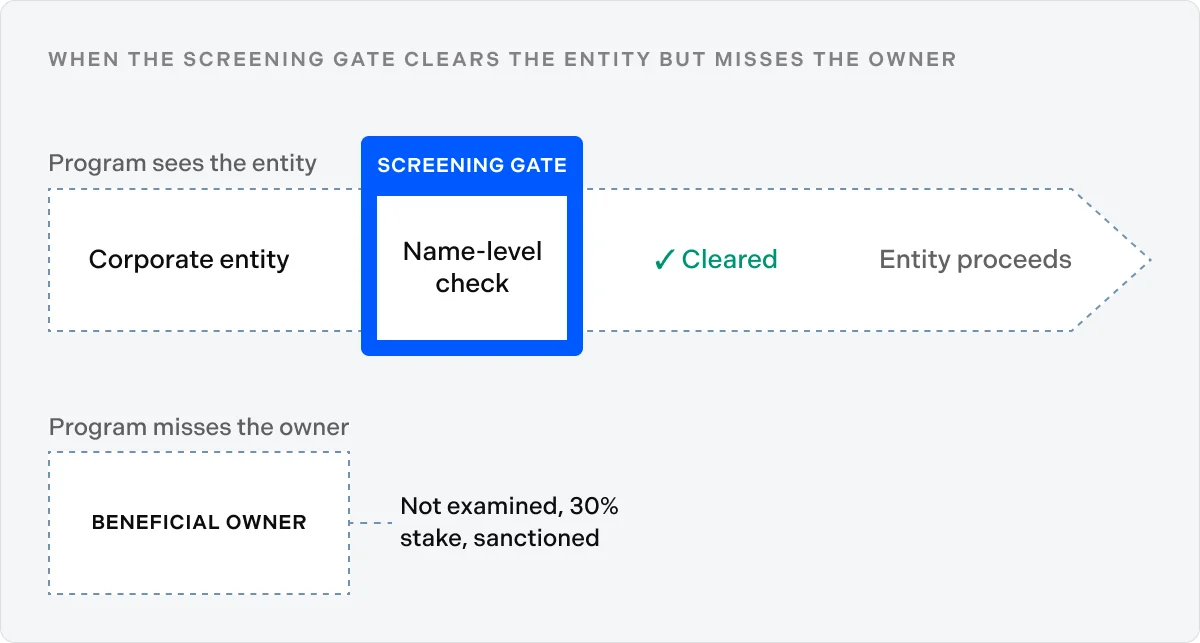
Screening the legal entity a customer presents at onboarding misses the exposure regulators are most concerned about. FinCEN’s CDD Rule requires covered financial institutions to identify and verify individuals who own 25% or more of a legal entity, as well as the individual who exercises control over it.
The FATF Beneficial Ownership standards under Recommendations 24 and 25 extend the same logic to legal persons and legal arrangements.
In practice, a sanctioned individual holding a 30% stake in a corporate entity will clear a name-only screen without triggering any review, which is why effective programs screen the beneficial ownership chain to the level required by their risk framework, not just the legal entity name on the account.
For higher-risk relationships, this means checking disclosed controllers, directors, and significant shareholders against the same watchlist universe as the entity itself.
3. Match list coverage to regulatory exposure
List coverage is a compliance decision. Selecting the wrong lists, or excluding the right ones, is a documented examination finding.
The major watchlist categories, their regulatory basis, and which institutions they apply to are mapped below.
| Watchlist type | Regulatory basis | Who it applies to |
| OFAC SDN / sectoral lists | IEEPA, TWEA, various | Any institution touching USD or US persons |
| UN Consolidated List | UN Security Council resolutions | Globally applicable |
| EU Consolidated Financial Sanctions List | EU regulations | Entities within EU jurisdiction or using EU financial infrastructure |
| UK Sanctions List (HM Treasury / OFSI) | UK Sanctions and AML Act 2018 | UK persons and entities with a UK nexus |
| FATF High-Risk Jurisdictions (R.19) | FATF standards | Institutions with cross-border exposure |
| PEP registries | FATF R.12, domestic AML laws | All regulated institutions |
| Adverse enforcement records | FFIEC BSA/AML Manual, EBA guidelines | Risk-based, institution-specific |
4. Tier your monitoring cadence by risk
FATF Recommendation 10 sets ongoing monitoring as a baseline obligation. How institutions fulfill it should reflect the risk profile of the person being monitored.
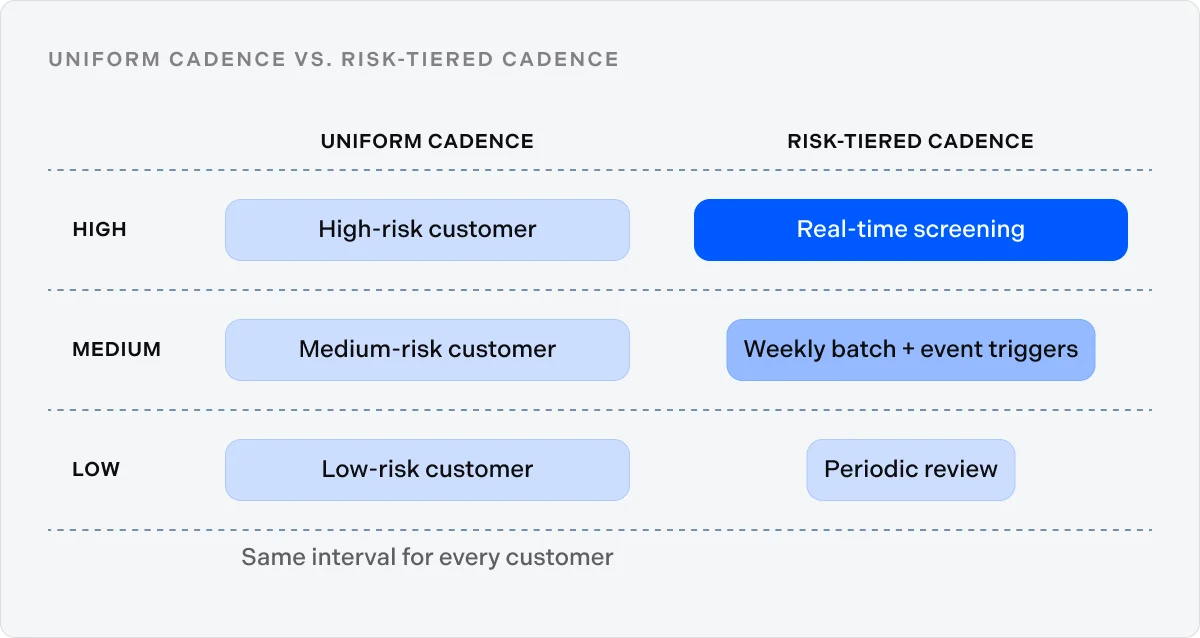
Treating every customer identically (the same screening frequency, the same alert logic, the same review backlog) produces two problems at once: Low-risk relationships get over-monitored, and high-risk ones get under-monitored.
A risk-tiered approach maps monitoring frequency to the customer’s assessed risk level:
- High-risk customers and counterparties require real-time or near-real-time screening against live watchlist updates, with automated alerts triggered by any new designation or status change.
- Medium-risk customers and counterparties fit a defined batch cadence (weekly or monthly), with event-triggered reviews when ownership changes, adverse media emerges, or a new geographic exposure appears.
- Lower-risk customers and counterparties warrant a longer review cycle, provided the tier classification is documented, and the batch cadence still captures major list updates promptly.
Documented criteria for tier assignment carry as much weight as the cadence itself. Examiners reviewing a program expect to find both the logic used to classify customers and evidence that the classification is applied consistently.
5. Build an audit-ready alert disposition record
Regulators reviewing a watchlist screening program examine every decision made when a potential match was identified. Each alert disposition record should capture the following:
- The version of the watchlist used at the time of the check
- The match score and the matching logic applied
- The identity of the reviewer who made the disposition decision
- A written rationale for the true positive or false positive determination
- A timestamp confirming when the decision was made and recorded
Programs that screen correctly but document decisions poorly are difficult to defend in an examination and nearly impossible to audit internally.
6. Run validation against your screening logic
A screening program can generate clean disposition logs while missing the exact risks it was configured to catch. Validation is the process that confirms the logic is performing as intended. It covers three different checks:
- Running the screening logic against a sample of known positive cases
- Testing threshold settings against historical data
- Reviewing whether list coverage still matches the institution’s exposure
Running all three is what separates a program that produces compliance documentation from one that produces actual risk coverage.
The FFIEC BSA/AML Examination Manual expects institutions to maintain internal controls that include independent testing of AML program components.
Periodic review of matching settings, list coverage, and alert disposition is how institutions meet the independent testing requirement. A clean disposition log alone is not sufficient evidence.
Sigma360: Built for the decisions that determine examination readiness
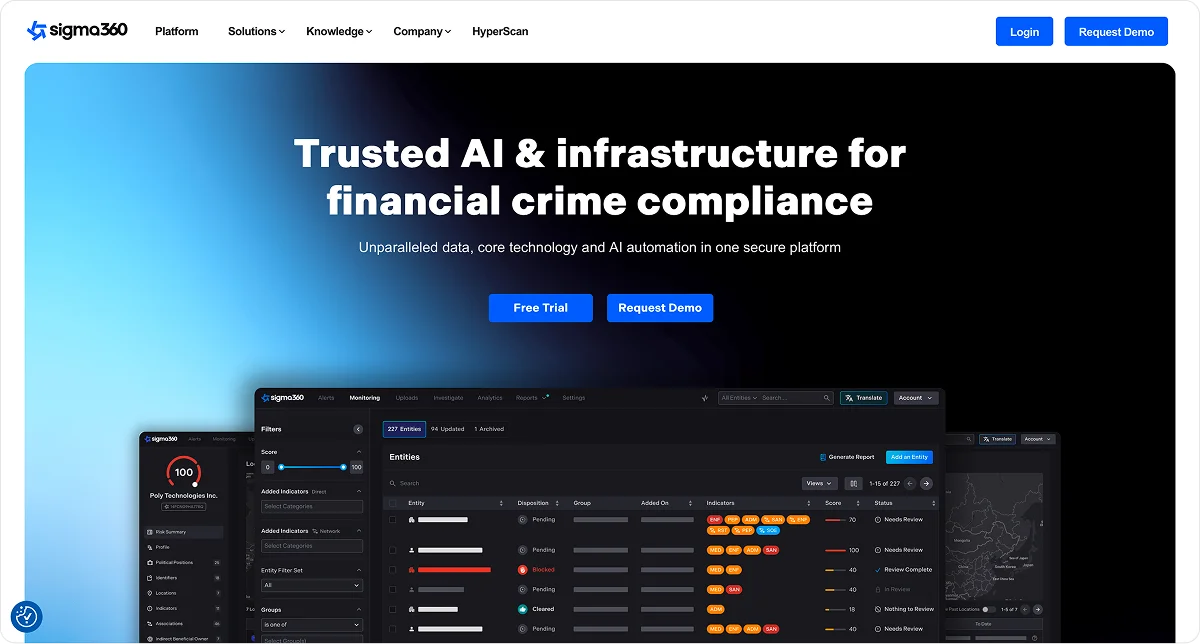
Sigma360’s platform is built around the premise that compliance teams should own every configuration decision in their screening program, with each layer remaining adjustable as the program evolves.
On threshold calibration, filter sets and match sensitivity adjust without engineering support. Teams can tune thresholds against their own historical data and update settings as their book changes.
Beneficial ownership screening extends past the entity name to corporate registries across 150+ jurisdictions, mapping ownership chains and connected entities that name-level checks miss. Screening at this depth covers the ownership layer that entity-level checks cannot reach, meeting the regulatory expectation for beneficial ownership visibility.
For alert documentation, every screening decision is automatically logged with the list version, match score, AI recommendation, analyst action, and timestamp. The Match Agent reduces manual match reviews by up to 90%, so analyst time goes to matches that warrant a decision.
Request a demo to see how Sigma360 applies to your specific screening program.
Read more: OFAC screening software best practices
FAQ
What is the difference between watchlist screening and sanctions screening?
Sanctions screening is one part of watchlist screening, focused on government-issued lists where violations carry strict liability. Watchlist screening is broader, covering PEP registries, adverse enforcement records, debarment lists, and jurisdiction risk flags alongside sanctions.
How often should watchlist data be refreshed?
Sanctions lists should update in real time, since new designations can appear without notice and create immediate liability. PEP and enforcement databases can be updated on a defined periodic cadence, but the frequency should be documented and tied to the risk tier of the customers being screened.
Who owns watchlist screening inside a financial institution?
Compliance or financial crime teams typically own it operationally, but technology, legal, and business lines all have a role. The compliance function sets risk appetite and list coverage, and business lines supply the customer data that feeds the screening logic.
What is the difference between watchlist screening and transaction screening?
Watchlist screening checks customer and counterparty identities against risk databases at onboarding and on an ongoing basis. Transaction screening checks individual payments against sanctions lists at the point of processing.
What is the role of fuzzy matching in watchlist screening?
Fuzzy matching enables screening systems to identify potential matches even when names are spelled differently, transliterated, or recorded with deliberate variations. Most regulatory frameworks treat some form of probabilistic matching as a baseline requirement, since exact-match logic alone misses too many real hits.
How should a compliance team handle a confirmed match?
A sanctions match requires immediate escalation, blocking, and, in most jurisdictions, a report to OFAC or the national FIU. A PEP match does not block the relationship but requires documented enhanced due diligence and senior management sign-off.

