
Adverse media screening is the compliance control that searches publicly available sources (news, court records, regulatory announcements, and other open-source content) to identify negative information about individuals or entities before it appears on any formal watchlist.
The window between what investigative reporting documents and what sanctions lists reflect can stretch for years.
For instance, Johnny and José Alfredo Hurtado Olascoaga, co-leaders of La Nueva Familia Michoacana (LNFM), a criminal organization, were publicly linked to cartel activity long before their November 2022 OFAC designation. Their sister Adita was not sanctioned until April 2025, despite her network connections being documented in public sources throughout that period.
Institutions screening only against watchlists had no basis to act for three years.
This article explains what adverse media screening is, where it fits in a compliance program, and what it takes to run one that catches risk before it becomes a regulatory or reputational problem.
Key takeaways:
- Adverse media and sanctions lists are not interchangeable
Sanctions lists only reflect decisions regulators have already taken. Adverse media covers what they have not yet acted on, which is where the most consequential failures tend to occur. - Onboarding screening alone is not a compliance program
Risk evolves throughout a customer relationship, and the events that matter most (ownership changes, new criminal investigations, regulatory actions) rarely happen at the point of onboarding. - A program that generates few alerts is not necessarily a good one
False negatives go undetected until enforcement exposes them. Narrow source coverage and overly conservative thresholds create the same compliance gap as a program overwhelmed by false positives. - Every adverse media decision needs a documented rationale, including clearances
Regulators expect a record of what was found, how it was assessed, and why a particular course of action was taken. A blank result with no record is indistinguishable from a check that never ran. - Sigma360 applies entity resolution and materiality scoring to 4.5 million articles per month before any alert reaches an analyst
Compliance teams looking to move from keyword-based screening to a program that genuinely prioritizes risk can request a demo to see how Sigma360’s platform works across their portfolio.
What is adverse media screening?
Adverse media screening (also called negative news screening) is a structured compliance control that examines publicly available sources for information connecting a customer, counterparty, or beneficial owner to financial crime, regulatory violations, fraud, corruption, or conduct that presents risk to an institution, before any formal designation has been made.
A client can pass every sanctions and PEP check cleanly while court filings, regulatory announcements, or investigative reporting document serious risks that no list has yet captured.
While watchlists only reflect decisions regulators have already taken, adverse media covers what they have not yet acted on. This includes active investigations, credible allegations, enforcement announcements, and reputational events that appear in public reporting long before they produce a list entry.
The sources typically covered include:
- News outlets and investigative journalism, local, national, and international
- Court records and legal filings
- Regulatory announcements and enforcement actions
- Government publications and parliamentary records
- Corporate and insolvency registers
- Social media and online publications
Adverse media runs at two critical points in a customer relationship:
- At onboarding, before a relationship begins
- Continuously throughout the client lifecycle, to catch risk that emerges after approval
Adverse media vs. sanctions lists vs. PEP data
Most compliance programs run three types of risk intelligence checks, each covering a different part of the risk picture, and none of them alone is sufficient. They are:
| Data type | What it captures | When risk appears | Is it structured? |
| Sanctions lists | Entities formally designated by governments or regulators (OFAC, UN, EU, OFSI, others) | When regulatory action has been taken | Yes: name, date, identifier |
| PEP data | Individuals in public roles with elevated corruption exposure and their close associates | When the role is held or recently vacated | Yes: role, jurisdiction, relationship |
| Adverse media | Negative public information: allegations, investigations, convictions, regulatory scrutiny, reputational events | When news is published, often months or years before designation | No: unstructured, requires NLP and entity resolution |
Sanctions lists confirm exposure regulators have acted on, while PEP data flags inherent risk tied to a person’s role. Adverse media is the only control that catches risk before either list reflects it, which is where the most consequential failures occur.
In Wirecard’s case, the Financial Times was raising specific concerns about the company’s accounting irregularities as early as 2015, five years before its collapse and the discovery of the €1.9 billion shortfall in its accounts.
The institutions that faced the heaviest consequences had access to the regulatory designations; what they lacked were the adverse media signals that preceded them.
Why adverse media screening is important
Financial crime compliance costs institutions an estimated $85 billion a year in EMEA and $61 billion in the US and Canada. Three reasons explain why adverse media has become a baseline control for regulated institutions:
It catches risk before regulators act
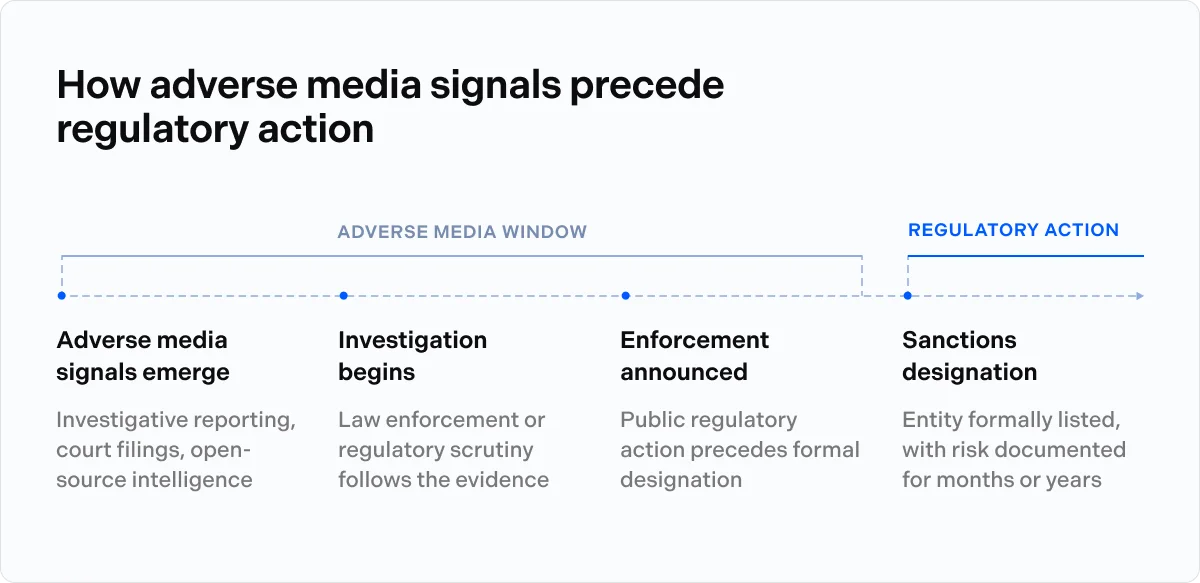
Enforcement actions follow investigations, which follow evidence, and evidence consistently appears first in public reporting, often months or years before it produces a designation or fine.
By the time a sanctions list reflects what investigative journalists, court records, or regulatory announcements have already documented, institutions relying solely on those lists will have been exposed for that entire window.
A program that monitors media continuously can catch those signals at the point they emerge, giving compliance teams time to assess and act rather than respond after a list update forces a reactive review.
It builds the audit trail regulators look for
Regulators don’t just look at whether a firm caught a risk; they want to know whether the program was designed to catch it. Under FATF Recommendation 10, institutions are expected to conduct ongoing monitoring using reliable, independent sources of information, a standard that encompasses publicly available sources including adverse media.
When examiners review an enforcement case, they look for evidence of a risk-based approach: the right customers screened at the right frequency, reasoning recorded, and proportionate action taken. Without adverse media, that evidence is incomplete.
It covers risk that watchlists were never built to catch
Fraud, money laundering, and sanctions evasion networks frequently operate through intermediaries, shell companies, and associates whose exposure is documented in open sources but absent from any formal list.
Adverse media covers allegations before they produce convictions and reputational concerns that no structured database was built to capture.
Screening once at onboarding—why is it not enough?
Most compliance programs screen customers at onboarding and then periodically thereafter. However, risk does not follow a schedule.
A client’s ownership structure can change, a counterparty can be implicated in a criminal investigation, and a supplier can become the subject of regulatory enforcement—all after onboarding, and none of it visible through a point-in-time check.
Adverse media screening applies at every stage where that risk can shift:
| Lifecycle stage | When screening applies | What triggers it |
| Onboarding | When a new relationship is being established | Customer application or counterparty due diligence |
| Periodic review | When scheduled intervals fall due based on risk tier | Annual, quarterly, or continuous review cycle |
| Trigger-based review | When specific events occur | Change of ownership, new adverse media alert, jurisdiction change, transaction anomaly |
| Enhanced due diligence | When standard screening identifies a red flag | High-risk jurisdiction, PEP status, elevated risk score |
| Offboarding | When a relationship is exited | Confirmation that the exit is not itself a risk event |
The most significant adverse events tend to emerge mid-relationship. Continuous monitoring catches those developments as they occur, and when they cross a materiality threshold, enhanced due diligence processes apply.
Adverse media also extends beyond direct customer relationships. Both the US Foreign Corrupt Practices Act and the UK Bribery Act 2010 create liability for inadequate due diligence on third parties acting on an institution’s behalf, making adverse media coverage of suppliers, agents, and payment partners a compliance obligation.
Read more:
What regulators require, and where they draw the line
Adverse media screening does not carry a single universal mandate. Expectations vary by jurisdiction, institution type, and customer risk profile, but across every major framework the direction is the same: Adverse media is expected to form part of a credible due diligence program.
FATF Recommendation 10 requires ongoing customer due diligence using reliable, independent sources of information. Its interpretive notes and the 2022 revisions to Recommendation 24 both treat publicly available information about customers and their ultimate beneficial owners as integral to a risk-based CDD program.
The four major regional frameworks follow the same direction:
- FinCEN does not mandate media searches categorically, but scales examiner expectations to customer risk, as confirmed in FIN-2020-G002 and the FFIEC BSA/AML Examination Manual, which requires banks to have policies governing when negative media searches are appropriate.
- The FCA expects firms to draw on publicly available sources. Its financial crime guide makes clear that a program limited to structured databases is not consistent with the Money Laundering Regulations 2017.
- The EBA lists adverse media as a specific risk indicator across multiple customer categories in its ML/TF Risk Factors Guidelines (EBA/GL/2021/02), with the most explicit obligations on correspondent and private banking relationships.
- The EU AML Regulation (AMLR) applies from 10 July 2027 for financial institutions and explicitly requires publicly available information to be considered in customer risk assessments; AMLA is already operational.
Taken together, these frameworks confirm that checking structured lists alone is not sufficient for any relationship that carries elevated risk.
Why adverse media programs fail in practice
Industry surveys consistently put AML false positive rates at 90–95% for transaction monitoring and up to 99.5% for sanctions screening, with compliance teams spending the majority of alert-handling time on matches that yield nothing useful.
Three challenges explain why most programs underperform:
1. Volume and unstructured data
Unlike sanctions lists or PEP data, adverse media arrives unstructured, coming through thousands of outlets across every jurisdiction where a client or counterparty operates, and no team can review it consistently through manual searches. Automated screening is a baseline requirement, and source depth determines what a program actually catches, specifically:
- Geographic coverage: whether local and regional outlets are monitored alongside national press
- Language coverage: whether reporting in the client’s operating jurisdictions is captured, not just English-language sources
- Source type: whether court records, regulatory announcements, and official publications are included alongside news media
- Deduplication: whether the same story published across multiple outlets generates one alert or many
2. False positives and false negatives
The most persistent operational problem is the false positive, i.e., a legitimate client flagged because they share a name with someone in adverse reporting.
Legacy keyword-matching systems can consume most of analyst review time without a single actionable finding. Effective programs address this through entity resolution, contextual analysis, and materiality scoring that prioritizes alerts by severity before they reach an analyst.
The false negative problem is harder to detect because it only becomes visible when an enforcement action exposes what a program failed to catch. It occurs when:
- Source coverage is too narrow to capture reporting from relevant jurisdictions or languages.
- Matching logic is too restrictive to identify individuals under aliases or name transliterations.
- Materiality thresholds are set so conservatively that relevant articles are filtered out alongside irrelevant ones.
A program that generates few alerts is not necessarily well-calibrated.
3. Materiality: the distinction most programs get wrong
Not all adverse media carries equal weight. An allegation of a minor regulatory infringement is categorically different from a conviction for financial crime, and treating both with the same urgency produces the fatigue that causes genuine risk to go unreviewed.
Materiality assessment requires judgment across four dimensions:
- Source credibility: whether the outlet or document is a reliable, verifiable record
- Severity: whether the allegation represents a material financial crime risk or a peripheral mention
- Recency: whether the event is current or historical context
- Proximity: whether the named individual connects directly to the institution’s actual customer
In the Hurtado Olascoaga case, Sigma360’s platform picked up adverse media connecting Adita to LNFM through local Spanish-language reporting and network intelligence as early as 2022, well before her April 2025 OFAC designation.
The signal came from open sources that keyword-based tools had missed: local press coverage, cartel network linkages, and entity connections that became visible only through entity resolution and Spanish-language coverage.
Programs built on keyword matching and volume-based alerting are structurally prone to this failure: High alert counts with low signal density mean the findings that warrant action are the hardest to find.
How Sigma360 approaches adverse media screening
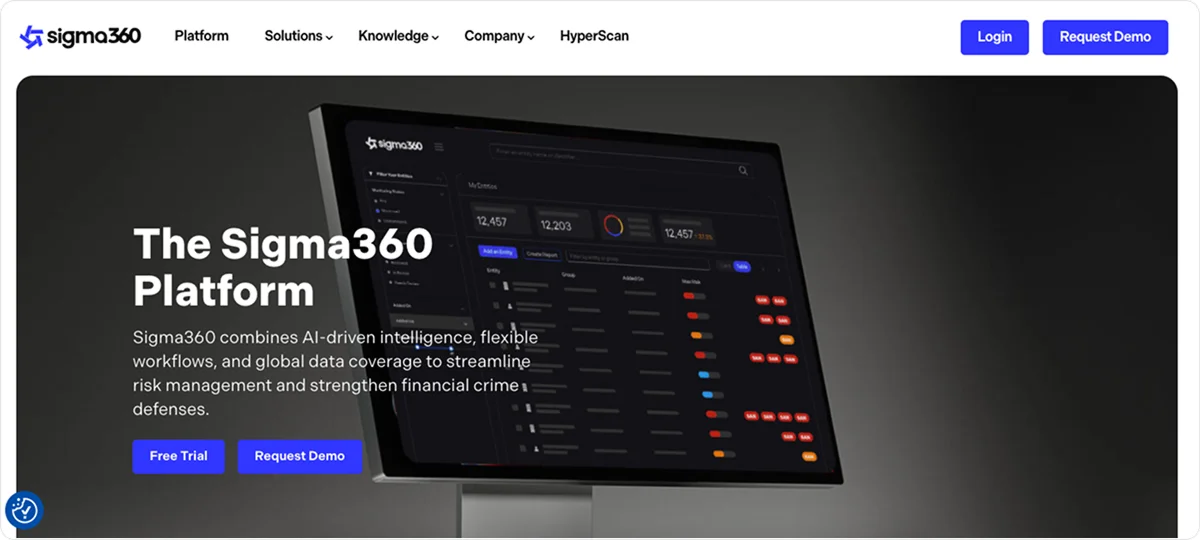
Sigma360’s AI risk intelligence platform draws on 4.5 million articles per month from 600,000+ sources, applying entity resolution and machine learning to every article before it reaches an analyst’s screen.
The platform addresses each of the three failure modes above:
- Materiality and entity risk scoring evaluates how serious an adverse media event is and how closely the named entity relates to the institution’s actual customer, so analysts work from a prioritized queue rather than a raw article volume.
- AI-powered Adverse Media Summary groups related coverage of the same event into a single structured narrative, cutting the duplication that overwhelms high-volume screening environments.
- Configurable filter sets let compliance teams adjust screening parameters to their own risk appetite by risk tier, jurisdiction, and entity type without engineering involvement.
- Continuous monitoring generates alerts as new reporting is published, so risk that emerges after onboarding is caught when it appears.
A Sigma360 case study documents how a top-10 global financial institution replaced its rule-based screening process with Sigma360’s AI-powered platform. False positives fell substantially, and analyst disposition rates improved across the portfolio, producing exactly the gains that addressing those three challenges should deliver.
Request a demo to see how Sigma360 handles adverse media screening across your customer and counterparty portfolio.
FAQ
Which industries are required to conduct adverse media screening?
Regulated financial institutions (banks, payment firms, fintechs, insurers, and asset managers) face the clearest obligations under AML/CFT frameworks.
Certain designated non-financial professions, including real estate agents, accountants, and lawyers, are increasingly subject to the same expectations, particularly as the EU AML Regulation expands the scope of obliged entities from July 2027.
Does adverse media screening need to cover beneficial owners, not just direct customers?
Yes. FATF’s guidance and the 2022 revisions to Recommendation 24 expect institutions to screen the individuals who ultimately own or control a legal entity, not just the entity itself. A customer that appears clean may still present exposure through a beneficial owner with adverse media history.
How should firms handle adverse media screening across multiple languages?
Screening should cover reporting in all languages relevant to the jurisdictions where a customer or counterparty operates. Limiting coverage to English-language sources is one of the most common causes of false negatives, since risk often appears first in local-language press before reaching international outlets.
What documentation does a regulator expect when adverse media is found?
A record of what was found, how it was assessed, and what decision was reached, including when the decision was to proceed. The audit trail should capture the source, the nature of the finding, the materiality assessment applied, and the escalation path or rationale for clearing.
What should a compliance team do when adverse media screening returns no results?
Record it as a documented outcome. Regulators expect evidence that screening ran, what parameters were applied, and what sources were checked. A blank result with no record is indistinguishable from a check that never took place.
How is adverse media screening different from a general internet search?
A general search is unstructured, inconsistent, and produces no audit trail. Adverse media screening applies defined source lists, entity resolution, materiality scoring, and documented outputs that support regulatory examination.

