
PEP screening and adverse media monitoring cover the same risk from different angles.
PEP screening checks whether a customer holds a position that creates elevated exposure to corruption, bribery, or money laundering. Adverse media monitoring searches public reporting for evidence of what the customer or their associates have been doing, often months or years before any formal designation reflects it.
A confirmed PEP match triggers enhanced due diligence, but it tells a compliance team nothing about the individual’s conduct, business relationships, or the activities of family members who may not appear in any structured database.
Enforcement actions in this space regularly trace back to failures in ongoing monitoring, not to failures at onboarding.
This article covers what each control detects, where their outputs must be read together, and how to design a program in which the two reinforce each other.
Key takeaways:
- PEP lists confirm a role, not the risk behind it
A confirmed match qualifies someone for enhanced due diligence, but says nothing about their conduct, their network, or what their associates may be doing. - Three compliance scenarios require both controls together
EDD documentation, sanctions co-occurrence, and RCA network exposure all produce incomplete findings when PEP and adverse media monitoring run in isolation. - PEP and adverse media false positives are different problems
Each type has a different root cause and requires a different resolution approach, which is why the two programs need separate calibration even on the same platform. - Sigma360 runs PEP and adverse media monitoring in a single workflow
Sigma360 addresses conduct visibility, RCA detection, and status timing through integrated AI agents and continuous monitoring.
What PEP screening and adverse media monitoring each do
PEP monitoring involves screening customers, counterparties, and beneficial owners against structured databases of politically exposed persons.
Under FATF Recommendation 12, financial institutions must obtain senior management approval before establishing or continuing a PEP relationship, take reasonable measures to establish the source of wealth and funds, and conduct enhanced ongoing monitoring throughout the relationship.
Each PEP record carries the individual’s role, jurisdiction, and relationship tier, and specialist providers update their databases when political appointments, elections, or status changes occur.
Where PEP data is structured, adverse media appears as free text across thousands of sources in dozens of languages.
Extracting a reliable signal from that volume requires natural language processing, entity resolution, and materiality scoring before any finding reaches an analyst. Sources span news outlets, court records, regulatory announcements, investigative journalism, and official publications.
The table below sets out how the two controls compare across the dimensions that shape program design decisions.
| Dimension | PEP monitoring | Adverse media monitoring |
| Data type | Structured (role, jurisdiction, relationship tier) | Unstructured (free text, open-source content) |
| Primary source | Curated PEP databases, corporate registries | News outlets, court filings, regulatory announcements |
| Update mechanism | Database refresh on appointment or status change | Continuous ingestion from global media sources |
| What it catches | Known political exposure tied to a current or former role | Alleged or confirmed conduct risk, often before formal action |
| Network coverage | Directly identified RCAs in structured records | Indirect associations detected through open-source reporting |
| Regulatory basis | FATF R12, EBA AML guidelines, FinCEN CDD Rule | FATF R10, FFIEC BSA/AML Manual, FCA financial crime guidance |
| False positive profile | Name collisions, common surnames, transliteration errors | Context mismatches, volume from unrelated coverage |
Why PEP screening is not enough on its own
PEP lists are incomplete by design. They reflect the universe of individuals that database providers have identified and classified, a set that grows with every election cycle, appointment, and update, but always lags behind the population of individuals who carry genuine political exposure.
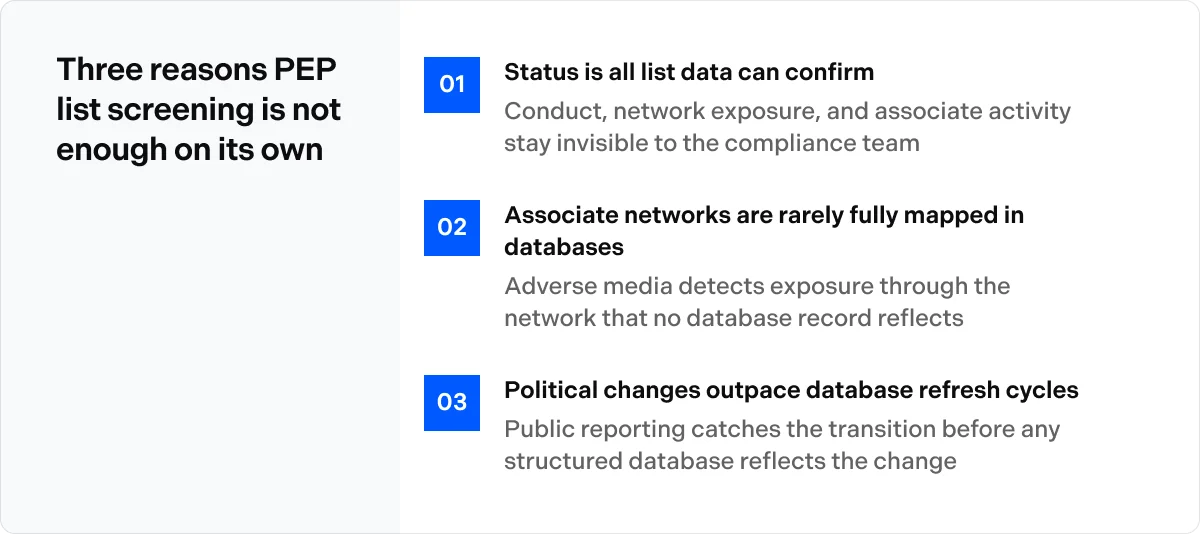
1. PEP lists reveal status, not conduct
Clearing a PEP match confirms that the individual qualifies for enhanced due diligence. What the list cannot convey is anything about their financial behavior, business relationships, or involvement in wrongdoing.
A compliance team working from PEP data alone has confirmed the role, not the underlying risk. It has also not necessarily confirmed who that individual is connected to.
2. PEP coverage of relatives and close associates is inconsistent
FATF guidance on PEPs requires institutions to take reasonable measures to identify close family members and known associates, but RCA coverage within structured databases is often incomplete, with relationships not always documented, associates potentially obscure, and connections changing over time.
Adverse media monitoring can detect exposure through that network (for instance, a PEP’s spouse implicated in a state contract, or a business associate named in a financial crimes investigation) that no database record reflects in time for it to affect the compliance decision.
3. PEP status changes faster than databases update
Someone who held no politically exposed designation at onboarding can acquire one overnight through election results, a government appointment, or a change in role.
Adverse media monitoring catches that transition as it enters public reporting, often before any structured database has been updated, giving compliance teams an earlier signal than list-based screening alone can provide.
Where the two controls connect
The compliance scenarios that carry the most weight for PEP relationships are also the ones where adverse media evidence is hardest to replace.
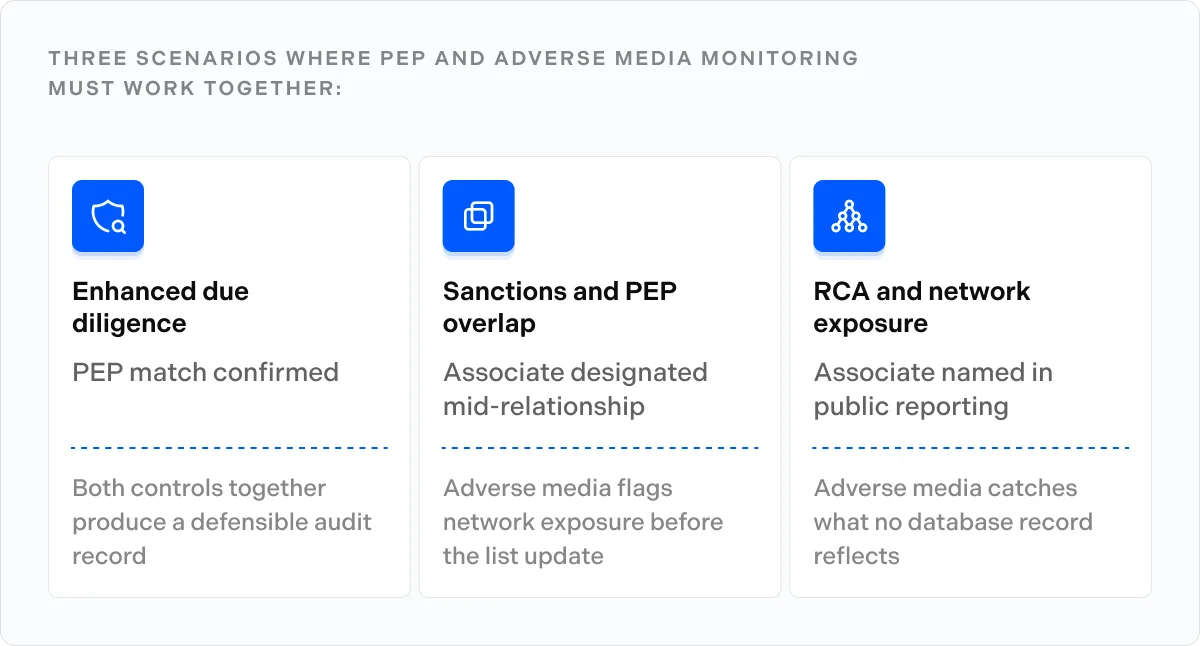
Enhanced due diligence
When a PEP match is confirmed, EDD is required, but PEP data alone does not provide the content that makes EDD defensible. Adverse media monitoring supplies the source of wealth context, business relationship history, and reputational background that allow an analyst to form a view the regulator can examine.
A PEP match with no adverse media findings still requires documentation, and running both controls together gives that documentation the evidential weight a regulator expects.
Sanctions and PEP overlap
PEP status and sanctions exposure frequently co-occur in the same population. A politically exposed individual who is not yet designated may have close associates who already are, and a sanctions update can bring a PEP into scope mid-relationship.
Running sanctions screening alongside PEP and adverse media checks ensures that a clean result at onboarding does not become a liability when list changes or new reporting alter the risk picture.
RCA and network exposure
Financial crime linked to politically exposed persons rarely stays in the PEP’s own name. When adverse media identifies an associate, that finding requires the same review process as a direct PEP alert, including a materiality assessment and a documented decision on how to proceed.
Read more: Why sanction lists and PEP screening are important for any business
Key differences in program design
The two controls differ in data structure, matching logic, monitoring cadence, and jurisdictional scope.
Source coverage and language
PEP database coverage depends on which provider covers the relevant jurisdictions, roles, and relationship tiers, and how comprehensively it tracks RCAs.
For adverse media, risk often appears first in local-language press, regulatory notices in non-English jurisdictions, or court records that require translation and NLP to extract a usable signal.
That volume and variety of multilingual content makes entity matching significantly harder than it does for structured PEP data.
Matching logic and false positives
PEP false positives are primarily an identity problem. Common names, close transliterations, and shared surnames generate matches that require secondary identifiers (date of birth, nationality, jurisdiction) to resolve.
With adverse media, the challenge is context rather than identity—the right person appears in an article, but their mention is incidental, historical, or unrelated to any financial crime risk.
Misconfigured source coverage and broad matching thresholds affect both types, which is why PEP and adverse media programs require separate calibration even when they run on the same platform.
Monitoring cadence and alert thresholds
For PEP relationships, cadence decisions follow the risk tier assigned to the customer and the rate of political change in the relevant environment. A stable low-risk domestic official warrants a different review frequency than a senior foreign official in a high-corruption jurisdiction.
On the adverse media side, continuous monitoring is the appropriate standard for PEP relationships because conduct risk can emerge and escalate quickly, and delayed detection leaves a compliance program as exposed as if it had never run the check.
Cadence requirements also vary by jurisdiction, since different regulatory frameworks set different expectations for how frequently PEP relationships must be reviewed.
Read more: Adverse media monitoring tools: features, use cases, and tips
Jurisdictional variation in PEP definitions
PEP definitions are not uniform across jurisdictions. In the United States, enhanced due diligence obligations apply to foreign PEPs, while domestic PEPs do not carry the same automatic classification under US AML rules.
The 2020 joint statement from FinCEN and the federal banking agencies confirmed that CDD requirements should be commensurate with the risks posed by each individual relationship.
The EU AML Regulation, which applies from July 10, 2027, takes a broader approach and requires enhanced measures for both domestic and foreign PEPs, regardless of origin.
Public reporting follows none of these classifications. A domestic PEP excluded from US EDD obligations can still generate material adverse media, and that reporting warrants the same review standard regardless of where the regulatory perimeter sits.
Regulatory expectations across both controls
Across the major AML frameworks, the obligation to run PEP screening and adverse media monitoring together is explicit.
FATF Recommendation 10 requires ongoing monitoring of the business relationship and scrutiny of transactions throughout the customer lifecycle. That obligation extends to the conduct and network risk that structured list data cannot capture for PEP relationships, making adverse media monitoring a compliance requirement rather than an operational preference.
Correspondent banking and private banking relationships carry the most explicit expectation, which the EBA addresses directly.
The EBA Risk Factors Guidelines add specificity, listing adverse media as a specific risk indicator for PEP relationships alongside standard EDD measures. In correspondent banking and private banking relationships involving PEPs, the guidelines treat adverse media as a baseline expectation whose absence will be examined.
Regulators examining these programs look beyond onboarding. Institutions that performed proper screening at the start but missed subsequent adverse media developments or changes in PEP status have faced enforcement on the same basis as those that did not screen at all.
Read more: Is adverse media screening a regulatory requirement or just best practice?
How Sigma360 integrates PEP and adverse media monitoring

The three limitations that make PEP screening insufficient on its own (incomplete conduct visibility, inconsistent RCA coverage, and timing lag on status changes) are also the three problems that integration with adverse media monitoring is designed to address.
Sigma360 runs both controls within a single workflow, so each control’s output is visible alongside the other when an analyst reviews a case.
The platform addresses each limitation directly:
- Adverse Media Agent consolidates related coverage of a PEP or their associates into a single structured narrative, giving analysts the conduct context and reputational background that PEP list data does not carry and that a defensible EDD record requires.
- Match Agent applies entity resolution across PEP data, adverse media findings, sanctions exposure, and corporate registry connections simultaneously, detecting RCA-linked exposure through the network rather than only at the named individual level.
- Perpetual KYC monitoring flags PEP status changes and new adverse media developments as they enter public reporting, giving compliance teams an earlier signal than any scheduled review cycle can provide.
Request a demo to see how Sigma360 handles PEP and adverse media monitoring across your portfolio.
FAQ
Does identifying a customer as a PEP mean you cannot do business with them?
No. PEP status triggers enhanced due diligence and ongoing monitoring, not a prohibition on the relationship. That distinction belongs to sanctions screening, where a confirmed match requires immediate action.
How long does someone remain a PEP after leaving public office?
Most frameworks require institutions to continue treating former PEPs with elevated scrutiny for at least 12 months after they leave their role, with a risk-based assessment determining how long beyond that minimum. Adverse media monitoring is especially important during this window, since reputational risk from prior conduct often surfaces after departure.
Do relatives and close associates of a PEP need to be screened against adverse media separately?
Yes. RCAs carry the same risk elevation as the PEP and are subject to the same EDD obligations. Adverse media monitoring is often the most reliable way to detect network-linked exposure that structured PEP databases do not capture.
What events should trigger a fresh adverse media review for an existing PEP relationship?
A new appointment, a jurisdiction change, news of an investigation involving their associates, or a change in ownership structure should all prompt immediate review outside the standard monitoring cycle.
Is a domestic PEP excluded from US EDD requirements still a compliance risk?
Yes. The exclusion applies to formal EDD obligations, not to risk-based oversight. A domestic official generating credible adverse media warrants the same investigative review as any other high-risk finding.

