
Financial crime compliance (FCC) is the framework that financial institutions use to prevent, detect, and report money laundering, fraud, sanctions evasion, terrorist financing, and related threats.
While most institutions have compliance programs designed to satisfy regulators, reliably detecting the financial crimes those regulations are meant to prevent is a separate, more demanding objective.
According to the United Nations Office on Drugs and Crime, an estimated $800 billion–$2 trillion in illicit funds moves through the global financial system each year, and financial crime compliance has become a $300 billion industry built around detecting and containing that threat.
Despite that scale of investment, most of those funds still move through the system undetected, and the pressure on compliance teams keeps growing.
This guide explains what FCC actually requires, where most programs go wrong, and what separates genuine detection from documented compliance.
Key takeaways:
- Poor data quality during onboarding creates problems that compound throughout the program
Incomplete KYC records flow into screening systems, influence risk decisions, and affect relationship management. Fixing data downstream can be significantly more costly than getting it right from the start. - Meeting regulatory requirements and detecting financial crime are not the same
FCC ensures controls exist and are documented, while FCRM asks whether those controls are effective in practice. Programs that mistake one for the other tend to pass audits while missing sophisticated threats. - Legacy programs create operational strain that compounds over time
Alert fatigue, fragmented data, and static screening are structural consequences of how most compliance programs were designed, and they tend to worsen as transaction volumes and regulatory expectations grow. - Regulatory enforcement is accelerating, and penalties are at historic levels
From AMLA’s direct supervision of high-risk institutions to record AML fines, regulators are making clear that controls must demonstrably work, not just exist on paper. - The right platform closes the distance between regulatory obligation and genuine risk detection
Sigma360 unifies screening, monitoring, and investigation in one system, so compliance teams can direct their attention toward risk assessment rather than administrative work.
What financial crime compliance covers
FCC is a set of interconnected obligations that cover every stage of a customer or counterparty business relationship, from the first identity check through to ongoing monitoring, investigation, and regulatory reporting.
In most institutions, these obligations run through multiple teams:
- Compliance screens and onboards customers
- Risk analysts monitor and escalate alerts
- Operations teams manage documentation and reporting
When those functions are not connected, control breaks down at the handoffs.
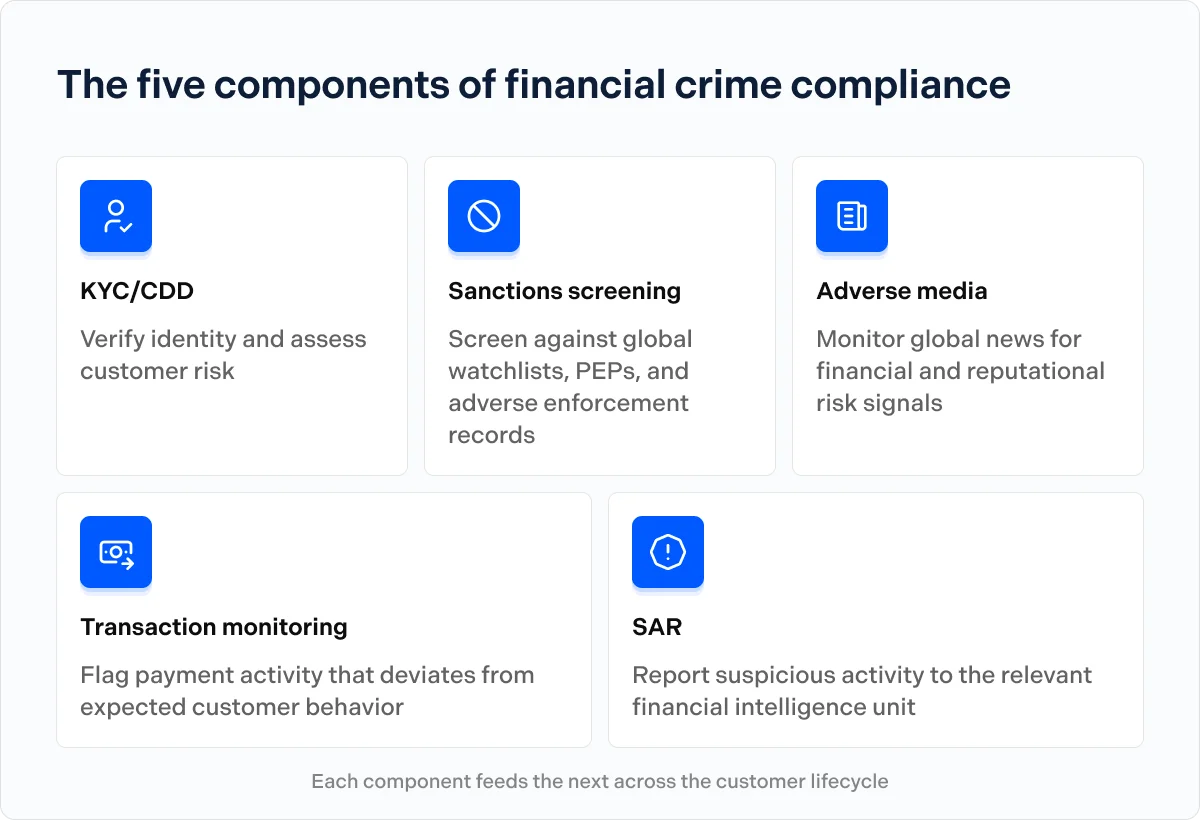
The core components below define what FCC requires at each stage of that lifecycle.
Know Your Customer and Customer Due Diligence
Know Your Customer (KYC) and Customer Due Diligence (CDD) form the foundation of every customer relationship, establishing the risk profile that governs how that relationship is managed in the future.
KYC is the process of verifying the identity of a customer or counterparty before a relationship begins.
CDD, on the other hand, assesses what that entity does, where their funds come from, and what level of risk they represent to the institution.
Together, they determine how a customer is classified, how closely they are monitored, and what controls apply throughout the relationship.
Higher-risk customers require Enhanced Due Diligence (EDD), which means deeper investigation and more rigorous ongoing review. This applies to:
- Politically exposed persons (PEPs) and their associates
- Entities in high-risk or sanctioned jurisdictions
- Complex corporate structures with opaque beneficial ownership
Incomplete or inaccurate records affect how a customer is screened, how risk is assessed, and how the relationship is managed throughout its lifetime. A 2024 industry study found that 67% of banks have lost clients as a result of inefficient or slow onboarding, confirming that weak processes create business risk, not just regulatory exposure.
Sanctions and watchlist screening
Sanctions screening requires checking every customer and counterparty against lists maintained by OFAC, the UN Security Council, the EU, and other regulatory bodies, as well as PEP databases, adverse enforcement records, and proprietary risk data that official lists do not capture.
A confirmed sanctions match can result in:
- A transaction being blocked pending investigation
- A formal investigation being opened against the entity
- The relationship being exited entirely
Match quality determines whether that process is actually effective. Common name variations, transliteration differences across languages, and duplicate entity records mean that systems can flag the wrong person or miss the right one.
Matching logic that is too broad floods analysts with false alerts, while logic that is too narrow allows genuine sanctions exposure to pass undetected.
Finding the right calibration (and maintaining it as customer data and sanctions lists evolve) is one of the more demanding operational challenges in a screening program.
Adverse media screening
Adverse media monitoring involves screening global news sources for negative coverage linked to a customer or counterparty, including regulatory actions, litigation, fraud allegations, and reputational incidents that may change a risk assessment.
Regulators increasingly expect it as part of both onboarding and ongoing monitoring, particularly for higher-risk relationships.
The volume of raw returns makes adverse media operationally difficult to manage. A single search can return hundreds of loosely matched or immaterial articles, and without materiality scoring and entity resolution, analysts spend more time cleaning irrelevant results than identifying genuine risk.
Read more: How a Top 10 Global Financial Institution Transformed Adverse Media Screening with AI
Transaction monitoring
Transaction monitoring systems analyze payment activity for patterns associated with money laundering, fraud, terrorist financing, and other financial crime typologies, generating alerts when activity deviates from expected customer behavior.
For most institutions, it is the primary mechanism for detecting suspicious activity after a customer has been onboarded.
Effective transaction monitoring requires accurate, up-to-date customer profiles to define normal behavior for each entity.
Outdated or incomplete profiles leave the system without a reliable behavioral baseline against which to measure activity, which is why alert quality in transaction monitoring depends directly on the strength of KYC and onboarding data.
Suspicious activity reporting
When a compliance team identifies activity that cannot be adequately explained, they are required to file a Suspicious Activity Report (SAR) with the relevant financial intelligence unit: FinCEN in the United States, the UK Financial Intelligence Unit (UKFIU) in the UK, or the equivalent body in their jurisdiction.
SAR filing is a legal obligation, and the quality of each report has a direct impact on what law enforcement agencies can do with the intelligence they receive.
High-quality SARs allow investigators to:
- Identify patterns across multiple cases and institutions
- Connect activity that would otherwise appear unrelated
- Build investigations that result in prosecutions or asset recovery
A poorly documented or incomplete report limits what investigators can act on.
The regulatory landscape: who sets the rules
FCC operates under a layered structure that combines global standards with national enforcement. The bodies below shape requirements across the markets where most of Sigma’s clients operate.
| Regulatory body | Jurisdiction | Primary focus |
| Financial Action Task Force (FATF) | Global | AML and CFT standards, country risk assessments |
| FinCEN | United States | Bank Secrecy Act (BSA) compliance, SAR reporting, beneficial ownership |
| OFAC | United States | Sanctions administration and enforcement |
| FCA | United Kingdom | AML supervision, financial crime systems and controls |
| EU AMLA | European Union | Direct supervision of high-risk institutions from 2028 |
| MAS | Singapore | AML/CFT for financial institutions in Singapore |
FATF anchors the global framework through its 40 Recommendations, which define the baseline for AML and CFT programs worldwide.
Its mutual evaluation process assesses whether countries are implementing those standards effectively, and a poor FATF rating carries direct consequences: reduced access to correspondent banking relationships and increased scrutiny from international counterparties.
United States
The BSA and the Anti-Money Laundering Act of 2020 set the primary framework, with FinCEN overseeing implementation. The 2020 Act significantly modernized BSA requirements, expanding whistleblower protections and directing FinCEN to prioritize high-value investigations over volume-based compliance metrics.
Beneficial ownership reporting was introduced through the Corporate Transparency Act, a separate statute enacted within the same broader National Defense Authorization Act that contained the AMLA 2020.
European Union
The Anti-Money Laundering Directives (now in their sixth iteration) have progressively tightened EU-wide requirements on beneficial ownership registers, cross-border data sharing, and sanctions compliance.
AMLA, the EU’s new dedicated supervisory authority, marks one of the most significant structural changes in global FCC in recent years. From 2028, it will directly supervise around 40 of the highest-risk financial institutions across EU member states, ending the fragmented national supervision model that has historically created regulatory arbitrage.
Institutions operating across EU markets should already be assessing how AMLA’s convergence reviews will affect their compliance architecture.
Across all jurisdictions, the direction is the same: more explicit expectations, faster enforcement, and less tolerance for programs that cannot demonstrate measurable results.
FCC vs FCRM: two functions, one goal
These two concepts are related but serve distinct purposes. Programs that treat them as the same function tend to meet regulatory requirements while missing the risks those requirements are meant to catch.
Together, they address what a program must do and whether it is actually working:
- Financial crime compliance (FCC) covers the policies, controls, and processes that regulators require: KYC, AML, sanctions screening, transaction monitoring, and SAR reporting. A well-run FCC program keeps an institution on the right side of the law and provides defensible documentation when regulators ask questions.
- Financial crime risk management (FCRM) focuses on understanding and reducing exposure. It assesses where the real risks exist in a portfolio and which customers, geographies, and transaction types carry the most vulnerability. It also evaluates whether existing detection controls would hold up against a sophisticated actor trying to evade detection.
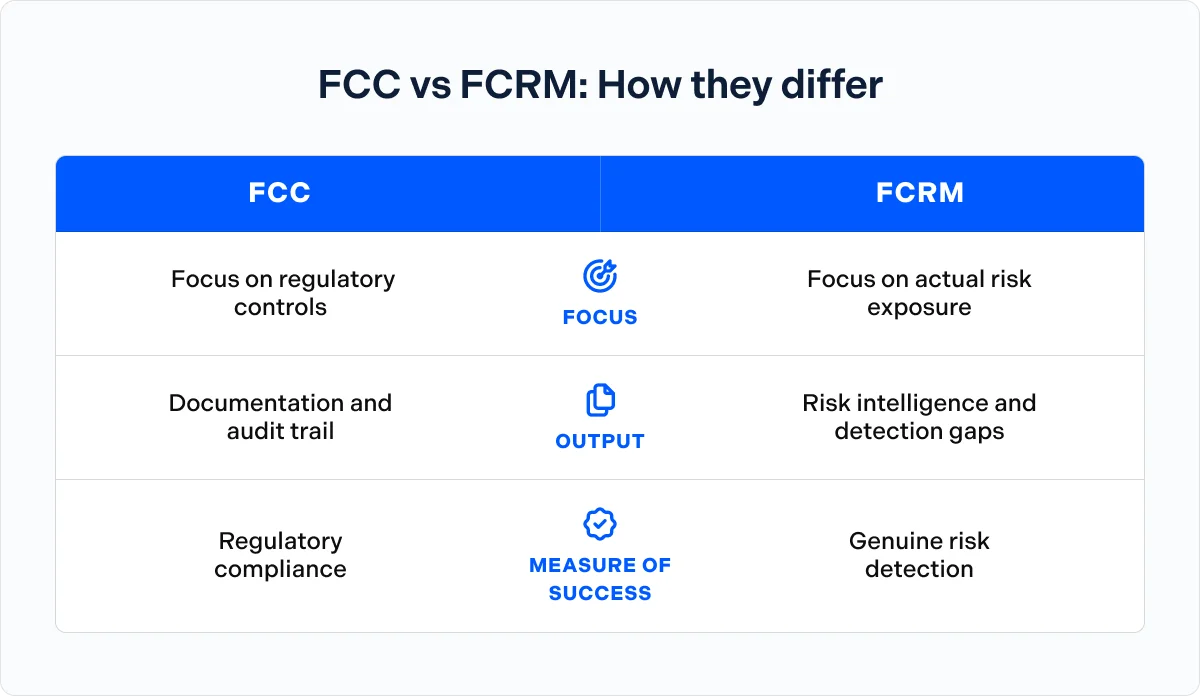
Institutions with the strongest programs treat both functions as two sides of the same operation rather than separate workstreams with separate owners.
Why most FCC programs struggle operationally
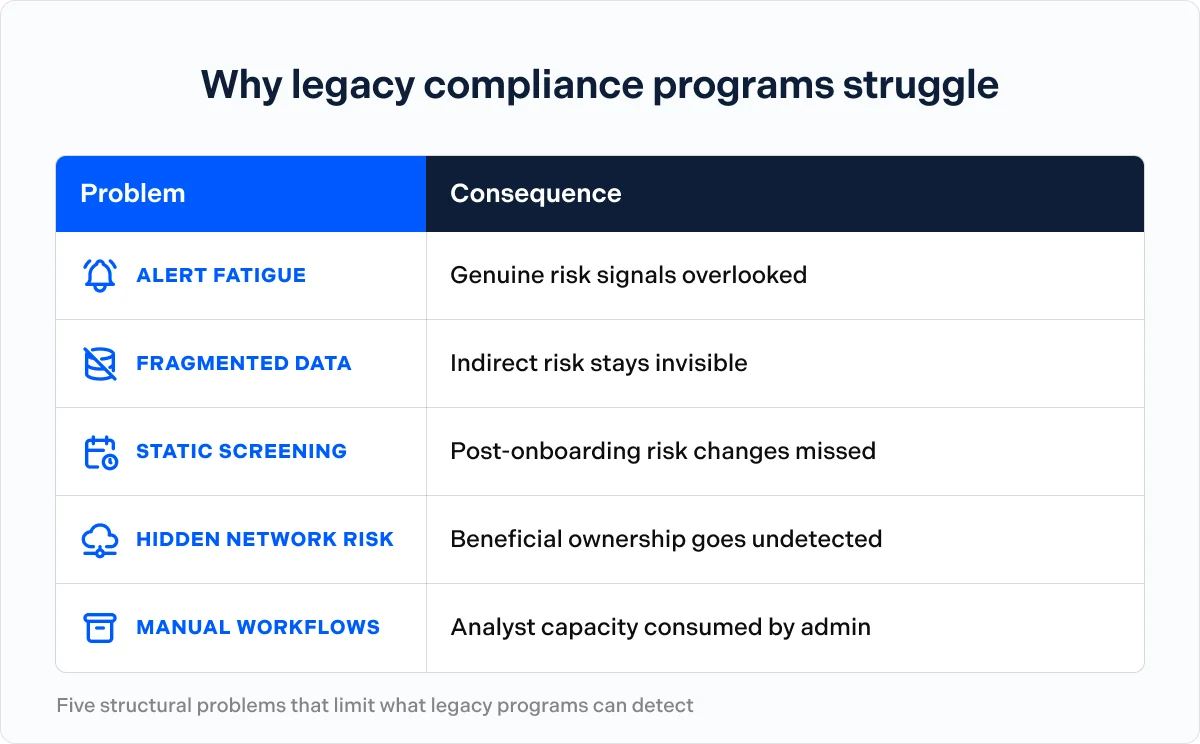
Most compliance programs were built for a threat environment that no longer exists, and the operational strain shows.
The most common problems compliance teams face are:
- Alert fatigue: Irrelevant alert rates in legacy screening systems often exceed 90%, meaning analysts spend most of their time clearing alerts that result in no action, while genuine risk signals compete for attention in the same queue.
- Fragmented data: Risk data spread across disconnected systems forces analysts to manually consolidate information from sanctions databases, adverse media tools, and corporate registries, making indirect or network-based risk nearly impossible to see.
- Static screening: Point-in-time checks at onboarding do not reflect how risk evolves, and a customer who was low risk then may become high risk months later due to changes in ownership, sanctions exposure, or adverse media coverage.
- Hidden network risk: Older tools struggle to detect indirect exposure through shell companies, nominee relationships, shared addresses, and ownership structures specifically designed to obscure beneficial ownership.
- Manual investigation workflows: Analysts still spend significant time compiling risk summaries, writing case narratives, and documenting decisions, at the expense of higher-value judgment calls.
What a modern FCC program looks like
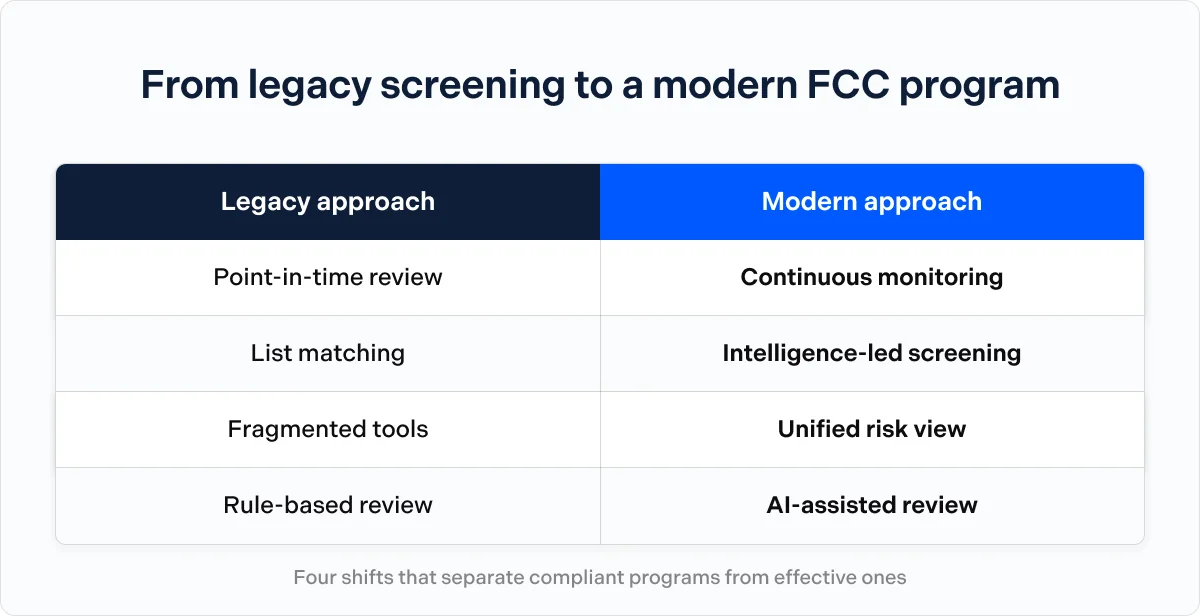
The difference between a compliant program and an effective one comes down to four operational areas:
From point-in-time to continuous monitoring
Perpetual KYC (pKYC) replaces periodic static reviews with continuous monitoring of the customer portfolio.
When a risk-relevant event occurs (a new sanctions designation, a change in beneficial ownership, or significant adverse media coverage), the system flags it in real time rather than at the next scheduled review cycle.
From list matching to intelligence-led screening
Modern screening programs go beyond official watchlists by incorporating:
- Risk intelligence not captured by government-maintained lists
- Adverse media with materiality scoring that filters noise before it reaches analysts
- Corporate registry data that maps ownership structures and indirect connections
- Entity resolution that identifies risk through relationships, not just name matches
The objective is to identify exposure that does not yet appear on any list, instead of confirming what regulators already know.
From fragmented tools to a unified risk view
When sanctions data, adverse media, PEP status, corporate registry information, and AML investigations history are all located in separate systems, analysts spend their time consolidating instead of making decisions.
A unified view of each customer and counterparty means context is always available at the point of decision, instead of being assembled on demand from multiple sources.
From rule-based to AI-assisted review
Machine learning models can clear irrelevant alerts at scale, reducing the manual review burden on analysts.
For adverse media, large language models consolidate related coverage into structured risk narratives. This shortens investigation time and improves consistency across case documentation.
Read more: AI You Can Trust: Sigma360’s AI Evaluation Framework for Compliance Leaders
The cost of getting FCC wrong
In the first half of 2025 alone, global sanctions-related fines reached $228.8 million, up from $3.7 million in the same period of 2024, according to enforcement data reported by Fintech Global. TD Bank’s $1.3 billion AML penalty in 2024 remains the largest bank AML penalty in US history, a marker of how consequential compliance failures have become.
Still, fines represent only part of the exposure. The full consequences of a significant compliance failure include:
- Reputational damage that strains correspondent banking relationships and erodes customer trust
- Regulatory remediation requirements that consume internal resources for years after the initial enforcement action
- Enhanced supervisory scrutiny that limits operational flexibility and slows business decisions
- Personal liability for compliance officers and board members in an increasing number of jurisdictions
The FCA’s financial crime guidance emphasizes that regulators expect institutions to demonstrate not just that controls exist, but that they work.
The bar for what constitutes an adequate FCC program keeps moving upward, and institutions that treat compliance as a fixed state rather than a continuous discipline will find regulators asking hard questions.
How Sigma360 supports financial crime compliance
Financial crime compliance programs struggle when screening, monitoring, and investigation run on separate tools with separate data. Sigma360 brings global risk data, core screening technology, and AI automation into a single platform, so compliance teams can move from data collection to confident decisions faster. That includes:
- Sanctions and watchlist screening: Sigma360’s sanctions screening software applies entity resolution across global watchlists, PEP databases, and adverse enforcement records to reduce false alerts without compromising coverage, so analysts work on matches that warrant review rather than clearing noise.
- Adverse media monitoring: Sigma360’s adverse media screening processes 4.5 million articles monthly across 600,000+ publishers, with AI-driven materiality scoring that prioritizes coverage by risk relevance rather than volume.
- Perpetual KYC: Sigma360’s perpetual KYC solutions replace scheduled review cycles with continuous monitoring, triggering risk reviews when sanctions exposure, ownership changes, or adverse media coverage shifts a customer’s risk profile.
- Enhanced due diligence: Sigma360’s enhanced due diligence uses proprietary intelligence to uncover beneficial ownership and indirect exposure that standard screening misses, giving investigators a more complete picture before decisions are made.
- AML investigations: Sigma360’s AML investigations software generates AI-powered entity summaries and risk narratives at the start of each case, so investigators spend less time compiling information and more time on judgment calls.
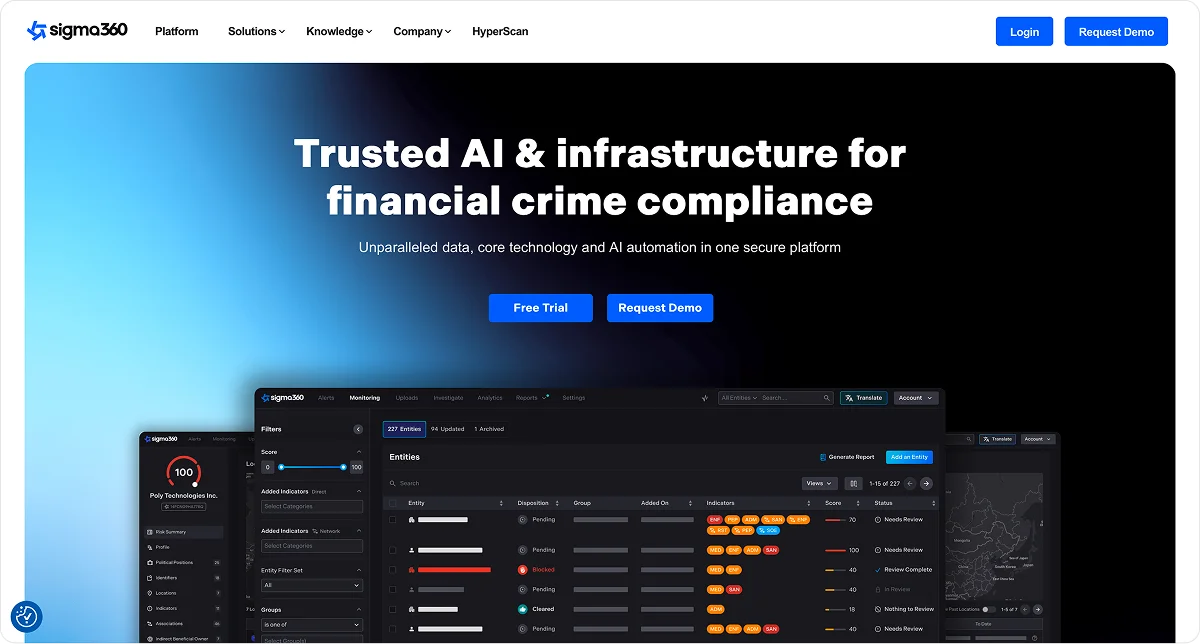
Ranked the #1 adverse media solution by Chartis Research for two consecutive years, Sigma360 is trusted by leading financial institutions across banking, payments, and fintech, with clients reporting up to 93% fewer false positives and faster time to decision.
Request a demo to see how Sigma360 can work for your team.
FAQ
What is a risk-based approach to financial crime compliance?
A risk-based approach means allocating compliance resources in proportion to the risk each customer, product, or geography presents. Higher-risk relationships receive more intensive due diligence and monitoring, while lower-risk ones are managed with lighter controls.
What triggers a Suspicious Activity Report?
A SAR is filed when transaction activity or customer behavior cannot be adequately explained by a legitimate business purpose. Common triggers include structuring, unusual cash activity, and transactions that do not match a customer’s expected behavior.
What does beneficial ownership mean in financial crime compliance?
Beneficial ownership refers to the natural person or persons who ultimately own or control a legal entity, even when that ownership is obscured through corporate structures. Identifying beneficial owners is a core CDD requirement, as shell companies and nominee arrangements are commonly used to conceal illicit funds.
How do regulators assess whether an FCC program is effective?
Regulators look beyond whether controls exist on paper and assess whether they work in practice. Key indicators include SAR quality, screening calibration, and whether the program reflects the institution’s actual risk profile.
What is the difference between sanctions screening and AML monitoring?
Sanctions screening checks customers and transactions against government-maintained lists to prevent prohibited activity. AML monitoring analyzes transaction behavior over time to detect patterns consistent with money laundering, which may not involve any sanctioned party.

