
Key takeaways:
- Simplified CDD reduces verification requirements but not all obligations Screening and monitoring still apply at every tier. The most common SDD failure is treating reduced documentation as a full exemption.
- Enhanced due diligence requires more than deeper identity checks EDD involves specific inquiries into how a customer's wealth was built and where transaction funds originate. Regulators treat these as distinct requirements and examine them separately.
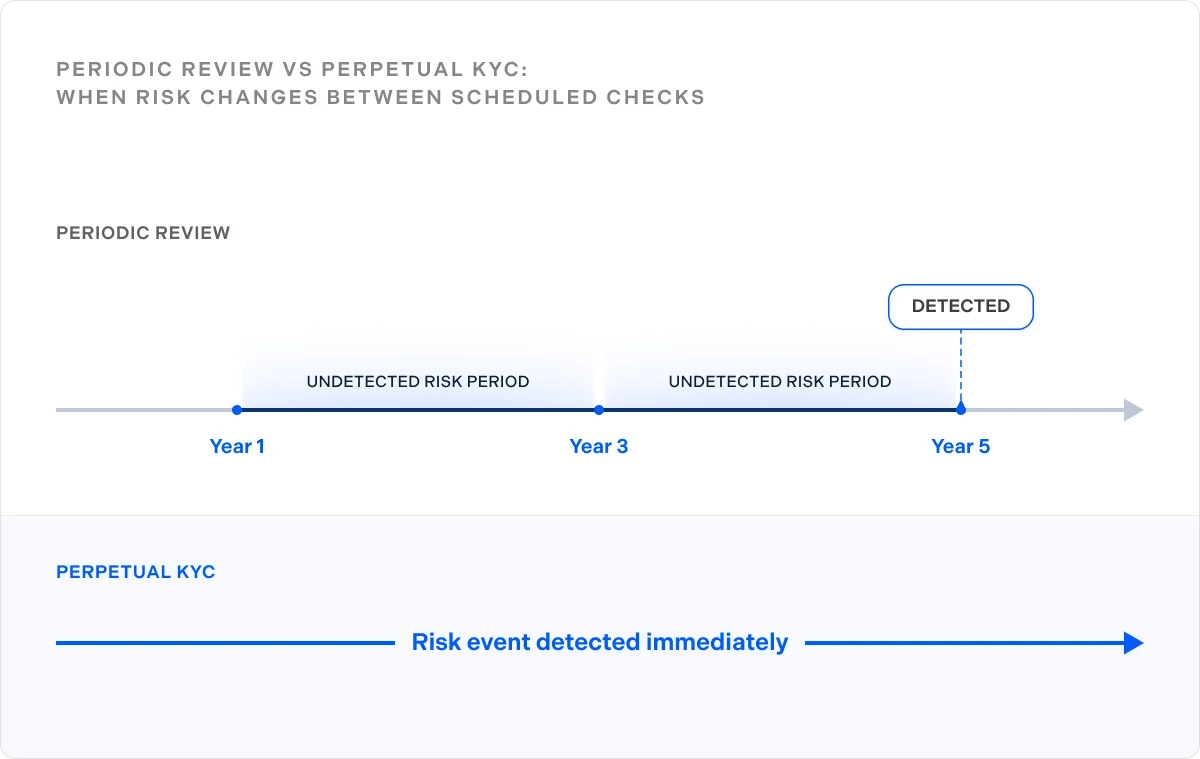
- Periodic review leaves predictable windows where risk goes undetected A customer's risk profile can change significantly between scheduled reviews. Continuous monitoring closes that window by triggering reassessment when material changes happen.
- Third-party and counterparty CDD involves a different verification challenge Institutions must identify the natural persons behind a corporate entity, not just the entity itself. Layered ownership structures make this harder and more important than individual customer CDD.
- Sigma360 handles all six CDD types in one platform Compliance teams use Sigma360 to screen, investigate, and monitor customers across every risk tier, from simplified screening to complex EDD, without switching tools or losing auditability.
What is customer due diligence?
Customer due diligence is the process regulated institutions use to verify customer identity, assess financial crime risk, and determine the level of monitoring a relationship requires. It's a core component of every financial crime compliance program, and it applies from the moment a customer relationship begins through its entire duration. CDD requirements scale with risk, which is precisely what regulators assess when they examine a program.
Types of customer due diligence: A quick-reference overview
The six CDD types differ in the depth of verification required, the customers they apply to, the documentation they generate, and the regulatory basis for each. Here's a quick overview:
| CDD type | Risk level | Who it applies to | Core requirement | Regulatory basis |
|---|---|---|---|---|
| Simplified CDD | Low | Regulated entities, low-risk products | Basic identification, reduced verification | FATF R.10; EU 4AMLD; FCA MLR 2017 |
| Standard CDD | Medium | Most retail and commercial customers | Identity, verification, beneficial ownership, purpose of relationship | FinCEN CDD Rule; FATF R.10; FCA MLR 2017 |
| Enhanced due diligence | High | PEPs, high-risk jurisdictions, complex structures | Deep verification, source of funds/wealth, senior approval | FATF R.10, R.12, R.19; FinCEN CDD Rule; FCA MLR 2017 |
| Ongoing/perpetual CDD | Continuous | All customers post-onboarding | Continuous monitoring, trigger-based reclassification, file updates | FATF R.10; FinCEN CDD Rule |
| Third-party/counterparty CDD | Variable | Business customers, vendors, correspondent banks | Corporate structure, UBO, business purpose, counterparty risk | FATF R.10, R.13; FinCEN CDD Rule; FCA MLR 2017 |
| Risk-based CDD | All levels | All customers | Risk-proportionate calibration across all CDD types | FATF R.1; FinCEN CDD Rule; AMLR (from July 2027) |
1. Simplified CDD
Simplified CDD (also called SDD) is the lowest level of due diligence regulators permit, and it applies only where the risk of money laundering or terrorist financing is demonstrably low. Institutions can reduce the depth of verification and documentation required, but obligations to identify the customer, screen against sanctions and PEP lists, and monitor the relationship for changes remain.
When simplified CDD applies
SDD is appropriate for lower-risk customer types and products, including:
- Publicly listed companies subject to disclosure obligations and regulatory oversight
- Public authorities and government bodies
- Low-value or function-limited products, such as prepaid cards with strict spending caps
- Regulated financial institutions subject to equivalent AML requirements
- Customers with well-established low-risk profiles under a documented risk assessment
The risk of applying SDD too broadly
The most common SDD failure is treating it as a default for whole customer categories instead of a documented decision for individual relationships. The EU's 4th Anti-Money Laundering Directive eliminated automatic SDD categories, requiring institutions to demonstrate and record a low-risk rationale for each case. Sanctions and PEP screening remain mandatory under SDD regardless of risk level, and skipping those checks disqualifies the reduced treatment entirely.
2. Standard CDD
Standard CDD is the baseline that applies to the majority of customer relationships, those that present a measurable but manageable level of risk. Both simplified and enhanced CDD are calibrated against it, so miscategorizing a customer creates a control failure that affects the entire program.
What standard CDD requires
CDD covers four core obligations. The first three must be completed before a relationship is established, and the fourth applies continuously:
- Verifying the customer's identity using reliable, independent sources
- Identifying and verifying the identity of beneficial owners for legal entities
- Understanding the purpose and intended nature of the business relationship
- Conducting ongoing monitoring to detect suspicious activity and maintain current customer information
The FinCEN CDD Rule, which covers US banks, mutual funds, brokers or dealers in securities, futures commission merchants, and introducing brokers in commodities, codifies these requirements and sets a specific beneficial ownership threshold. Institutions must identify any natural person owning 25% or more of a legal entity customer, and the individual who controls it. Read more: Customer Due Diligence Checklist: Key Steps for AML
Where standard CDD breaks down
Incomplete beneficial ownership is the most persistent finding examiners raise at the standard tier. Institutions collect identity data but rarely trace ownership to the natural-person level, leaving nominee arrangements and shell structures undetected. Files that were opened correctly but never updated present an equally common problem, leaving risk assessments anchored to the customer's onboarding profile long after their circumstances have changed.
3. Enhanced due diligence (EDD)
Enhanced due diligence applies when a customer's risk profile exceeds what standard CDD is designed to address. The EDD process requires deeper investigation, more extensive documentation, and senior management approval before the relationship can proceed.
What triggers EDD
Regulators recognize specific customer and relationship characteristics that require escalation:
- Politically exposed persons (PEPs) and their close associates
- Customers from or transacting through high-risk or sanctioned jurisdictions
- Complex or opaque ownership structures, including nominee shareholders and multi-layered entities
- Correspondent banking relationships with foreign financial institutions
- Customers in cash-intensive industries or private banking relationships
- Adverse media or negative intelligence surfaced during screening
What EDD requires operationally
An EDD file must reach a higher degree of evidence than standard CDD. The investigation should establish the customer's source of funds (where specific transaction funds originate) and source of wealth (how accumulated assets were built), two obligations regulators treat as separate in examinations. In March 2026, FinCEN issued an $80 million penalty against broker-dealer Canaccord Genuity in part because the firm onboarded a Bahamas-based foreign bank without adequate EDD. The firm failed to escalate even after its own BSA officer and law enforcement raised concerns about the client. Read more: Customer Due Diligence vs. Enhanced Due Diligence
4. Ongoing/perpetual CDD
Ongoing CDD extends the due diligence obligation beyond onboarding into the full life of the customer relationship. In its most mature form, it's operationalized as perpetual KYC (pKYC): continuous, automated monitoring that responds to risk changes as they occur rather than waiting for a scheduled review cycle.
How ongoing CDD differs from periodic review
Traditional ongoing CDD runs on periodic reviews, with low-risk customers reviewed every three to five years and high-risk customers annually. Between those cycles, a customer can be sanctioned, acquire a PEP relationship, or move into a high-risk industry without triggering any review at all. Perpetual KYC replaces that time-based model with continuous, event-driven monitoring that includes:
- Continuous automated screening against updated sanctions, PEP, and adverse media sources
- Trigger-based reclassification when material changes are detected in a customer's profile
- Automatic escalation to EDD when a monitoring event meets the institution's defined threshold
- Real-time risk score updates instead of manual file refreshes
The EU's AML Regulation (AMLR), which takes effect on 10 July 2027, will tighten ongoing customer monitoring obligations across European institutions, requiring continuous monitoring systems and moving away from calendar-based review as the default.
5. Third-party and counterparty CDD
Third-party CDD applies when the customer isn’t an individual but a corporate entity, vendor, partner platform, or correspondent bank. The institution must look past the entity itself to identify the natural persons who own and control it.
What third-party CDD requires
A complete third-party CDD file should establish:
- The entity's legal structure, registration, and jurisdiction of incorporation
- Ultimate beneficial ownership (UBO) traced to the natural-person level, with a 25% ownership threshold applied in most jurisdictions
- The nature and purpose of the business relationship, including expected transaction volumes and counterparty networks
- Sanctions, PEP, and adverse media screening for the entity and all identified beneficial owners
- An assessment of the respondent institution's AML controls and regulatory standing, for correspondent banking relationships
Where third-party CDD most commonly fails
Corporate registry data is a starting point, not a conclusion. Nominee shareholders, layered holding structures, and bearer instruments can obscure the true controlling person, and institutions that accept a registry extract as proof of ownership are working from an incomplete picture of what may be a far more complex structure. Institutions serving fintechs, payments companies, or embedded platforms face a wider perimeter. Their counterparties may onboard end customers of their own, and the CDD program must cover that underlying customer base, not only the direct relationship. Sigma360's third-party risk management capabilities address this kind of layered counterparty exposure.
6. Risk-based CDD
Risk-based CDD is the calibration framework that determines which CDD type applies to which customer. It connects customer risk scoring to CDD tier assignment, monitoring intensity, and review frequency, translating the risk-based approach mandated by FATF Recommendation 1 into the operational decisions a compliance program makes every day.
How risk-based CDD works in practice
A functioning risk-based program applies CDD consistently across three operations:
- Scoring each customer against defined risk factors at onboarding: geography, customer type, product, delivery channel, and transaction patterns
- Mapping that score to the appropriate CDD tier, with documented criteria for what triggers simplified, standard, or enhanced treatment
- Revisiting the score when new information arrives from monitoring alerts, adverse media, or changes in the customer's circumstances
The FinCEN CDD Rule requires covered financial institutions to develop risk-based procedures for ongoing CDD, and regulators test for exactly that during examination. Institutions that can’t show a documented, consistently applied risk-scoring methodology connecting scores to CDD tier decisions present the same deficiency examiners flagged most frequently in 2024 enforcement actions, pointing to inadequate processes rather than no program.
When a CDD type needs to change
Regulators evaluate how institutions responded when a customer's risk profile shifted, not only how accurate the initial classification was. Monitoring alerts identify warning signs, but the more common failure is recognizing them and not acting. Reclassification triggers mid-relationship include:
- A sanctions or PEP screening hit on a previously clean customer
- Adverse media identifying criminal, regulatory, or reputational risk
- Unusual transaction patterns that deviate from the customer's expected behavior
- A change in beneficial ownership, jurisdiction, or business activity
- Law enforcement contact or a suspicious activity report filed on the account
When any of these triggers fire, the institution must document the event, reassess the customer's risk score, and apply the CDD measures appropriate for the revised tier. Regulators penalize failure to reclassify consistently. In August 2026, FinCEN assessed a $125 million penalty against a major US broker-dealer, in part because deficient CDD on high-risk customers with ties to Russia and Latin America, including failure to act on negative news, contributed to hundreds of untimely SAR filings. Institutions that reduce false positives in AML screening without also improving true positive detection end up with an alert queue that misses genuine reclassification events. The calibration has to work in both directions. 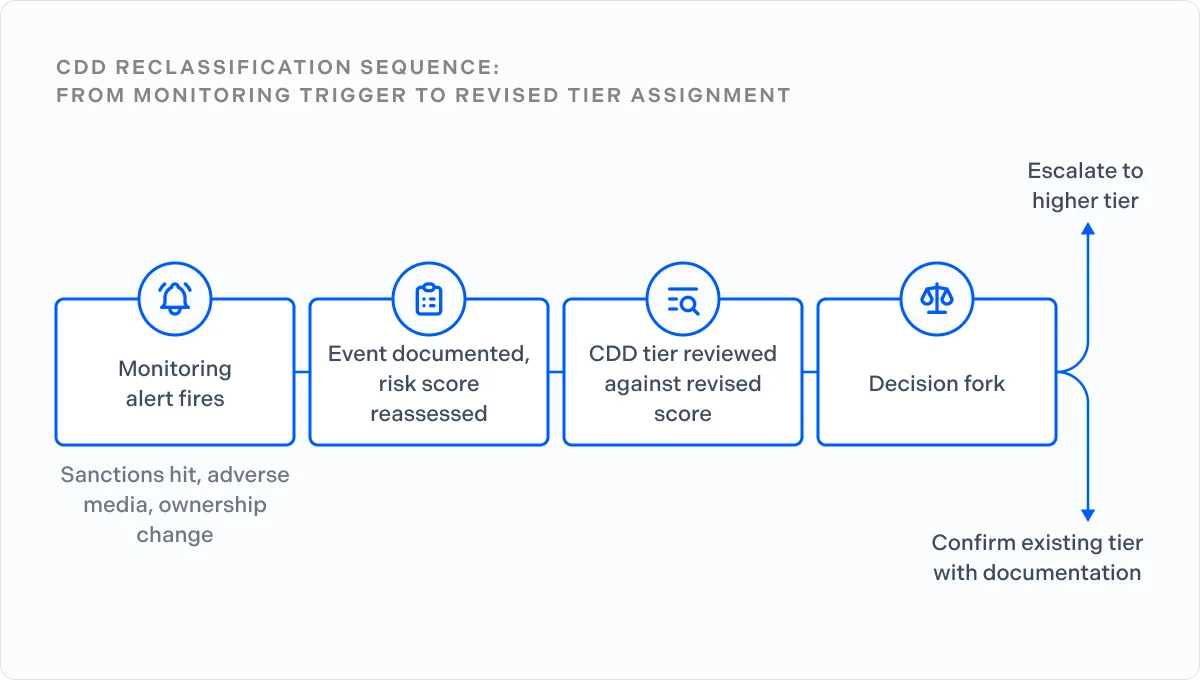
How Sigma360 handles CDD across every tier
Sigma360 is an AI risk intelligence platform used by Tier 1 banks, global financial institutions, fintechs, payments firms, asset managers, and regulated corporates to run any CDD program from simplified screening to complex EDD investigations. Key capabilities across the CDD spectrum cover each tier:
- Match Agent: Clears identifiable false positives from screening queues, cutting manual match reviews by 90% so analysts can spend time on genuine exposures and not alert volume
- Entity Summary: Generates structured risk summaries based on global KYC data, corporate registry details, watchlist results, and aggregated adverse media, providing the foundation of a defensible standard or enhanced CDD file
- Adverse Media Summary: Consolidates related news into a single contextualized risk story, reducing the time analysts spend assessing materiality across high-volume media environments
- Perpetual KYC: Continuously monitors the full customer portfolio, scoring risk changes in real time and triggering reclassification automatically when a monitoring event meets the institution's defined threshold
- EDD Agent: Maps indirect risk connections, hidden ownership links, and shared relationship networks across 260+ jurisdictions, reaching the intelligence depth that standard CDD tools can’t
The six CDD types apply as much to embedded platform and partner use cases as they do to direct customer programs. A leading identity verification provider used Sigma360's white-labeled KYC solution to launch a full CDD offering for its own clients with minimal internal build, showing how the tiered framework scales across both in-house compliance programs and embedded partner deployments. Request a demo to see how Sigma360 runs each CDD type in a single workflow.
FAQ
What is the difference between CDD and KYC?
KYC is the overall process of identifying and verifying a customer, while CDD is the risk assessment step within it. CDD determines which tier of scrutiny applies and how closely the relationship must be monitored. A bank can complete KYC without running an adequate CDD program, and the two aren’t interchangeable.
What happens if CDD is incomplete at onboarding?
An institution can’t open an account until CDD is complete. If the documentation can’t be obtained, the institution must consider filing a suspicious activity report and shouldn’t proceed with the relationship.
Does CDD apply to existing customers or only at onboarding?
CDD applies throughout the life of a relationship. Institutions must keep customer information current, reassess risk when circumstances change, and escalate the CDD tier when a monitoring trigger fires.
Who is responsible for CDD within an institution?
The first line of defense, most often relationship managers and onboarding teams, performs CDD, while the compliance function sets the standards and reviews high-risk decisions. The BSA/AML officer holds overall accountability and is the primary contact during regulatory examinations.
Can CDD be delegated to a third party?
Yes, but liability stays with the institution. Under FATF Recommendation 17, the third party must be regulated and subject to equivalent AML requirements, and its CDD records must be obtainable upon request without delay. R.17 covers third-party reliance, where the third party has its own independent relationship with the customer. Outsourcing arrangements follow a separate framework.

