
Customer risk assessment is the process by which regulated institutions decide how much scrutiny each customer deserves.
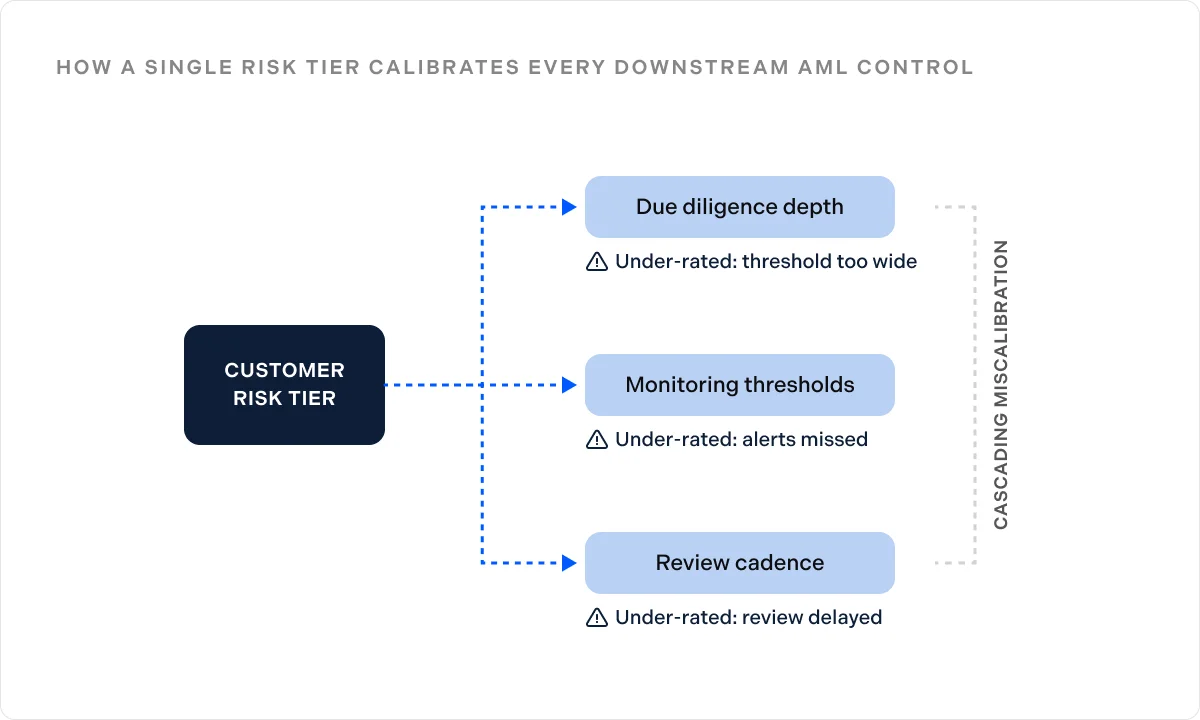
The rating assigned at onboarding governs due diligence depth, monitoring sensitivity, and review frequency. Because every downstream control calibrates from that score, an error at the rating stage runs through the entire compliance program.
In July 2025, the UK Financial Conduct Authority fined Monzo Bank £21 million after finding that key risk indicators were either omitted or not systematically assessed during onboarding. In total, the bank opened over 26,000 high-risk accounts in breach of a regulatory restriction, and the FCA estimated that inadequate controls may have led to onboarding approximately 34,000 high-risk customers overall. According to the FCA, the underlying cause was a customer risk assessment framework that hadn’t kept pace with the business it was supposed to govern.
This guide covers how risk scores are built and why programs based on the same underlying data can produce very different outcomes at examination.
Key takeaways:
- The risk score drives every compliance decision that follows
The tier assigned at onboarding sets due diligence depth, monitoring sensitivity, and review frequency. A miscalibrated score propagates errors across the entire program without producing any immediate signal that something is wrong.
- Standard scoring models share a common blind spot
The four established risk factor categories cover direct indicators well but leave indirect exposure (through ownership chains, shared addresses, and related entities) largely unaddressed. This is where much of modern financial crime operates.
- Auditability is an examination requirement, not a design choice
Regulators expect institutions to trace exactly why a specific customer received a given risk tier. Models that can’t produce that record create examination risk regardless of how sound the underlying methodology is.
- Point-in-time scores go stale between reviews
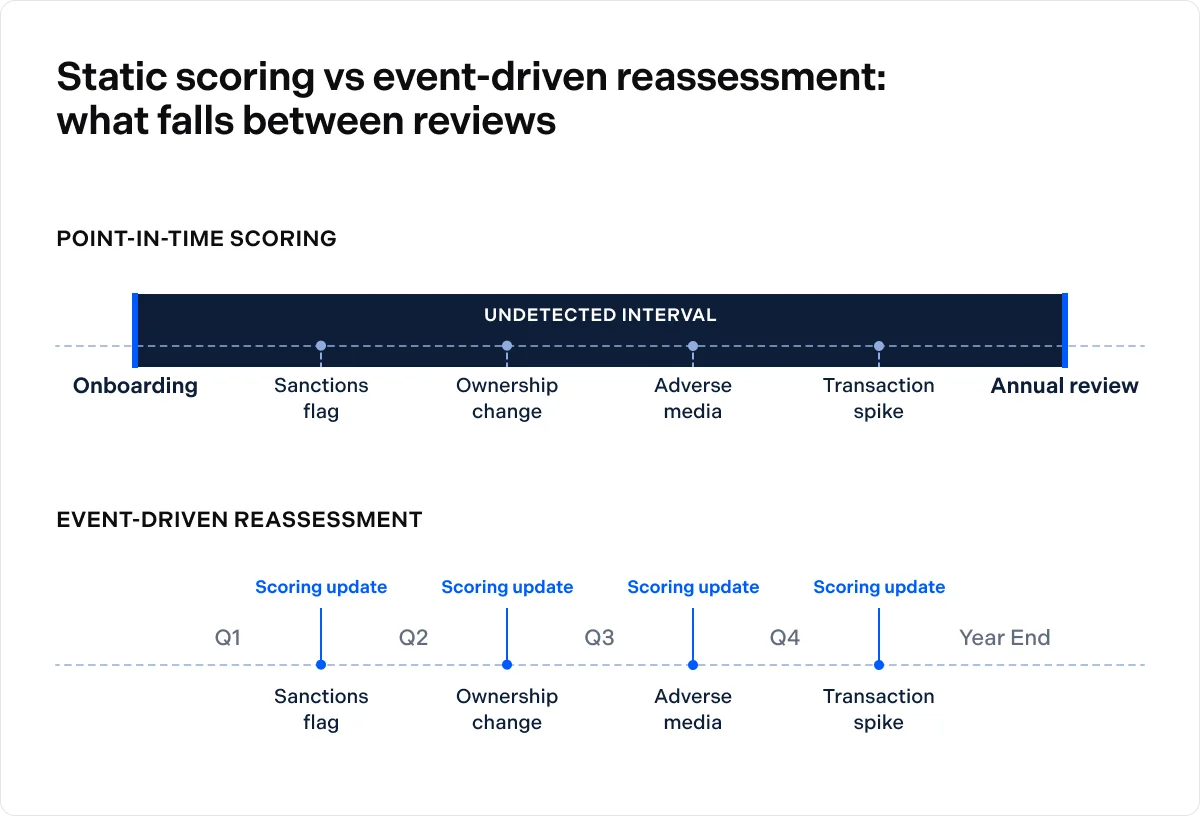
Sanctions listings, ownership changes, and new transaction patterns emerge continuously. A score updated only at scheduled intervals won’t reflect them until the next review cycle, which may be months away.
- Sigma360 connects the data, scoring, and audit trail into one environment
Trusted by a top-10 global financial institution and protecting over $2 trillion in assets, Sigma360 offers compliance teams consolidated risk intelligence, continuous monitoring, and fully traceable scoring decisions in a single platform.
What is customer risk assessment?
Customer risk assessment is an AML compliance process that evaluates how much financial crime risk a customer presents and assigns a risk tier (low, medium, or high) that determines the level of due diligence, monitoring, and review the institution will apply throughout the relationship.
The process is the operational expression of the risk-based approach, which FATF Recommendation 1 establishes as the global standard for AML compliance. Rather than applying uniform scrutiny across the customer base, institutions focus controls where exposure is highest and document the reasoning behind each decision.
The FinCEN CDD Final Rule requires covered financial institutions in the US to maintain risk-based CDD procedures, and AMLA, operational since July 2025, reinforces differentiated, documented risk ratings across the EU.
Three terms in this space are often used interchangeably, but each describes a different layer of the same process:
- Customer risk assessment: The overall evaluation, from data collection to the final rating decision
- Customer risk scoring: The weighted model that converts risk factors into a numerical score
- Customer risk rating: The output tier (low, medium, or high) that the score maps to, which then drives CDD intensity, monitoring thresholds, and review cadence
How the risk score shapes compliance decisions
Every compliance decision made about a customer at onboarding flows from the risk score they’re assigned. The score determines due diligence depth, transaction monitoring sensitivity, and review frequency, and a single miscalibrated rating affects all three without producing any immediate signal that something is wrong.
Due diligence intensity is the most immediate output. Lower-risk customers proceed through standard CDD, while those rated high-risk are routed to enhanced due diligence, which requires deeper investigation of source of funds, ownership structures, and business relationships.
The rating also sets transaction monitoring thresholds, with higher-risk accounts subject to tighter alert rules and lower trigger points. Review cadence follows the same principle, with higher-risk customers called back more frequently for periodic reassessment.
Underrating a customer means their transactions clear thresholds they should trigger, their file goes unreviewed on schedules designed for low-risk accounts, and any escalation that does occur arrives later than it should.
Overrating, on the other hand, generates unnecessary alerts and absorbs analyst time on accounts that carry no genuine elevated risk, diverting attention away from the cases that do warrant it.
Read more: Financial Crime Risk Management: A Complete Guide
The four risk factor categories
The same four categories appear across FATF, FFIEC, EBA, and Wolfsberg Group guidance because they cover the dimensions of a customer relationship that most reliably predict financial crime exposure: who the customer is, where they operate, what products they use, and how they transact in practice.
The table below covers each category, listing its key inputs and explaining why each one signals elevated risk:
| Risk factor category | Key inputs | Why it signals risk |
| Customer and entity | PEP status, legal form, occupation, ownership structure, adverse media | Complex structures and high-risk profiles are more frequently exploited for financial crime |
| Geographic | Country of residence, nationality, place of incorporation, operational footprint | Some jurisdictions carry significantly elevated money laundering, corruption, or sanctions risk |
| Product, service, and channel | Cash-intensive products, private banking, non-face-to-face onboarding, correspondent relationships | Higher-anonymity products and delivery channels create greater opportunity for abuse |
| Transaction and behavior | Transaction volumes, cross-border flows, counterparty patterns, deviation from expected activity | Actual behavior reflects real-time operational risk more accurately than static declarations |
Each category contributes a weighted score, with institutions setting the weights based on their own risk appetite and customer base. FATF guidance explicitly leaves weighting to each firm’s own risk assessment, with no mandated formula, and the distribution varies considerably across institution types.
Indirect or network risk is the dimension these frameworks most commonly underserve. The exposure a customer carries through connections to other entities (ownership chains, shared addresses, common directors) can link a seemingly clean profile to a sanctioned counterparty through multiple ownership layers. Scoring models built only on direct indicators won’t detect that exposure.
How customer risk scoring works
The scoring process runs the same sequence at every institution, from onboarding a retail customer to reassessing a high-risk corporate. These are the typical steps:
- Collect customer data: Gather onboarding and KYC attributes, including identity, legal form, occupation or industry, ownership structure, and expected account activity.
- Screen against risk lists: Run checks against sanctions lists, PEP databases, and adverse media sources to identify direct risk indicators.
- Aggregate behavioral data: Collect transaction history, counterparty patterns, geographic flows, and deviations from the customer’s declared activity profile.
- Apply the scoring model: Combine risk factors with their assigned weights and rules to produce a customer risk score.
- Assign a risk tier: Map the numerical score to the institution’s defined categories (low, medium, high, or a finer segmentation).
- Act on the rating: Set CDD depth, EDD triggers, monitoring thresholds, and review frequency according to the assigned tier.
Each step feeds the next, which means a weak input at step one or a poorly calibrated model at step four will degrade every output that follows.
Examination findings consistently identify two failure points: incomplete or stale input data at the collection stage, and scoring models whose factor weights haven’t been validated against the institution’s actual risk experience. The FFIEC BSA/AML Examination Manual sets the standard US examiners use to evaluate a customer risk framework’s calibration against the institution’s actual exposure.
Static vs. dynamic customer risk assessment
Point-in-time scoring runs at two moments: during onboarding and at scheduled periodic reviews. High-risk customers are reviewed annually at a minimum and lower-risk ones on longer cycles, but scores only update at the two defined moments. A customer who cleared onboarding can appear on a sanctions list six months later, change beneficial ownership, or attract adverse media, and a static score won’t reflect any of it until the next review.
Dynamic, event-driven assessment solves the scoring gap by recomputing the score whenever the customer’s profile changes instead of waiting for the scheduled review. Programs built around perpetual KYC generate alerts the moment a customer’s risk status changes, so institutions can concentrate review resources on accounts where risk has genuinely shifted rather than running scheduled checks across the full portfolio.
The failure modes behind inaccurate customer risk scores
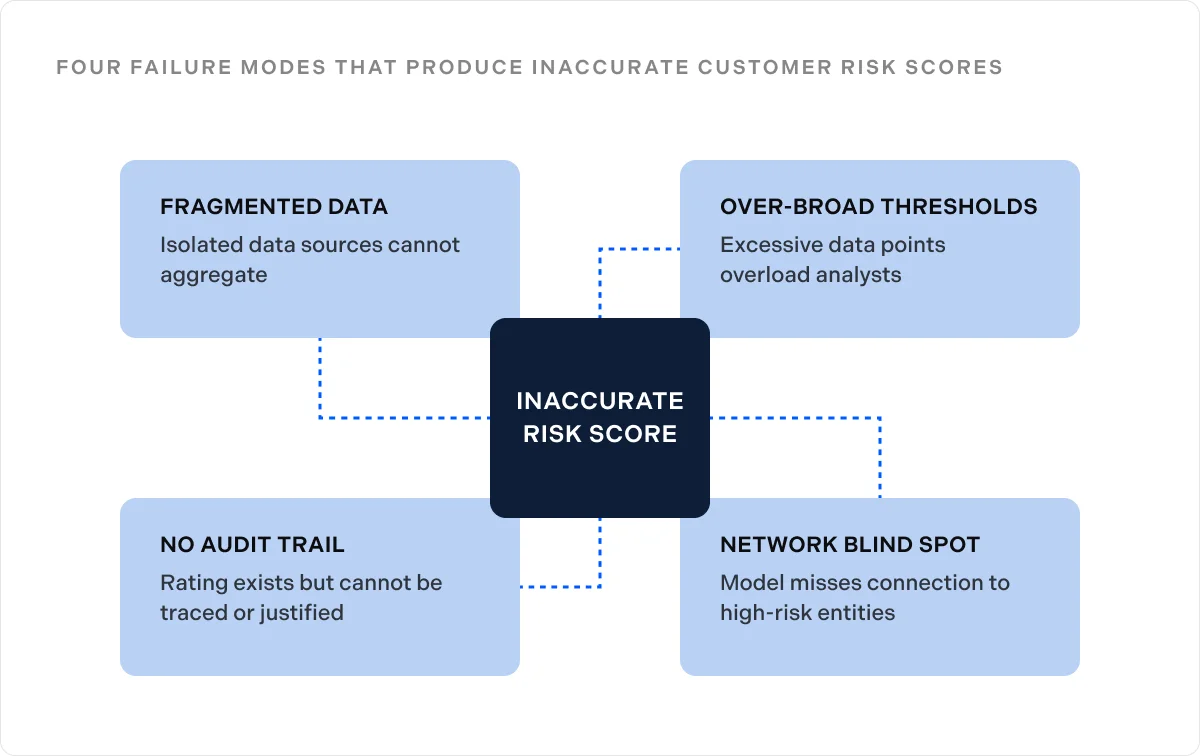
Scoring frameworks tend to fail in recognizable patterns.
Poor data quality produces inaccurate scores. A scoring model is only as accurate as the data it runs on. Institutions that manage customer data across fragmented systems, with separate tools for sanctions screening, adverse media, corporate registry data, and transaction monitoring, often can’t aggregate inputs reliably. The model applies correct weights to incorrect or incomplete data and produces a rating that doesn’t reflect actual exposure.
Over-rating generates false positives and analyst overload. The same alert fatigue problem that affects screening programs applies to risk scoring. Overly broad risk criteria or poorly calibrated thresholds push too many customers into high-risk tiers, and compliance teams end up reviewing accounts that carry no genuine elevated risk. Meanwhile, the cases that do warrant attention get less of it.
Black-box models create examination risk. When examiners ask why a specific customer was rated low risk, the compliance team needs to produce a traceable record of the exact factors and weights that produced that score. A model that can’t generate that record produces scores that can’t be defended under examination.
Network blindness leaves indirect exposure undetected. Standard scoring models evaluate customers on their direct indicators and don’t assess the risk carried through connections to related entities, including shared directors, common addresses, and overlapping beneficial ownership structures. Financial crime operating through intermediaries and layered ownership is invisible to models built only on direct signals.
Sigma360: From fragmented data to defensible risk scores
The four failure modes in the previous section map to specific capabilities in Sigma360’s AI risk intelligence platform:
- Fragmented data is solved through consolidated risk intelligence. Sigma360 brings sanctions and watchlist screening, adverse media monitoring, corporate registry data, PEP exposure, and network connections into one environment, so the inputs feeding a customer’s risk score come from a single source, rather than multiple disconnected tools.
- False positive overload is reduced by the Match Agent, which applies AI-driven entity resolution at the screening layer to clear low-quality matches before they inflate risk scores. Sigma360 reports that clients see up to a 93% reduction in false positives, freeing analysts to focus review effort on accounts that carry genuine elevated risk.
- Stale ratings are resolved through Perpetual KYC. Sigma360 continuously monitors every customer and counterparty and generates an alert the moment a material change occurs (such as a new sanctions listing, an ownership update, or an adverse media development), so risk tiers reflect current conditions rather than the profile at the last scheduled review. High-risk accounts flagged by monitoring flow into AML investigations workflows with full signal context.
- Weak auditability is handled through explainable AI. Every alert, decision, and source behind each risk signal is logged automatically, so when an examiner asks how a customer reached a given risk tier, the compliance team can trace the exact factors and weights that produced it.
Request a demo to see how Sigma360 handles customer risk assessment across your portfolio.
FAQ
What is the difference between customer risk assessment and transaction monitoring?
Customer risk assessment classifies each customer into a risk tier at onboarding and updates that classification as the relationship evolves. Transaction monitoring is a separate control that analyzes payment behavior in real time to detect suspicious activity and runs on top of the risk tier set at assessment.
Does customer risk assessment work the same way for companies as for individuals?
Corporate assessments are more complex because they must cover the entity’s ownership structure, ultimate beneficial owners, and jurisdictional exposure across all related parties. Individual assessments follow the same four-factor logic but are simpler in scope.
What is a risk floor in a scoring model?
A risk floor is a rule that assigns a customer to a minimum risk tier regardless of how other factors score. A confirmed sanctions match, for example, triggers a high-risk classification regardless of how favorable the rest of the customer’s profile is.
What triggers a mid-relationship risk reassessment?
A new sanctions listing, a change in beneficial ownership, adverse media coverage, or transaction patterns that deviate from the declared account purpose should each trigger an out-of-cycle reassessment. Under a perpetual KYC model, these events generate automated alerts rather than waiting for the next scheduled review.
How often should the scoring model itself be validated?
Industry best practice is annual validation at minimum, and an immediate review whenever the institution’s customer base, products, or regulatory environment changes materially. Validation involves back-testing scores against historical case outcomes to confirm the model is still predictive and that no customer segment is being systematically misrated.
Does customer risk assessment work differently for fintechs than for banks?
Fintechs onboard at higher volumes, across more geographies, and through non-face-to-face channels that carry inherently higher anonymity risk. Their scoring models tend to weight product and channel risk more heavily than a traditional retail bank’s model would.

