
Key takeaways:
- PEP classification is a regulatory risk designation, not a finding of wrongdoing
- FATF divides PEPs into three categories, each with a different due diligence threshold
- The compliance obligation goes beyond the named PEP to their relatives and close associates
- PEP screening and ongoing monitoring are two distinct controls with different failure modes
- Sigma360 handles PEP identification, RCA coverage, real-time monitoring, and EDD documentation in one workflow
What is a politically exposed person?
Under FATF Recommendation 12, a PEP is an individual who is or has been entrusted with a prominent public function. The classification is deliberately broad, because the risk it targets is structural. Authority over public funds, state resources, or regulatory decisions creates conditions for financial crime that standard customer due diligence isn’t built to detect. The category extends well beyond elected politicians and covers senior positions across government branches, state-owned enterprises, international organizations, and major political parties. PEP status doesn’t end when someone leaves office. Most frameworks require elevated scrutiny for at least 12 months after departure, with the duration set by a risk assessment of the individual relationship rather than a fixed calendar rule.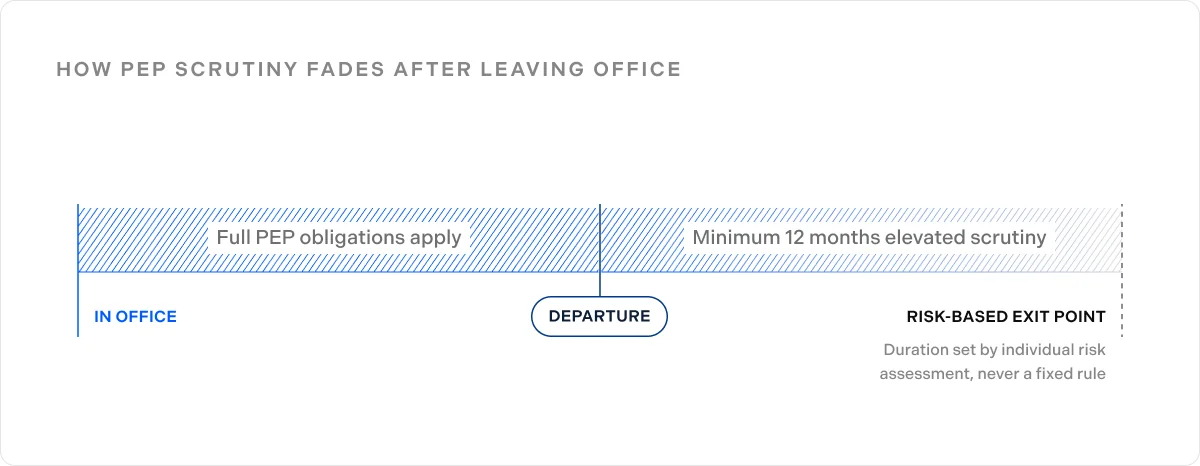
Who qualifies as a PEP: Roles and positions
The roles below appear consistently across FATF member jurisdictions, though exact scope varies by country:- Heads of state, heads of government, and senior cabinet ministers
- Members of parliament or similar legislative bodies
- Senior judicial officials, including members of courts of last resort
- Senior military officials
- Senior executives and board members of state-owned enterprises
- Senior officials of international organizations and intergovernmental bodies
- Senior officials of major political parties
The three types of PEPs
FATF divides PEPs into three categories based on their origin and institutional affiliation:| PEP type | Who it covers | Risk profile |
| Foreign PEP’s | Senior officials entrusted with prominent public functions by a country other than where the institution is based | Automatic EDD required under FATF R12; generally the highest-risk category, since the institution has less visibility into the PEP's home oversight environment |
| Domestic PEPs | Senior officials entrusted with prominent public functions within the same country as the institution | Risk-based approach applies; EDD required only when the relationship is assessed as higher risk. The US doesn’t classify domestic officials as PEPs at all; the UK treats them as lower starting-point risk unless other risk factors are present |
| Heads of international organizations (HIOs) | Senior executives of international or intergovernmental bodies (UN, World Bank, IMF, and equivalent entities) | Risk-based approach applies, as with domestic PEPs; EDD required when the relationship is assessed as higher risk, given the broad financial authority these roles carry |
What are relatives and close associates (RCAs)?
PEP status extends beyond the named individual to their relatives and close associates (RCAs). Family members covered under most AML frameworks include:- Spouses and civil partners
- Parents, siblings, and children
- Parents and siblings of spouses
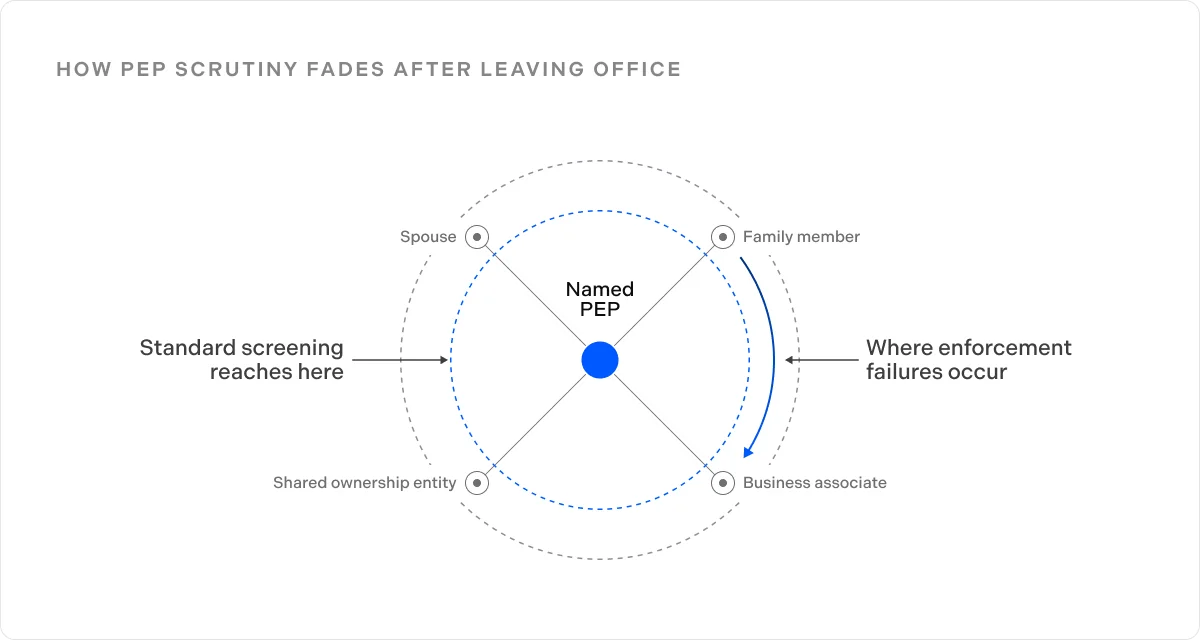 Enforcement actions against financial institutions frequently cite RCA coverage failures as a contributing factor in PEP program breakdowns. Examiners reviewing those cases found funds flowing through accounts the program had never flagged for review.
The EBA's risk factors guidelines treat RCA identification as a baseline requirement for PEP relationships in correspondent and private banking.
Read more: PEP and Adverse Media Monitoring: Connection and Differences
How jurisdictions define PEPs differently
FATF sets the global baseline, but national implementations vary enough to create real program design differences for institutions operating across multiple markets. Here’s how the common frameworks compare:| Framework | Domestic PEPs | Former PEP treatment | Notable feature |
| FATF | Included, EDD only when higher risk | Risk-based period post-departure | Three-category taxonomy (foreign, domestic, HIO) |
| EU AMLR (from July 10, 2027) | Included, same EDD as foreign PEPs | Risk-based, minimum 12 months | Treats domestic and foreign PEPs equally. Enhanced measures apply regardless of origin |
| US / FinCEN | Not classified as PEPs | Risk-based | The 2020 FinCEN joint statement confirmed CDD should be commensurate with individual relationship risk |
| UK FCA | Lower starting-point risk under 2024 MLR amendments | Minimum 12 months, risk-based beyond | EDD still applies when other risk factors are present; domestic PEP status alone doesn’t exempt the relationship |
What compliance obligations does PEP status trigger?
A confirmed PEP match raises the compliance standard applied to the relationship. Under FATF Recommendation 12, foreign PEPs trigger automatic enhanced due diligence. For domestic PEPs and HIOs, the same measures apply when the relationship is assessed as higher risk. The four measures are:- Senior management approval before establishing or continuing the business relationship
- Source of wealth and source of funds verification of how the PEP accumulated their assets
- Enhanced ongoing monitoring of transaction activity
- Documented EDD file recording the due diligence conducted, the decisions made, and the reasoning behind each
PEP screening vs. PEP monitoring: Key differences
Both controls are required, but they govern different points in the customer lifecycle and fail in different ways.- PEP screening runs at onboarding and at scheduled periodic reviews. It checks a customer's identity and profile against structured PEP databases to determine if enhanced due diligence applies. The output is a point-in-time snapshot of the customer's status.
- PEP monitoring covers what happens between those snapshots. Customers who weren’t PEPs at onboarding can become one following an election or government appointment. Existing PEP accounts can generate new adverse media, attract regulatory attention, or see ownership changes that alter the risk picture, and a scheduled review catches none of it in time.
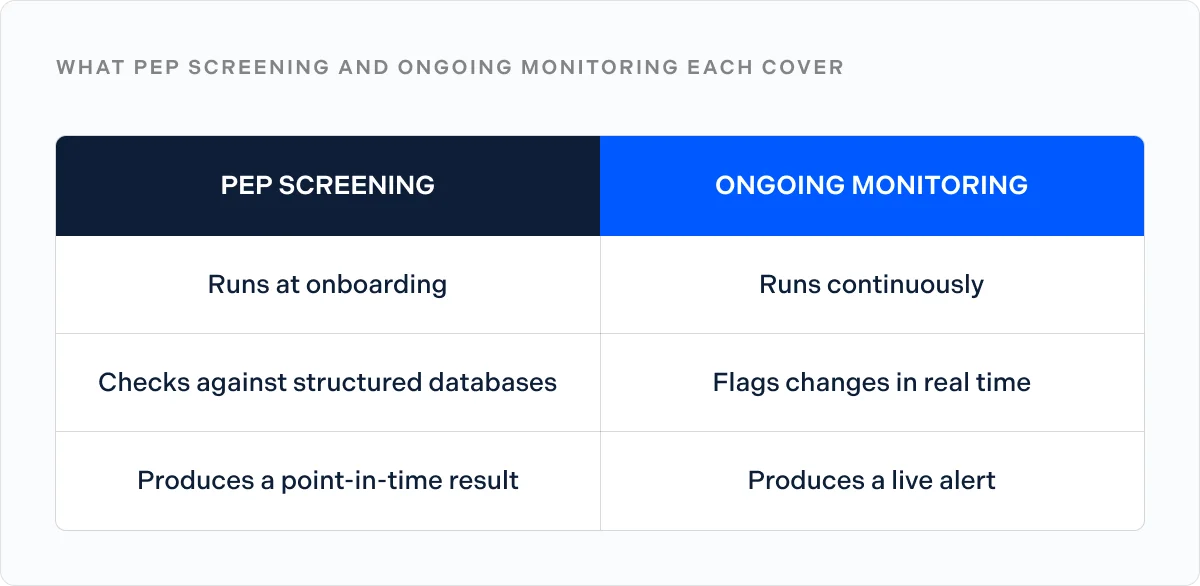 This distinction has three important implications for how programs should be built:
- A clean onboarding result doesn’t protect against enforcement for subsequent monitoring failures. Institutions that screened properly at the start but missed adverse media developments or PEP status changes afterwards have faced enforcement on the same basis as those that didn’t screen at all.
- Monitoring cadence should be calibrated to the risk tier of the relationship. A high-risk foreign official in a high-corruption jurisdiction warrants a different review frequency and alert threshold than a lower-risk domestic official.
- PEP classification is one of the highest-weighted inputs in customer risk scoring. It directly drives due diligence depth and monitoring sensitivity.
Sigma360 in a PEP compliance workflow
Sigma360 is an AI-powered risk intelligence platform that handles PEP identification, RCA coverage, ongoing monitoring, and EDD documentation within a single workflow.Accurate identification throughout the full PEP network
PEP exposure travels through ownership chains and the entities around them. The Match Agent runs entity resolution across PEP databases, corporate registry connections, and adverse media findings simultaneously, detecting risk at every level of the ownership network. Clients report a 93% decrease in false positives, meaning PEP-related alerts are grounded in genuine risk signals with far fewer name collisions.Real-time status change detection
Government appointments, elections, and adverse media can alter a PEP relationship's risk profile before the next review cycle opens. Perpetual KYC monitors the full PEP portfolio continuously, flagging changes as they enter public reporting ahead of the next scheduled review window.EDD documentation built for examiner scrutiny
Examiners reviewing a PEP-related EDD file look for evidence that the institution can reconstruct how it reached its decision. Sigma360 builds that record in three layers:- The Adverse Media Summary consolidates related media coverage into a structured narrative, giving analysts the conduct context that list data can’t supply.
- The Entity Summary pulls in beneficial ownership, shared directors, and direct or indirect risk indicators from the corporate registry layer before any decision is recorded.
- The EDD investigation output is a traceable, sourced record of how the risk was assessed, with every finding and decision documented for examiner review.

