
False positive rates in AML screening don't improve automatically when automation is introduced. Entity data that was never properly consolidated and thresholds carried over from a legacy program without review produce the same alert volumes as before. The difference is that those alerts are now attached to a model that's difficult to explain when an examiner asks who approved a specific clearance. Chartis Research's 2025 AI in Financial Crime report found that only 16% of respondent banks use AI for sanctions screening at an operational or at-scale deployment, while 82% plan to increase AI investment by more than 25% in the next two to three years. For most institutions, sequencing is where the implementation work breaks down. This guide covers the implementation steps for AML screening automation and the requirements at each stage that make the next one work.
Key takeaways
- The implementation steps run in dependency order
Entity resolution has to work before threshold calibration makes sense, and thresholds have to be calibrated before human oversight design can follow.
- Human oversight has to be designed before the program goes live
Escalation paths, override capability, and sign-off requirements that get deferred to post-launch are the first things examiners ask about and the hardest to retrofit.
- Perpetual monitoring activated too early creates the problem it was meant to solve
Without the triage, threshold, and audit layers already in place, continuous rescreening adds alert volume a program has no capacity to handle.
- Most automation failures are process problems, not technology ones
If escalation paths are unclear and decision criteria vary by analyst before automation, the model will scale that inconsistency across the full alert queue.
- A platform that covers each stage reduces the sequencing risk
Sigma360 addresses the implementation sequence from entity resolution and threshold calibration through AI-powered triage and perpetual monitoring in one connected program.
What AML screening automation covers
AML screening automation and transaction monitoring are two different controls. Transaction monitoring evaluates customer activity over time for behavioral patterns that deviate from expected norms, such as structuring or unusual transaction volumes, and generates alerts based on what a customer does. Screening, by contrast, checks who a party is against sanctions lists, watchlists, adverse media, and other risk data sources at onboarding and continuously throughout the relationship. The two work together in a full AML program, and a compliance team that automates its screening workflow still carries the full obligation to run transaction monitoring separately. Within screening, automation targets the triage layer. It separates genuine hits from name coincidences and clears low-confidence alerts before they reach an analyst. Decisions on ambiguous or elevated-risk cases stay with a person, but the analyst reaches that decision faster, with more relevant information already assembled. Read more: AML Solutions: What They Cover & How to Choose the Right One
What has to be true before you build anything
Three conditions have to be met before AML screening automation produces reliable results.
Customer data is consolidated and consistent
Entity information scattered across separate systems means automation makes decisions with an incomplete picture. Missing dates of birth and inconsistent name formats reduce match confidence and drive false positive volume up. Before configuring any automation rules, audit the data that will flow through them.
Existing program performance is documented
Record how your current rule-based system performs before any AI layer touches it. False positive rate and alert-to-SAR conversion rate are the two figures an examiner will ask for when reviewing a changed program. Without them, there's no way to demonstrate that automation improved anything.
Threshold ownership is assigned
Every automated clearance traces back to a threshold decision, and the person accountable for it needs to be named. FinCEN's April 2026 proposed AML/CFT program rule lists effective use of AI and advanced monitoring tools among the factors its Director would consider in enforcement decisions, specifically if a program produces demonstrable outputs that evidence its effectiveness. 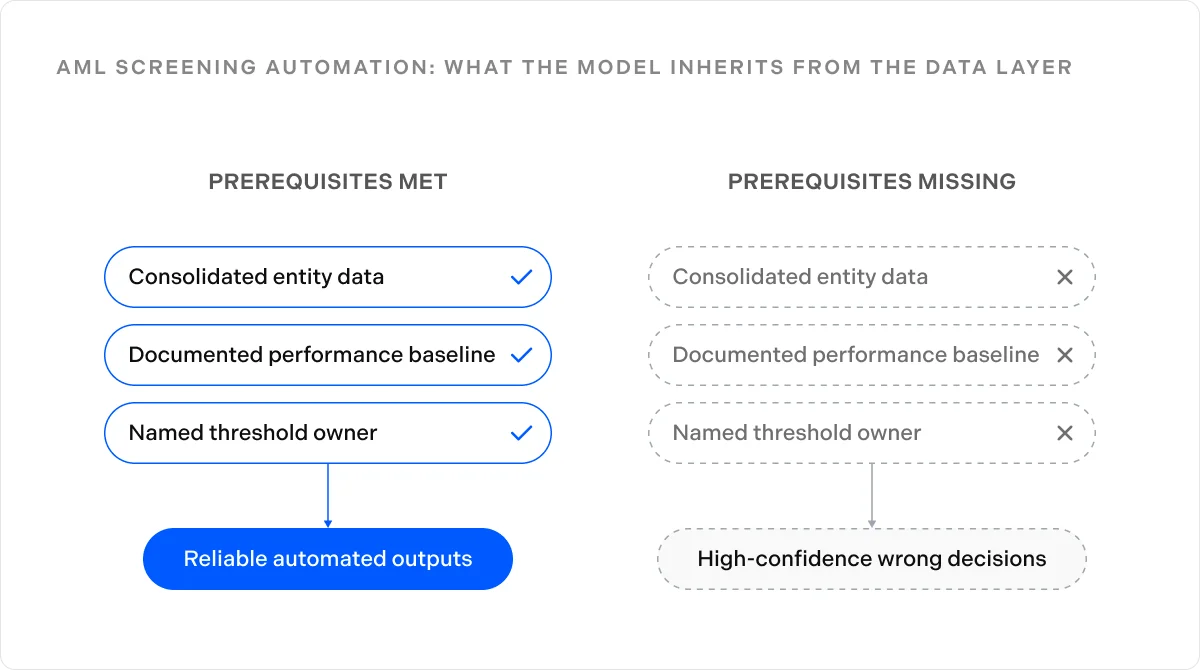
The implementation sequence
The six steps below run in dependency order. Here’s what each one establishes and what goes wrong when it's left out:
| Step | What it establishes | What breaks if you skip it |
| Data preparation | Consolidated, consistent entity records as the input layer | Automation makes high-confidence decisions on bad inputs |
| Entity resolution configuration | Match logic accounting for name variation, aliases, transliterations | False positive volume stays high regardless of threshold settings |
| Risk-based threshold calibration | Alert generation rules proportionate to your risk profile | Genuine risk passes undetected, or the analyst queue stays unmanageable |
| Human oversight design | Defined escalation paths, override capability, sign-off requirements | Automated decisions have no defensible governance layer |
| Audit trail architecture | Logged, traceable record of every automated clearance and routing decision | Decisions exist only as system outputs with no reviewable rationale |
| Perpetual monitoring activation | Continuous rescreening triggered by risk changes, not a calendar | Post-onboarding designations and ownership changes go undetected |
Step 1: Data preparation
A model trained on fragmented or inconsistent inputs produces confident wrong decisions: a name mismatch clears a genuine hit, and a missing date of birth forces the algorithm to rely on name similarity alone, which is exactly where false positives multiply. Every subsequent stage depends on the data quality established here. Before building anything else, consolidate customer records across systems and verify that identity records include secondary identifiers such as date of birth and nationality.
Step 2: Entity resolution configuration
Entity resolution is the logic that decides if two records refer to the same real-world entity. It's the difference between a screening system that treats "Aleksandr Petrov" and "Alexander Petroff" as two different people and one that recognizes them as the same individual recorded under different transliteration conventions. Your configuration needs to account for the following:
- Name transliterations across scripts, including Latin, Cyrillic, and Arabic
- Aliases, maiden names, and alternative spellings
- Common names where secondary identifier confirmation is required before a match is flagged
- Corporate entity variations, including registered name, trading name, and abbreviations
Entity resolution has to be configured before thresholds are set. The match logic underneath your thresholds determines how well they perform, and poorly resolved entities produce false positive volumes that threshold adjustments alone can’t fix. Read more: How to Reduce False Positives in AML Screening
Step 3: Risk-based threshold calibration
With entity resolution in place, thresholds determine which alerts require analyst review and which are cleared automatically. Calibration is a risk decision that needs a named owner. Accepting a vendor default without review is a common reason programs perform poorly under examination. Calibration draws on three inputs: your current baseline false positive rate, the risk appetite from your institution's customer risk assessment, and the daily volume your analyst team can genuinely review. The fourth input falls outside that calibration entirely. For OFAC and other sanctions designations, examiners expect documented rationale and human review for any clearance decision, and no threshold configuration changes that expectation. Threshold errors in either direction produce problems that only become visible during examination. Thresholds set too loosely let genuine risk through without human review, and thresholds set too tightly rebuild the manual burden the automation was meant to reduce.
Step 4: Human oversight design
Before any automated clearance goes live, define exactly where human review is required and what that review must produce. Technical configuration usually gets attention while governance design is deferred until an examiner asks who approved a specific clearance decision and compliance can't answer. The oversight design needs documented answers to four questions:
- Which alert types and risk scores require analyst review before disposition?
- Which ones require senior compliance officer sign-off?
- How does an analyst override get logged, and who can initiate one?
- What triggers escalation from automated clearance to full investigation?
The FFIEC BSA/AML examination manual, FinCEN, and the OCC each expect institutions to demonstrate that qualified analysts review AI-generated outputs and retain authority to override automated decisions. Documented analyst review gives an automated program a defensible record when examiners look at how specific clearance decisions were made. 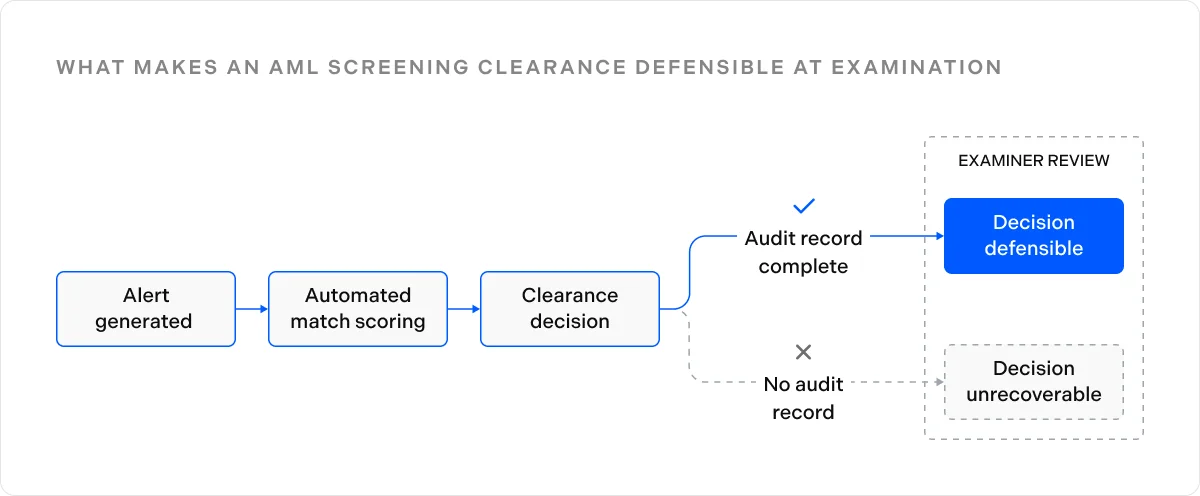 Read more: AI in AML Compliance: Benefits, Risks, and Governance
Step 5: Audit trail architecture
Every decision the automated program makes needs a complete, reviewable record, and this architecture has to be in place before the program scales. Building it into a program already in production is far harder. Regulators treat undocumented decisions as decisions that were never made. Each record should include:
- The data sources queried
- The confidence score and match logic applied
- The threshold version in effect at the time
- The analyst's review outcome where human review occurred
An automated program without a complete audit trail is harder to defend than a manual one, because decision volume is higher and individual clearances can't be explained when an examiner asks why a specific match was cleared.
Step 6: Perpetual monitoring activation
Onboarding screening captures risk at a single point in time. A customer who cleared every check at onboarding can receive a sanctions designation the following day or have their beneficial ownership structure change with no review triggered until the next scheduled cycle. Perpetual KYC replaces fixed review cycles with continuous rescreening, so alerts fire when a risk indicator changes rather than when a calendar date arrives. When the oversight and audit infrastructure is already in place, those alerts flow into a governed program. Activated before that infrastructure exists, perpetual monitoring adds alert volume that the program has no capacity to absorb. Read more: AML Automation Guide: Benefits, Tools & Best Practices
Four reasons AML screening automation programs fail
Each of the four patterns below traces back to an organizational decision made before the model ran in production.
Automating a process that isn't defined
If escalation paths are unclear and decision criteria vary by analyst, automation turns that variation into a program-wide pattern. What was previously a variation in how individual analysts handled borderline alerts becomes a systematic pattern applied across the entire queue. When an examiner asks why a specific category of alert was consistently cleared without review, the program has no defensible answer, because no one documented the decision rule before encoding it. The process design has to come before the automation build.
Treating thresholds as a one-time configuration
Calibration set at launch drifts as the institution's risk profile changes. New customer segments and new product lines change what "normal" looks like, and without a defined review cadence, the drift goes undetected until an examination finds it. By then, the thresholds no longer reflect the population they screen, and the program has no data showing when the misalignment started.
Framing automation as a cost-cutting exercise
When headcount reduction drives the business case, model governance and audit infrastructure get deprioritized as non-essential costs. The interagency SR 26-2 guidance on model risk management, issued by the Federal Reserve, OCC, and FDIC in April 2026, is unambiguous on what examiners expect: training data documentation, performance metrics, validation testing, and explainability for individual decisions. Programs that cut these controls to move faster create regulatory exposure that outweighs the savings.
Expecting full automation immediately
Programs that start with one high-volume, low-judgment workflow and validate over 60 to 90 days before expanding are better positioned than those launched at full scope without validated performance data. BCG's 2025 analysis of AI in KYC found that unrealistic automation expectations and underestimation of required organizational changes are among the leading barriers to scaling beyond the pilot stage. 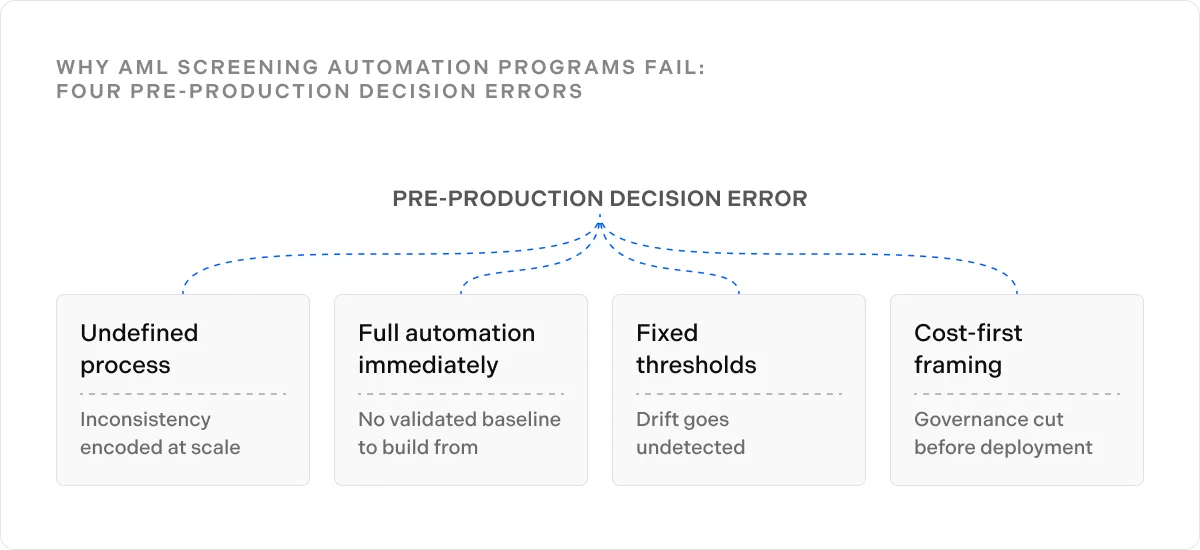
Where Sigma360 fits in the automation sequence
Each capability in Sigma360's AI risk intelligence platform addresses a specific stage of the implementation sequence.
Data foundation
Sigma360 covers 100B+ data points spanning sanctions and watchlist screening, 150+ corporate registries, and 4.5M adverse media articles per month (per Sigma360). Entity resolution runs across scripts and jurisdictions, giving the match logic underneath threshold calibration the breadth it needs to distinguish genuine hits from name coincidences.
Threshold calibration and oversight
Risk thresholds are configurable through a no-code interface, keeping calibration decisions with compliance teams. Every clearance is logged and reversible, and the AI360 Oversight Dashboard produces the documented analyst review record that human oversight and audit trail requirements depend on.
Automation layer
The AI360 suite covers the triage workflows where alert volume is highest:
- AI Investigator Agent applies AI scoring to clear low-confidence false positives, reducing manual match reviews by up to 90%.
- Adverse Media Summary consolidates related coverage into a single risk narrative scored by relevance, cutting review time without reducing coverage.
- Entity Summary assembles watchlist status, registry data, beneficial ownership connections, and adverse media into one structured file before an analyst opens the case.
Continuous monitoring
Perpetual KYC replaces scheduled review cycles with event-driven rescreening, so the program catches risk changes when they occur. The AML investigations workflow connects to the same data layer, keeping screening alerts and investigation support in one program. Request a demo to see how each capability applies to your institution's screening program.
FAQ
Who owns threshold documentation when the screening system is vendor-hosted?
The institution does, regardless of who configured the settings. Examiners will direct questions about calibration rationale to the compliance team, not the vendor, so the institution needs to be able to explain every threshold decision independently.
Can an automated clearance decision be reversed if new information surfaces later?
Yes, if the audit trail was built correctly. Each clearance needs to log the match logic and data sources used at the time, so the decision can be reviewed, the alert reinstated, and the change documented if new adverse information comes in.
Does the same automation logic apply to individual and corporate entity screening?
No. Corporate entities need separate configuration. Registered names, trading names, abbreviations, and beneficial ownership chains introduce variation that individual name screening doesn't face, so threshold settings and entity resolution rules need to be defined for each entity type.
What false positive rate should an institution target after implementing AML screening automation?
There’s no universal figure. The more useful measure is if the rate is improving from the pre-automation baseline and whether the alerts that remain are genuinely ambiguous cases that warrant analyst review.
How do you validate a live AML screening model without disrupting production?
Most institutions run validation on a sample of recent decisions without pausing the program. Validation needs to cover clearance quality as well as alert quality, because false negatives are harder to catch and more consequential than false positives.

