
Banks and fintechs are deploying AI across AML programs faster than their governance frameworks can keep up.
According to EY’s Global Financial Services Regulatory Outlook 2026, more than 70% of banking firms are already using agentic AI in some form, while a general lack of robust governance frameworks persists across the sector. For compliance teams, this means the liability from ungoverned AI can accumulate faster than the operational savings it delivers.
This guide explains why AI in AML compliance produces different outcomes depending on how it is governed, and what compliance teams need to get that right.
Key takeaways:
- The type of AI deployed determines how the program is governed
Analytical AI, generative AI, and agentic AI each serve different parts of the AML workflow and carry different governance requirements.
- Model drift and bias are the risks most compliance teams underestimate
A model that performed well at deployment can degrade silently over time, and the degradation produces no alert until an examiner finds it.
- Regulators want evidence of human control, not evidence that AI performed well
Explainability, documented analyst review, and model governance on a schedule are baseline expectations across the US, EU, and UK.
- The analyst role changes in an AI program; it does not disappear
AI handles routine screening and data gathering. Analysts move to reviewing outputs, making judgment calls, and maintaining the oversight layer regulators require.
- Sigma360 combines risk data, screening technology, and agentic AI in one platform
Sigma360 is built for compliance teams that need better matching, faster investigations, and continuous monitoring without stitching together multiple tools.
What AI in AML compliance means
Compliance teams often use “AI in AML” as a single term for several different capabilities, each suited to a different part of the workflow and carrying different governance requirements.
Deploying the wrong capability in the wrong workflow is how most AML AI programs create new problems alongside new efficiency.
What AI does not do is replace the program itself. The BSA/AML framework remains the compliance team’s responsibility. AI changes how efficiently those obligations are met, and how defensible the decisions are when examiners review them.
Types of AI used in AML programs
The distinction starts with the type of AI involved. Three categories define how AI operates in AML programs:
| AI type | Primary AML application | What it cannot do alone |
| Analytical AI (machine learning) | Customer risk scoring, transaction pattern detection, behavioral profiling | Interpret unstructured data; explain decisions in examiner-ready language |
| Generative AI (large language models) | SAR narrative drafting, entity risk summarization, adverse media consolidation | Make compliance decisions; validate its own outputs |
| Agentic AI | Autonomous alert clearing, CDD workflow automation, perpetual KYC monitoring | Override policy controls; operate without a defined governance framework |
Governance underlies every listed limitation. McKinsey’s research on financial crime compliance found that agentic AI can deliver productivity gains of 200–2,000% compared with the 15–20% efficiency gain that analytical and generative AI typically deliver. Both figures depend on the program defining where human review is required and keeping evidence that those decisions are documented.
Where AI delivers measurable results in AML programs
AI performs most reliably in specific, bounded workflows where the use case is tightly scoped and the underlying data is clean.
1. Customer risk scoring at onboarding
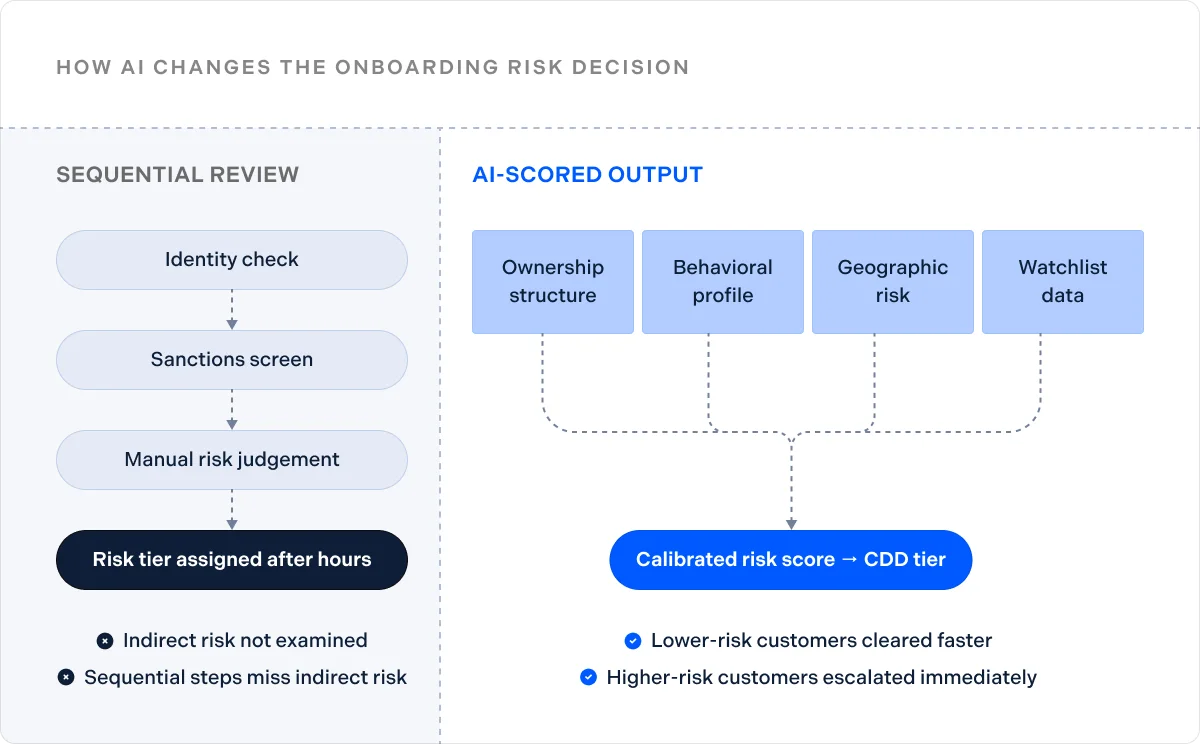
Machine learning models assess new customers against behavioral profiles, ownership structures, geographic risk, and watchlist data simultaneously, producing a calibrated risk score that feeds directly into CDD tier assignment.
Replacing the sequential, checklist-based review with a scored output means lower-risk customers move faster and higher-risk ones get the additional review their risk level requires.
2. SAR investigation support
Generative AI compiles entity profiles from sanctions data, adverse media, corporate registries, and internal case history into a single structured summary.
Analysts review rather than assemble, compressing the investigation timeline and producing consistent documentation that meets examiner expectations regardless of which analyst handled the case.
AML investigations built on AI-generated summaries also produce a more defensible audit trail than those assembled manually from scattered sources.
3. Continuous portfolio monitoring
Rule-based periodic reviews miss risk that changes between cycles.
AI-driven continuous monitoring fires alerts the moment a customer’s risk profile shifts (a sanctions designation, a change in beneficial ownership, an adverse media event), so the institution responds in days rather than waiting for the next scheduled review.
This is the operating model behind perpetual KYC, which replaces fixed review cycles with continuous visibility across the customer portfolio.
4. Alert triage and false positive clearing
Entity resolution and probabilistic matching distinguish genuine hits from name coincidences at a threshold that static rules cannot achieve, reducing alert volume and directing analyst time toward cases that warrant investigation.
The result is a review queue that reflects genuine risk, with documented reasoning for every alert cleared.
The risks compliance teams must manage
AI introduces efficiency alongside failure modes that rule-based systems do not have.
Model bias in customer risk scoring
Machine learning models trained on historical case data can reflect the biases in that data, including demographic or geographic patterns that have no legitimate bearing on money laundering risk.
If the training set overrepresents certain customer types in high-risk classifications, the model will reproduce that skew across every customer it scores.
Fair lending and fair banking obligations extend to AI-driven risk scoring, and regulators and supervisors have specifically flagged bias in AML and KYC systems as an area of active attention. Testing models for disparate impact before deployment, and at defined intervals thereafter, is a control regulators expect to find documented.
Model drift
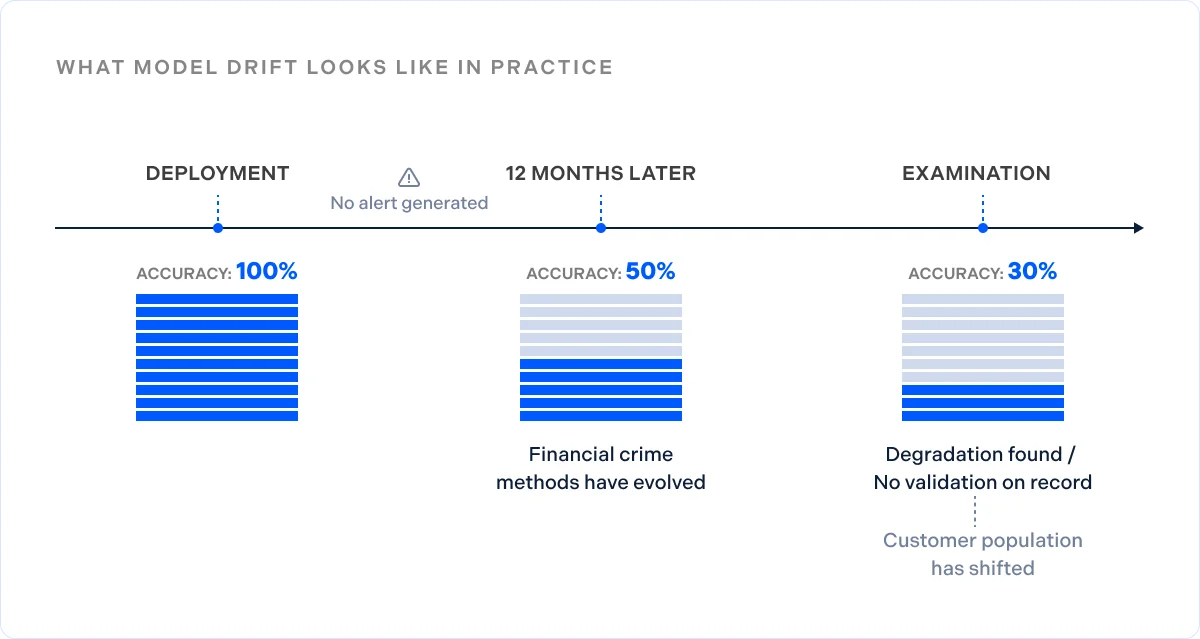
Financial crime methods change faster than most models are retrained. As typologies evolve and customer populations shift, accuracy can degrade without producing any visible signal in the compliance output.
Wolters Kluwer’s 2026 US Banking AI Risk and Governance Index found that 72% of banks are least prepared for model kill-switch protocols and regulatory reporting of AI failures, the controls that become critical when a model stops performing as expected.
Without a validation schedule and defined thresholds, a drifting model stays invisible until an examination finds it.
Over-reliance on automated outputs
When analysts approve AI recommendations without reviewing the reasoning, the human oversight that regulators require goes undocumented. In an examination, that absence is the finding.
Examiner guidance from FinCEN, the OCC, and the FFIEC is consistent on this. All three identify human oversight as a required element of AI-assisted AML programs, a baseline control with no optional status in a regulated AML workflow.
Explainability failure under examination
If an institution cannot explain why a model cleared an alert, escalated a case, or assigned a risk score, it cannot demonstrate that the decision was compliant. “The model recommended it” is not an adequate response to an examiner’s question.
Every AI-assisted compliance decision needs a documented rationale covering the data used, the threshold applied, and the analyst’s review.
The regulatory bar for AI in AML programs
Regulatory expectations on AI in AML have moved from guidance to an enforcement posture across all major jurisdictions. FinCEN’s risk-based compliance framework accepts AI as a valid method for meeting program obligations, provided institutions can show the technology is explainable and subject to documented human review.
The FFIEC BSA/AML examination manual defines what examiners test when they review suspicious activity monitoring systems, including AI-enhanced ones.
The EU’s deadline is fixed and close. The EU Anti-Money Laundering Regulation (AMLR) applies from July 10, 2027, less than a year from now. AI-assisted compliance tools must meet the explainability, data governance, and model oversight standards that EU regulators apply across AI systems in regulated industries. Institutions in DACH, the UK, and broader Europe that have not yet addressed these requirements have limited time to close the distance.
Three requirements now run through every major jurisdiction’s approach to AI in AML:
- Traceable decisions: Every AI-assisted alert disposition, risk score, or investigation summary must carry a documented record of the data it drew on, the threshold it applied, and the adjustments analysts made to the output.
- Model governance on a schedule: Models must be validated at defined intervals, monitored for accuracy degradation and bias, and reviewed whenever the institution’s risk profile or regulatory environment changes.
- Documented human review: Institutions must specify which workflow steps require analyst sign-off and keep records showing those reviews occurred.
Will AI replace AML analysts?
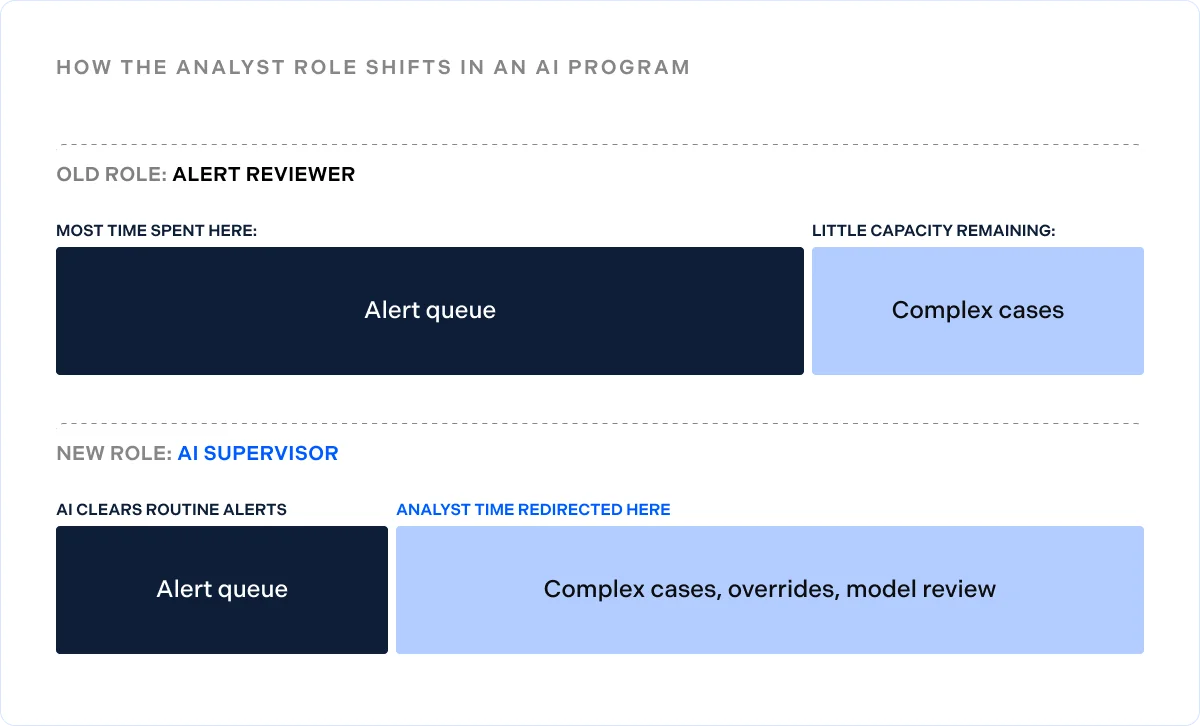
The answer is no, but the role looks different in a program that uses AI well. What changes is the work analysts spend most of their time on.
What AI handles in a well-governed program:
- Routine alert screening and initial scoring
- False positive clearing on high-confidence name mismatches
- Data gathering across sanctions lists, registries, and media sources
- First-draft SAR narrative generation
- Continuous monitoring across the customer portfolio
The judgment that remains with analysts:
- Reviewing AI-generated outputs for accuracy and contextual fit
- Making the call on complex, ambiguous, or high-risk cases where the stakes or complexity exceed what scoring alone can resolve
- Identifying when a model recommendation should be overridden and documenting why
- Communicating compliance decisions to regulators and internal stakeholders
- Providing the feedback loops that improve model performance over time
The shift is from analyst-as-reviewer of every alert to analyst-as-supervisor of AI-assisted processes.
Institutions that treat this as headcount reduction risk losing the judgment layer that keeps the program defensible. Those that treat it as a capability upgrade keep the same team while covering a larger and more complex portfolio.
How to prepare your AML program for AI
Deployment before readiness is where most AI programs create more problems than they can solve.
There are six steps worth sequencing before the first model goes live:
- Assess data quality first. AI performance depends heavily on the quality of the data it processes. Fragmented customer records, inconsistent name formats, and incomplete transaction history produce unreliable outputs regardless of the model’s sophistication.
- Define the use case precisely. The narrower and more specific the initial deployment (alert triage for a single product line, for example), the easier governance and validation become.
- Build the governance framework before going live. Model validation documentation, defined accuracy benchmarks, a review cadence, bias testing protocols, and a process for analyst override and escalation all need to be in place before the first model goes live.
- Sequence use cases by risk. Begin with workflows where AI failure is visible and recoverable (false positive clearing, for example), then expand to workflows where a failure directly affects a compliance filing or an enforcement decision.
- Document the human review layer. Every institution needs records showing that qualified analysts reviewed AI outputs, applied judgment to complex cases, and retained authority to override the model.
- Validate on a schedule, not just at launch. Set performance thresholds (accuracy, false positive rate, false negative rate) and test against them quarterly. Establish a defined response for when performance falls below threshold, including escalation and model replacement.
Read more:
Sigma360: Built for AI in AML compliance
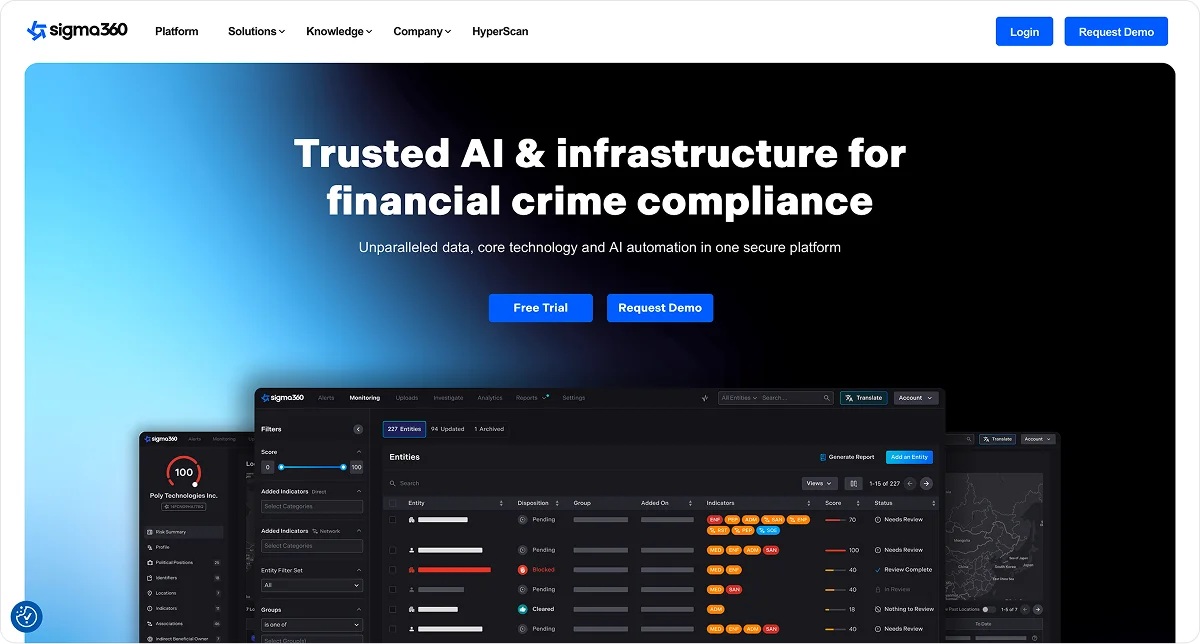
Sigma360 is an AI-powered risk intelligence platform built for global financial institutions, Tier 1 banks, fintechs, asset managers, regulated corporates, and payments firms.
Most compliance platforms provide one piece of that infrastructure. Sigma360 connects all three:
- Global risk data: More than 100 billion data points across sanctions lists, PEPs, 4.5 million monthly adverse media articles, and corporate registries covering 150+ countries, plus proprietary intelligence on shared addresses, directors, and nominee relationships that standard datasets do not include.
- Core screening technology: Configurable sanctions and watchlist screening with entity resolution and risk scoring engineered for high-volume AML programs. Sigma360 reports a 93% reduction in false positive rates, cutting the alert load that consumes analyst capacity.
- Agentic AI: The AI360 suite includes three tools built specifically for AML workflows. The AI Investigator Agent clears false positives autonomously and reduces manual match reviews by up to 90%. Adverse Media Summary consolidates related news into single risk narratives so analysts spend up to 95% less time on adverse media review. Entity Summary generates comprehensive, audit-ready risk profiles covering KYC data, watchlist status, registries, and adverse media in a single click.
Sigma360 logs every alert disposition, analyst override, and risk score with traceable source documentation, fully auditable and explainable, providing the record that internal governance reviews and regulatory examinations require.
Request a demo to see how Sigma360’s AI applies to your AML program.
FAQ
How do you evaluate an AI vendor for AML compliance?
Ask for validation documentation before agreeing to a demo. A vendor that cannot explain how the model handles edge cases, logs analyst overrides, and reports performance drift is not ready for a regulated workflow.
Does AI in AML create fair lending or fair banking risk?
Yes, if the training data reflects historical bias. Models that overrepresent certain customer types in high-risk classifications will reproduce that skew across every customer they score, and fair lending frameworks treat biased risk scoring as a compliance issue regardless of intent.
What is the difference between agentic AI and generative AI in AML?
Generative AI produces outputs that analysts review before acting. Agentic AI takes actions autonomously (clearing alerts, triggering workflows), which means governance requirements are higher because no human reviews each decision before it takes effect.
How long does it take to implement AI in an AML program?
Bounded use cases like alert triage and adverse media screening can go live in weeks if data quality is sound. Broader deployments covering investigations and continuous monitoring take longer, mostly due to data preparation and model validation.
Can AI miss money laundering that rule-based systems would catch?
Yes. A model calibrated to reduce false positives can, if poorly tuned, also suppress genuine hits. Unlike false positives, false negatives produce no alert, which makes them harder to detect and more dangerous.

