
AML evaluations go deep on features and data coverage and stop short of the question that shapes how a program holds up in practice: How well do the components share data once deployed?
What is difficult to see in a procurement process is how a sanctions hit connects to a customer’s risk score, how an adverse media alert reaches an open case, and how the audit trail gets built, or whether it gets built at all. Getting the architecture wrong means the program generates compliance activity without reliably catching risk, and at the scale financial crime now operates, those are not the same thing.
In July 2026, FATF president Giles Thomson identified fraud as a $500 billion annual threat at the launch of the body’s two-year fraud roadmap, signaling that regulators will scrutinize programs for genuine risk detection, not just alert processing.
This article gives compliance teams a framework to evaluate AML solutions based on the factors that determine real program performance.
Key takeaways:
- AML solutions cover more than screening
A full program includes several interconnected functions that work best when they share data, and the architecture behind them determines whether they perform as a system or as a collection of separate tools.
- Architecture outweighs the feature list
How modules connect and pass data to each other reveals more about a platform’s real-world performance than any individual capability shown in a demo.
- Evaluation criteria shift by institution type
What a Tier 1 bank needs from an AML solution differs from what a fintech or asset manager needs, and choosing based on the wrong criteria is how programs underperform despite looking well-specified on paper.
- A vendor demo is not a proof of concept
The metrics that matter most only emerge when a platform is tested against your own data, your own alert population, and your own operational context.
- Sigma360 connects screening, monitoring, and investigations in one program
Sigma360 consolidates risk intelligence across 100B+ data points and automates triage, so compliance teams spend less time assembling cases and more time making them.
What AML solutions cover
Regulated institutions need more than a tool that checks names against lists. A complete AML program brings together the connected functions required to monitor customers continuously across the lifecycle, from onboarding through ongoing monitoring, investigation, and regulatory reporting.
Seven core functions make up a full AML solution:
- Sanctions and watchlist screening: Checking customers, counterparties, and transactions against government-issued sanctions lists, PEP databases, and enforcement records at onboarding and on an ongoing basis
- Adverse media screening: Scanning global news and public records for negative signals (criminal proceedings, regulatory enforcement, fraud allegations, corruption investigations) that may not yet appear on any watchlist
- Customer risk scoring: Assigning and updating a risk score based on geography, industry, transaction behavior, beneficial ownership, and other factors, so controls can be applied proportionally across a portfolio
- AML investigations: Reviewing flagged activity, gathering supporting evidence, making disposition decisions, and filing suspicious activity reports (SARs) where required
- Enhanced due diligence: Running deeper background checks on high-risk customers, including ownership structure, corporate registry data, and proprietary derived intelligence, where standard CDD is insufficient
- Perpetual KYC: Monitoring customers continuously, triggering risk reviews when sanctions exposure, ownership, or media coverage changes
- Regulatory reporting: Generating and filing SARs, currency transaction reports (CTRs), and other mandatory disclosures with the relevant financial intelligence units
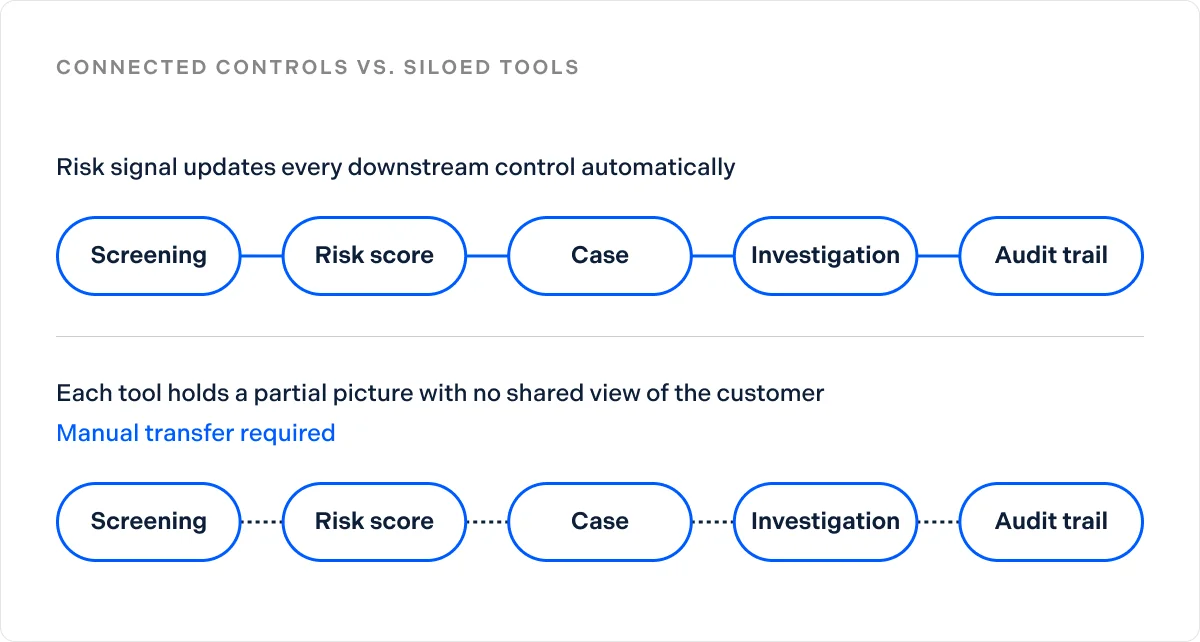
All seven functions work best as a connected system. When risk signals flow between controls automatically, analysts start each review with a complete, pre-assembled picture, and every decision gets documented in the process.
AML solution types: A practical comparison
How modules connect and share data determines more about program effectiveness than the individual features within them.
Three broad architecture types shape how that connection works in practice:
| Solution type | Architecture | Key strength | Key limitation | Best for |
| Point solutions | Separate tools for each function (screening, monitoring, case management) | Deep, best-in-class capability per module | Manual bridging of findings across tools required | Institutions supplementing existing infrastructure |
| Integrated platforms | Modules built on a shared data layer | Automatic flow of risk signals between controls | Consolidation of existing tools required | Mid-market and enterprise programs seeking unified coverage |
| AI-native platforms | Unified platform with AI triage, entity resolution, and automation built in | Reduced false positive volume and manual review time | Governance framework and explainability controls required | Regulated institutions with high alert volumes and audit requirements |
Programs that run controls in isolation consistently lag behind the risk they are meant to manage. Where adverse media, sanctions, and KYC data are held in separate systems, the financial crime risk management program has no shared picture of the customer, and neither does the analyst reviewing the case.
What to evaluate when choosing an AML solution
Choosing an AML solution on features and pricing alone is how programs end up well-specified on paper and underperforming in production. The criteria below focus on what a vendor demo will not show.
1. Do modules share data, or do analysts piece it together manually?
No other evaluation question gets closer to how a program performs once deployed. When a sanctions hit does not automatically update a customer’s risk score, the program recreates the same fragmentation that manual processes had.
Press vendors on this specifically; not what modules they offer, but how completely those components exchange data with each other.
2. How does the solution handle false positives?
Legacy rule-based screening generates alert volumes that most teams cannot clear at the required pace. Entity resolution quality, contextual matching, and threshold configurability all determine how well a solution separates genuine risk from irrelevant hits, and those factors reveal more about a platform’s real-world performance than any feature comparison.
Ask for documented, independently validated evidence of false-positive reduction at comparable institutions.
3. Can you configure risk thresholds without engineering support?
Compliance teams need to adapt controls as their customer base, products, and regulatory obligations change.
A solution that requires an IT project to adjust a screening threshold or monitoring rule puts the program perpetually behind the risk environment. FATF’s risk-based approach guidance reinforces that controls must be calibrated to actual institutional risk rather than applied uniformly.
4. What does the audit trail look like?
Examiners expect institutions to demonstrate that a control was applied consistently and that the reasoning behind each decision is documented. Check that the platform logs every alert, analyst action, and disposition automatically, and that the log exports in a format suitable for regulatory review.
5. How does it handle indirect and network risk?
Direct sanctions exposure is the floor. Sophisticated financial crime moves through shell companies, nominee relationships, and indirect ownership chains that name-matching against published lists will not catch.
Confirm that the solution can identify shared addresses, shared directors, and beneficial ownership connections across the full entity network.
6. What is the deployment timeline and ongoing support model?
Six-month implementation timelines are not realistic for a compliance program that needs to be running. Get a specific timeline from the vendor, understand what data preparation is required on your side, and confirm what ongoing support looks like after go-live.
Read more: How AI Cuts AML Delays and Regulatory Risk
How evaluation criteria shift by institution type
Evaluation priorities shift by institution type, and choosing against the wrong criteria is how programs end up well-specified on paper and underperforming in practice.
Tier 1 banks and global financial institutions
These institutions operate across multiple jurisdictions with high transaction volumes, layered ownership structures, and intense regulatory scrutiny. The evaluation priorities are:
- Explainability and audit trail integrity, meaning that every AI-assisted decision must be documented and defensible to an examiner
- Indirect ownership detection to identify hidden relationships that name-matching against published lists will miss
- Enterprise-scale deployment without compromising decision quality or review speed
Fintechs and payments firms
False positive rates affect customer experience and operational cost directly, so the evaluation tilts toward speed and configurability. The evaluation priorities are:
- API-first deployment and real-time screening throughput to match transaction speed
- Configurable thresholds by customer segment to avoid uniform controls on heterogeneous risk
- Speed to production, as a lengthy implementation window is not compatible with a business that is scaling
Asset managers and regulated corporates
These institutions deal less with transaction volume and more with counterparty exposure. Hidden ownership, indirect relationships, and adverse media across multilingual global news sources are the primary risk vectors. The evaluation priorities are:
- Corporate registry depth and beneficial ownership data quality across multiple jurisdictions
- Multilingual adverse media coverage, as risk signals in non-English sources must reach the analyst
- Counterparty network intelligence to identify indirect exposure before it becomes a liability
The FFIEC BSA/AML Examination Manual sets out the control standards all three segments are expected to meet.
Across all institution types, the financial crime compliance framework must drive the software decision. Architectural fit outweighs feature count. How well the solution maps to the program’s risk profile, regulatory obligations, and the pace at which analysts need to make defensible decisions is what determines real program performance.
What a rigorous AML evaluation looks like in practice
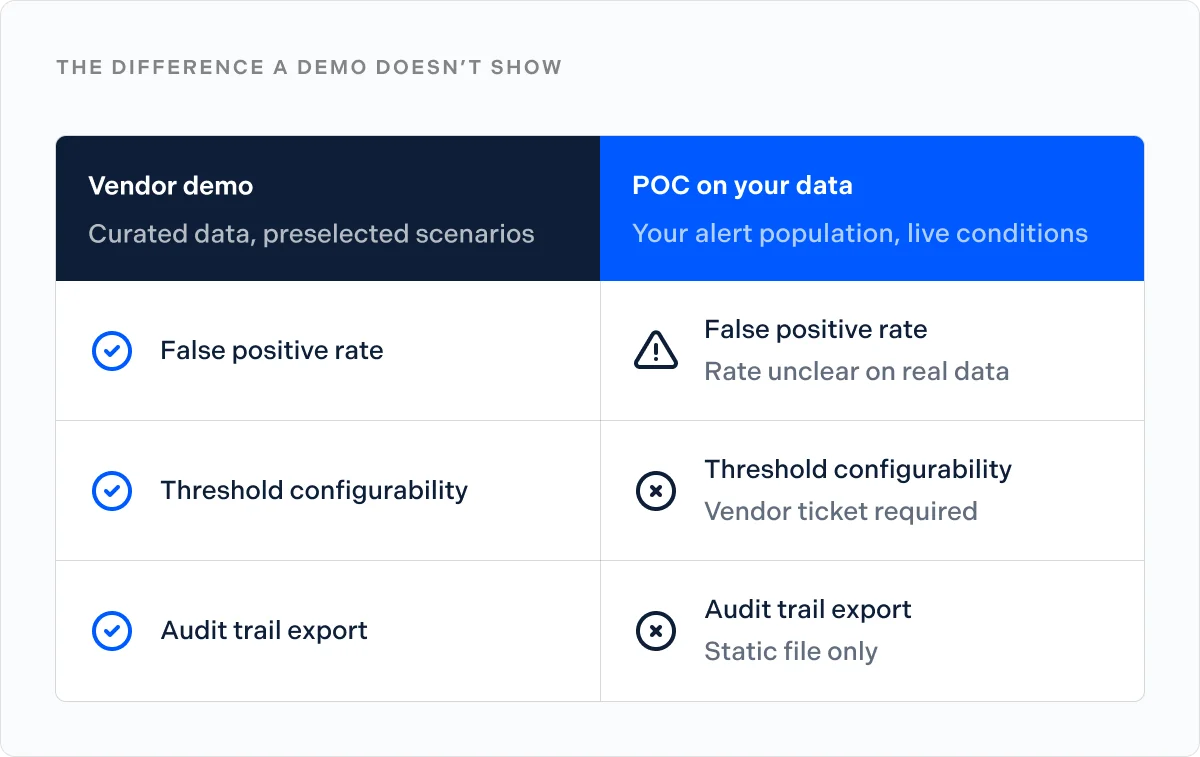
A vendor demo uses curated data and preselected scenarios. A proof of concept against your own data, with agreed measurement criteria, is the only way to see how the platform behaves under real conditions.
Before starting one, agree internally on what to measure:
- False positive rate on your own alert population (not a vendor-supplied sample)
- Time from a watchlist update to analyst queue
- Steps from a screening hit to a documented disposition
These metrics reveal architectural quality in ways a feature comparison cannot.
Watch for three red flags:
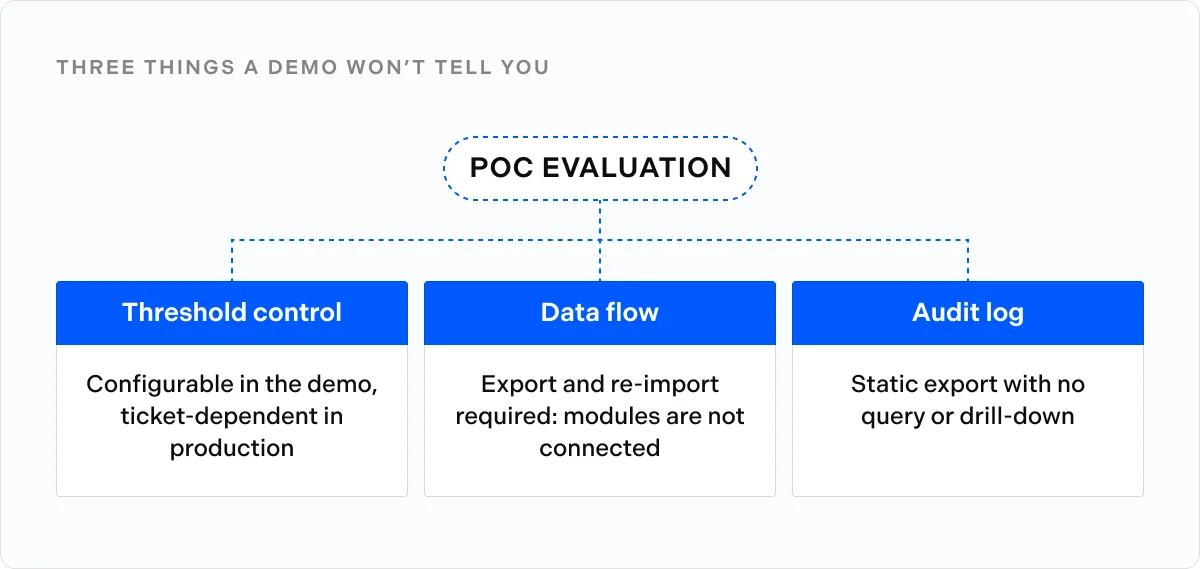
- Data that does not flow automatically between modules. If moving a screening result into a case requires manual export and re-import, the platform is not integrated in any meaningful sense.
- Threshold changes that need a vendor ticket to implement. What the demo showed as configurable may not be configurable in production.
- Audit logs that are static file exports with no queryable structure. A log the compliance team cannot interrogate is not the audit trail an examiner expects to see.
A vendor willing to run a POC on your data, with agreed measurement criteria, is demonstrating something a demo cannot.
How Sigma360 approaches AML compliance
Sigma360 is an AI-powered risk intelligence platform built for Tier 1 banks, global financial institutions, fintechs, payments firms, asset managers, and regulated corporates that need screening, monitoring, and investigation to operate as one connected program across a unified data layer.
The platform brings together 100B+ data points across global watchlists, corporate registries, adverse media, and proprietary derived intelligence. Continuous monitoring flags risk changes across a portfolio as they occur.
Sigma360’s Match Agent clears low-quality false positives before they reach analyst queues, reducing manual match reviews by up to 90%, per the company.
The AI News Agent consolidates related news into a single contextualized story across 225M+ articles from 730K+ publishers in 120+ languages. Both agents are part of AI360, Sigma360’s suite of generative AI capabilities.
The platform’s EDD Agent handles the investigation layer, generating due diligence reports that synthesize KYC data, watchlist records, corporate registry information, adverse media, and proprietary research, so analysts open each case with a full picture already assembled.
All screening decisions, analyst actions, and dispositions are logged at the time they occur and are retrievable on demand, creating the documentation trail regulators expect without manual assembly.
In one proof of concept with a global payments leader, Sigma360’s screening workflow automated alert clearing by 93%, freeing the compliance team to scale review capacity without adding analyst resources.
If you’d like to learn more, request a demo or speak to a compliance expert about your institution’s requirements.
FAQ
What’s the difference between AML software and AML screening software?
AML screening software handles one function: checking customers and transactions against sanctions lists, PEP databases, and adverse media sources.
AML software is the broader category, covering screening alongside transaction monitoring, case management, risk scoring, investigations, and regulatory reporting.
Do I need AML software if I already have a KYC solution?
Yes. KYC verifies who a customer is at onboarding. AML software monitors that customer throughout the relationship, tracking risk changes, screening for sanctions updates, and supporting investigations when needed.
How long does it take to implement an AML solution?
Point solutions can deploy in weeks. Enterprise platforms with deep integration requirements typically take longer. The key variables are data preparation, API integration scope, and configuration of risk thresholds, and those should be discussed with a vendor before a contract is signed.
What do regulators look for in an AML program’s technology?
Regulators look for controls calibrated to the institution’s actual risk profile, consistently applied, and documented with clear reasoning at each decision point.
FinCEN’s national AML/CFT priorities are designed to help institutions assess risk and allocate compliance resources where they have the most impact, not spread effort uniformly regardless of actual exposure.
Is AI in AML solutions safe to use in a regulated environment?
Yes, when it is explainable, governed, and subject to human oversight. Regulators expect institutions to demonstrate that AI reasoning is logged, analyst overrides are possible, and model performance is documented, not just that AI is in use.
What is the total cost of ownership for an AML solution?
The license fee is rarely the largest cost. Implementation, data migration, API integration, configuration, and staff training all contribute, and those variables differ considerably between point solutions and enterprise platforms.
Can AML software replace compliance staff?
No. AML software automates screening, triage, and documentation, but the judgment, regulatory expertise, and accountability that compliance officers provide cannot be automated. A well-implemented platform redirects analyst time toward decisions that require human judgment.

