
AML automation is a set of technologies that routes compliance work to the right layer, clearing high-volume, rule-bound alerts automatically so analyst time can focus on cases that require a decision.
When automation is deployed without a clear structure, the failures that follow are related to governance. Programs can run screening and monitoring workflows continuously and still miss risk. The technology keeps processing, but no one remains accountable for what it produces, how it is configured, or when its outputs require human review.
This is what FinCEN found when it assessed an $80 million civil money penalty against Canaccord Genuity on March 6, 2026, the largest BSA penalty ever imposed on a broker-dealer. The firm’s AML program was significantly under-resourced and not proportional to the risks of its business model. Monitoring weaknesses that regulators had flagged repeatedly went unaddressed for years, and the firm failed to file at least 160 suspicious activity reports.
In this guide, you will learn what AML automation covers and what it takes to deploy it as a compliance control rather than a processing shortcut.
Key takeaways:
- AML automation routes work to the right layer
The technology handles high-volume, rule-bound tasks so analysts can focus on cases that require a decision, not just clearance.
- Multiple workflows qualify for automation
Screening, adverse media, investigations, ongoing monitoring, and SAR preparation each have distinct automation approaches and different impacts on analyst workload.
- Automated and manual programs diverge most on documentation
Automated programs produce consistent, auditable decision trails. Manual programs produce output that varies by analyst and is difficult to examine across large portfolios.
- Regulators require governance, not just technology
Deploying automated tools without documented oversight, model validation, and escalation paths draws examiner attention regardless of how well the technology performs.
- Platform fit matters more than feature count
The right AML automation tool should match the institution’s risk profile, data environment, and regulatory obligations, not just claim the highest reduction numbers.
What is AML automation?
AML automation applies technology to replace or accelerate the manual tasks that make financial crime compliance programs expensive and slow.
Without it, compliance teams spend most of their time reviewing alerts that produce no investigation, clearing low-confidence matches, reading irrelevant news hits, and compiling case notes by hand.
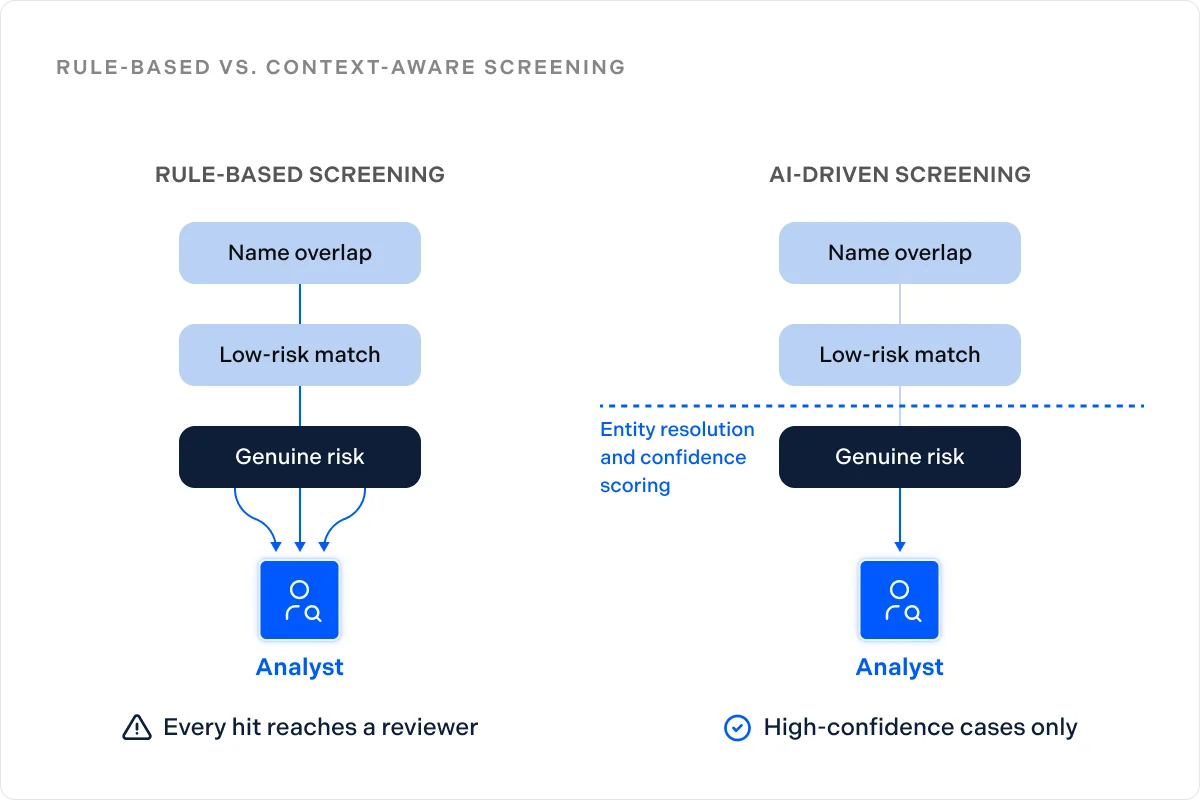
Rule-based systems, which dominated AML compliance for most of the past two decades, generate alerts based on fixed thresholds. They flag transactions, names, or media hits that meet a defined criterion. The result is a high volume of alerts, most of which resolve as false positives.
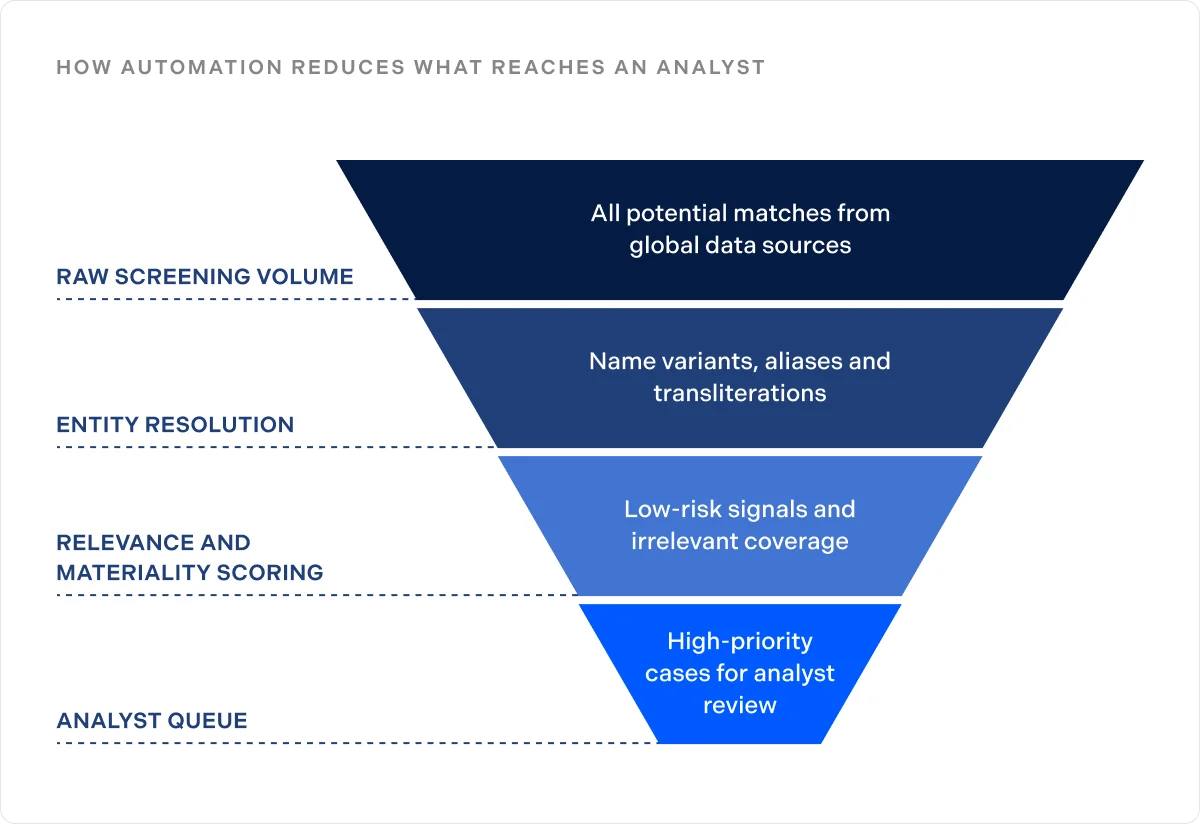
Modern AML automation replaces or supplements rule-based logic with AI-driven processes that evaluate context, apply entity resolution across name variations, score risk based on source quality and event materiality, and automatically clear alerts that fall below a configurable risk threshold.
Analysts receive a smaller, better-prioritized set of alerts, and the decisions behind that prioritization are documented, auditable, and defensible in a way that manual triage rarely is.
Most programs automate some processes and retain human review for others. Regulators pay close attention to where that line is drawn and how clearly it is documented.
What does AML automation cover?
AML programs run dozens of distinct workflows, but automation delivers its clearest returns on the subset that is high-volume, rule-bound, and repeatable enough to route without requiring human judgment at every step.
Customer screening and watchlist matching
Screening customers and counterparties against sanctions lists, watchlists, and PEP databases is the highest-volume task in most compliance programs.
Automated screening applies entity resolution logic that accounts for name variations, transliterations, aliases, and date-of-birth matching, distinguishing likely true matches from low-risk name overlaps that do not warrant review.
Automation clears obvious non-matches, leaving analysts to focus on cases where the risk picture is genuinely unclear or where the potential exposure is high enough to warrant review.
Adverse media monitoring
Keyword matching alone generates high volumes of irrelevant results.
Automated adverse media screening applies natural language processing to assess relevance, severity, and materiality, consolidating related articles into a single risk narrative and clearing coverage that does not meet a configurable threshold.
Early risk signals in adverse media often appear months before a formal regulatory or legal action. Automating the triage layer means compliance teams can act on those signals while there is still time, catching exposure during a routine news cycle and not after it emerges in an examination.
AML investigations and case management
AML investigations involve gathering risk data, reviewing entity connections, assessing network exposure, and documenting findings. Done manually, each case can consume several hours before an analyst has enough information to make a decision.
Automated investigation support consolidates data from multiple sources into a single entity view, exposes direct and indirect risk connections, and generates standardized case summaries ready for analyst review and approval.
Analysts still make judgment calls on complex cases; automation removes only the data-gathering burden, freeing review time for the interpretation work that requires a person.
Ongoing monitoring and perpetual KYC
Point-in-time screening at onboarding misses risks that emerge later, including a sanctions designation, a change in beneficial ownership, or an adverse media event tied to an existing customer.
Perpetual KYC automates continuous monitoring across a portfolio, triggering alerts when risk indicators change rather than waiting for the next scheduled review cycle.
Periodic manual reviews leave coverage windows that regulators and enforcement actions have repeatedly identified as program weaknesses, and for institutions managing large customer portfolios, keeping pace manually is not operationally viable.
SAR preparation support
Financial institutions filed 4.7 million suspicious activity reports in fiscal year 2024, averaging 12,870 filings per day. Each one requires assembling transaction data, entity information, risk indicators, and a compliant narrative, a preparation burden that grows sharply when case volumes are high.
Automation handles the assembly layer, where report fields are pre-populated from case data, and draft narratives are generated for analyst review. The filing decision and sign-off remain with compliance staff.
Manual vs. automated AML: What changes?
The difference between manual and automated programs is most visible at the workflow level, where the same task produces different outcomes depending on whether a system or a person is making the first determination.
Alert triage, deciding which alerts warrant analyst attention, is one of the clearest examples, but the pattern repeats across every major compliance workflow.
| Workflow stage | Manual process | Automated process |
| Customer screening | Analyst reviews each alert individually against watchlist data | Entity resolution logic clears low-confidence matches; analyst reviews the remaining set |
| Adverse media review | Analyst searches and reads individual articles per entity | AI consolidates related articles into a single risk narrative; analyst reviews summary |
| Alert triage | Analyst ranks alerts by arrival time or basic risk score | AI prioritizes by relevance, severity, entity exposure, and configurable risk appetite |
| Investigation | Analyst manually gathers data from multiple systems | AI consolidates entity data, network connections, and risk signals into one view |
| Ongoing monitoring | Analyst conducts periodic reviews on a scheduled cycle | AI monitors the portfolio continuously, triggering alerts when risk indicators change |
| Case documentation | Analyst writes case notes and SAR narrative from raw data | AI generates standardized summaries; analyst reviews, edits, and approves |
Benefits of AML automation
Alert review, analyst capacity, investigation speed, and documentation consistency are the four areas of a compliance program that automation addresses most directly. Each has a different cost profile and a different return:
- False positives: Published industry estimates put legacy rule-based screening false positive rates at 90–95%. AI-driven screening applies context and confidence scoring upstream, clearing low-value alerts before they reach a reviewer.
- Program capacity without proportional headcount growth: In high-growth environments, transaction volumes and customer portfolios expand faster than compliance teams can scale, and automated screening absorbs that increase without a proportional rise in headcount.
- Faster investigation cycles: When entity data is pre-assembled and risk signals are consolidated, investigators move directly to the interpretive work that requires their attention.
- Consistent audit documentation: Automated programs generate standardized decision records at every step, consistent across analysts and readable by examiners.
What regulators expect from automated AML programs
Automated AML programs carry two sets of regulatory obligations, including the underlying AML requirements that apply to any program, and a second layer of governance obligations specific to the automated systems themselves.
Most institutions are better prepared for the first than the second.
FATF Recommendation 15 requires member jurisdictions to identify and assess ML/TF risks arising from new technologies. For institutions deploying AI in screening or risk profiling, this means a documented risk assessment of the AI system itself.
The Anti-Money Laundering Act of 2020 made automation an explicit expectation, directing FinCEN to establish streamlined, automated filing processes and mandating that institutions leverage technology to strengthen their BSA programs.
AML risk profiling and automated decision-making are explicitly classified as high-risk AI under Annex III of the EU AI Act. Following the AI Omnibus, which entered into force on July 27, 2026, compliance obligations for these systems apply from December 2, 2027. They include pre-deployment risk management systems, technical documentation, human oversight mechanisms, and post-market monitoring.
Institutions that deploy AI need to be able to demonstrate the following:
- Explainability: Can the institution explain why a specific alert was cleared, escalated, or prioritized?
- Human oversight: Are complex or uncertain cases escalated for human review?
- Ongoing validation: Is the institution monitoring that automated systems continue to perform as intended as transaction patterns, customer profiles, and risk typologies evolve?
Read more: AI in Financial Crime Compliance: Benefits and Use Cases
How to evaluate AML automation tools
Most AML automation platforms claim similar outcomes. The eight dimensions below cover what actually differentiates them in a regulated environment.
| Evaluation dimension | What to look for |
| Entity resolution quality | Accurate disambiguation across name variations, transliterations, aliases, and non-Latin scripts |
| Data coverage | Sanctions, watchlists, PEPs, adverse media, corporate registries, and UBO data in a single platform |
| Explainability | Documented reasoning, source attribution, and confidence scoring behind every automated decision |
| Configurability | Risk thresholds, filter sets, and escalation rules adjustable without engineering involvement |
| Human-in-the-loop design | Clear escalation paths for uncertain cases; analyst override capability with full logging |
| Audit trail quality | Decision history, model outputs, and override records available for examination |
| Integration | API access for embedded use cases; compatible with existing case management systems |
| Governance framework | Model testing, performance monitoring, and ongoing validation documented |
AML automation best practices
Automation amplifies the design decisions built into a compliance program, and a poorly designed one will fail faster and at a greater scale than its manual equivalent.
There are five things you can do to ensure your program will hold up under examination:
- Calibrate to your risk profile before configuring any tool: The FATF risk-based approach requires controls proportionate to risk exposure, and default vendor configurations are rarely proportionate to any specific institution’s risk profile.
- Design human oversight into the program before deployment: Regulators do not accept “the system decided” as a compliance defense, so build clear handoff points for uncertain cases into the program design and ensure analyst override capability is logged and accessible.
- Validate before and after deployment: Model validation is not a one-time exercise. Automated systems require periodic retesting as customer risk profiles change and new financial crime methods emerge.
- Integrate data before automating decisions: Automation built on fragmented data sources produces fragmented results. Consolidating sanctions, adverse media, corporate registry, and UBO data into a unified entity view first reduces irrelevant alerts and improves risk signal accuracy.
- Document the design rationale as thoroughly as the outputs: Examiners will ask why thresholds were set the way they were, and the documentation should answer those questions independently of the technology vendor.
Where Sigma360 fits in an automated AML program
Sigma360 is an AI-powered risk intelligence platform that combines screening technology, global risk data, and agentic AI in one system built for compliance teams that need automation, data depth, and governance together.
The platform covers the core AML automation workflows:
- Sanctions and watchlist screening
- Adverse media monitoring
- AML investigations
- Enhanced due diligence
- Perpetual KYC
The underlying data covers 100B+ data points, 150+ corporate registries, and news coverage in 124 languages, and the AI360 suite handles the automation layer through the following capabilities:
- AI Investigator Agent clears low-risk alerts automatically using entity resolution and AI scoring, reducing manual match reviews by up to 90%. Every clearance decision is logged, explainable, and reversible by an analyst.
- Adverse Media Agent consolidates related news articles into a single contextualized risk narrative, cutting adverse media review time by up to 95% without reducing coverage.
- Entity Summary synthesizes watchlist data, corporate registry records, adverse media, and proprietary intelligence into a standardized risk profile, so investigators arrive at each case with a full risk view.
Every automated output is tracked through the AI360 Oversight Dashboard, giving compliance leaders the documentation trail that examiners and internal audit require.
Start a no-risk free trial to see the screening, investigation, and monitoring workflows in practice.
FAQ
What is the difference between AML automation and transaction monitoring?
Transaction monitoring is one workflow within an AML program, focused on detecting suspicious patterns in transaction data. AML automation is the broader set of technologies applied across the full program, including customer screening, adverse media, investigations, and ongoing monitoring, of which transaction monitoring is one component.
Can a fintech or smaller institution implement AML automation effectively?
AML automation is often more accessible for fintechs than for large banks because API-first platforms can be deployed without replacing existing infrastructure. The evaluation criteria are the same regardless of institution size: entity resolution quality, data coverage, explainability, and governance documentation.
How do you measure whether AML automation is performing as intended?
The primary indicators are false positive rate, escalation volume, time-to-decision per case, and override frequency. Increasing override rates or deteriorating false positive ratios after deployment are early signals that model calibration or threshold configuration needs review.
Does AML automation reduce compliance risk or create new risk?
Automation reduces the operational risk of manual programs but introduces model risk if governance is absent. A well-governed automated program, with validated models, documented thresholds, and defined escalation paths, carries lower examination risk than a manual program of equivalent scale.
How does automated screening handle entities in high-risk or sanctioned jurisdictions differently?
Effective automated screening applies configurable risk weighting by jurisdiction, so entities with exposure to high-risk countries or sanctioned regions receive elevated scrutiny even when no direct name match is found. The system identifies indirect connections, such as corporate registry links or ownership structures tied to sanctioned jurisdictions, that keyword matching would miss.

