
Beneficial ownership is the identity of the natural person who ultimately controls a legal entity and benefits from it, even when the formal title is held by another company, nominee, or intermediary. In a July 2026 review of 242 asset management and alternatives firms, the Financial Conduct Authority found that a small number of private-markets firms had no formal process for establishing who ultimately owned their customers when complex or offshore structures were involved. Layered ownership is precisely where getting that identification wrong carries the most regulatory and reputational weight. This guide covers what beneficial ownership is, why the official filing rarely tells the whole story, and what regulated institutions are expected to do about it.
Key takeaways:
- Ownership and control are two different tests
Holding shares above the threshold is one route to beneficial ownership, but control through voting rights, appointment powers, or influence counts independently of equity.
- Registry filings reflect declarations, not verified ownership
Because filings are self-reported and can involve nominee arrangements or offshore structures, the declared owner may not be the individual who ultimately controls the money.
- Beneficial ownership is a continuous obligation
Ownership structures change after onboarding, and regulators expect institutions to detect those changes through ongoing monitoring.
- US and EU frameworks each impose distinct requirements
The EU AMLR applies from July 2027 with harmonized verification standards, while the August 2026 FinCEN final rule permanently exempted domestic US companies from BOI reporting.
- Sigma360 connects the data and controls beneficial ownership verification requires
From tracing complex ownership structures with proprietary derived intelligence to continuous monitoring and auditable case records, Sigma360 covers the full workflow.
What is beneficial ownership?
Beneficial ownership is a legal and regulatory concept that requires institutions to look past the registered name on a corporate structure. The person of interest is the natural person at the end of the ownership chain, i.e., the human being who exercises real control or receives the economic benefit, regardless of what company, trust, or nominee holds formal title. The most widely applied test is an ownership or voting rights threshold, set at 25% or more of shares or voting rights in most jurisdictions. But equity is only one route to control. Someone who can appoint or remove directors, exercise dominant influence through a shareholder agreement, or veto material decisions may be the beneficial owner of an entity without holding a single share. When no natural person can be identified through ownership or control, most regulatory frameworks require institutions to record the entity's senior managing officials as a fallback. Senior managing official status is a procedural floor, not an exit from the obligation to trace real ownership.
Why financial crime compliance depends on beneficial ownership
Anonymous ownership is one of the oldest tools in financial crime. Through shell companies, layered holding structures, and proxy arrangements, illicit actors can:
- Move money across borders without their names appearing on any transaction record
- Evade sanctions by transfering assets inside entities that don't trigger watchlist hits
- Launder proceeds through corporate accounts that appear clean on paper
The identity of who controls a business, not who filed the incorporation documents, is what makes screening against sanctions lists, PEP registries, and adverse media meaningful. Without that step, customer due diligence rests on a foundation that a determined bad actor can bypass. Institutions that onboard entities without adequately tracing the beneficial owner face examination findings, enforcement actions, and remediation costs that far exceed the revenue those relationships generate. 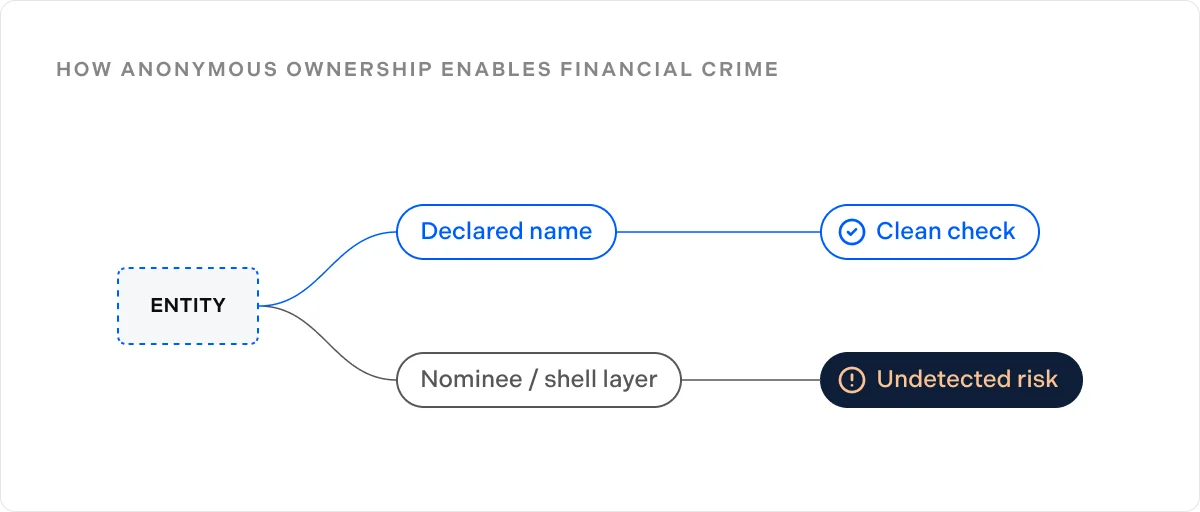
How to identify a beneficial owner
Regardless of jurisdiction, identifying a beneficial owner requires multiple specific steps:
- Trace ownership interests: Identify all direct and indirect stakes in the entity. For a straightforward company, this means obtaining the shareholder register and flagging anyone holding 25% or more. For layered structures, it means looking through each intermediate entity until a natural person appears or the chain ends in a publicly listed company or government body.
- Apply the control test independently: Ask whether any individual has the practical ability to direct the entity's activities, appoint key personnel, or block material decisions, regardless of what the shareholder register shows. Beneficial ownership through control requires no equity stake.
- Document the process and the reasoning behind it: Examiners want to see the institution's reasoning, including what sources were used, what the data showed, and how the team responded when information was incomplete or contradictory. A well-identified beneficial owner with no audit trail is still a regulatory exposure.
What registry data misses
Registries are where ownership tracing starts, but what they record and what exists in practice often differs. Here’s what registries usually don’t reflect:
- Self-reporting with no verification: There’s no systematic check on what a company declares, and updates may lag behind real-world ownership changes by months or years.
- Offshore entities outside registry scope: Companies incorporated in jurisdictions with minimal disclosure requirements may hold shares in regulated-jurisdiction entities without any registry capturing the natural person behind them.
- Nominee arrangements: A nominee shareholder holds shares on behalf of another person, often under a private agreement that never appears in any public filing.
- Bearer instruments: Securities owned by whoever physically holds the certificate have been progressively restricted across jurisdictions, but historical exposures persist.
Registries record what companies report, but they don’t verify that information and can’t see through the arrangements that separate a filed name from the person who controls the money. Proprietary derived intelligence, including corporate registry cross-referencing, shared directorship patterns, nominee relationships, and network links between entities, reveals ownership connections that standard filings leave invisible. 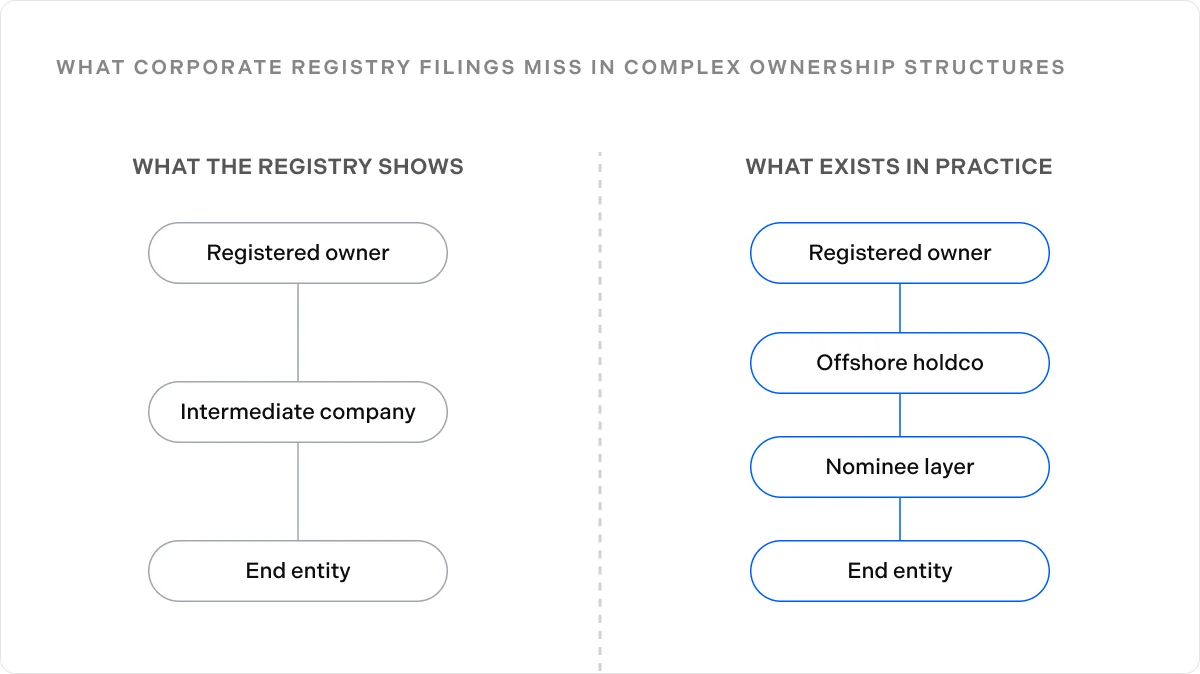 Read more: Enhanced Due Diligence Guide: Process and Requirements
Beneficial ownership across regulatory frameworks
Beneficial ownership identification is a legal requirement across multiple jurisdictions, with each framework setting its own threshold and verification standard. The table below maps the key provisions for institutions operating across the US and EU:
| Framework | Jurisdiction | Threshold | Key obligation |
| FATF Recommendation 24 | Global | 25% (guidance) | Identify and verify the natural persons who ultimately own or control legal persons; keep records current |
| FinCEN CDD Rule | US | 25% | Financial institutions must identify beneficial owners of legal entity customers at account opening |
| Corporate Transparency Act (CTA), as amended August 2026 | US | 25% | Foreign entities registered to do business in the US must file BOI reports with FinCEN; domestic US companies are permanently exempt under the August 2026 final rule |
| EU AMLR (applies July 10, 2027) | EU | 25% (15% for high-risk sectors) | Harmonized CDD and beneficial ownership verification requirements across all member states; directly applicable, no national transposition |
Institutions operating across more than one jurisdiction must map their procedures against each framework separately, because compliance with one doesn’t equal compliance with all. The March 2025 FinCEN interim final rule substantially narrowed the Corporate Transparency Act's reporting scope. US domestic companies are now exempt from filing beneficial ownership information with FinCEN, and the obligation falls only on foreign entities registered to do business in the US. Those foreign entities are also not required to report US persons as beneficial owners. For institutions subject to the EU AMLR, the provision allowing the ownership threshold to drop from 25% to 15% in high-risk sectors represents a significant tightening. Combined with harmonized verification standards throughout all 27 member states from July 2027, it sets a higher evidentiary standard for beneficial ownership identification than most institutions currently meet.
Ongoing monitoring: The obligation that goes beyond onboarding
Ownership structures change after onboarding, and customers have no general obligation to report those updates to the institutions they deal with. An institution with no mechanism to detect those changes is operating on a profile that may no longer reflect who it is dealing with. Perpetual KYC, meaning continuous monitoring of the customer portfolio against live data rather than periodic static review, is the operational answer. When an ownership change occurs, the institution needs to:
- Detect the change through automated monitoring before any customer disclosure triggers it
- Update the risk profile to reflect the new ownership or control picture
- Re-screen the newly identified beneficial owner against sanctions lists, PEP registries, and adverse media
- Document the decision, including what triggered the review and what the institution concluded
Large corporate portfolios make manual handling impractical. The volume of entities under monitoring and the pace at which ownership and sanctions exposure can change make automated infrastructure a requirement. The AML automation architecture underpinning that monitoring also has to produce an audit trail regulators can examine. Every action in that process needs to be logged with enough context to reconstruct the reasoning behind it. 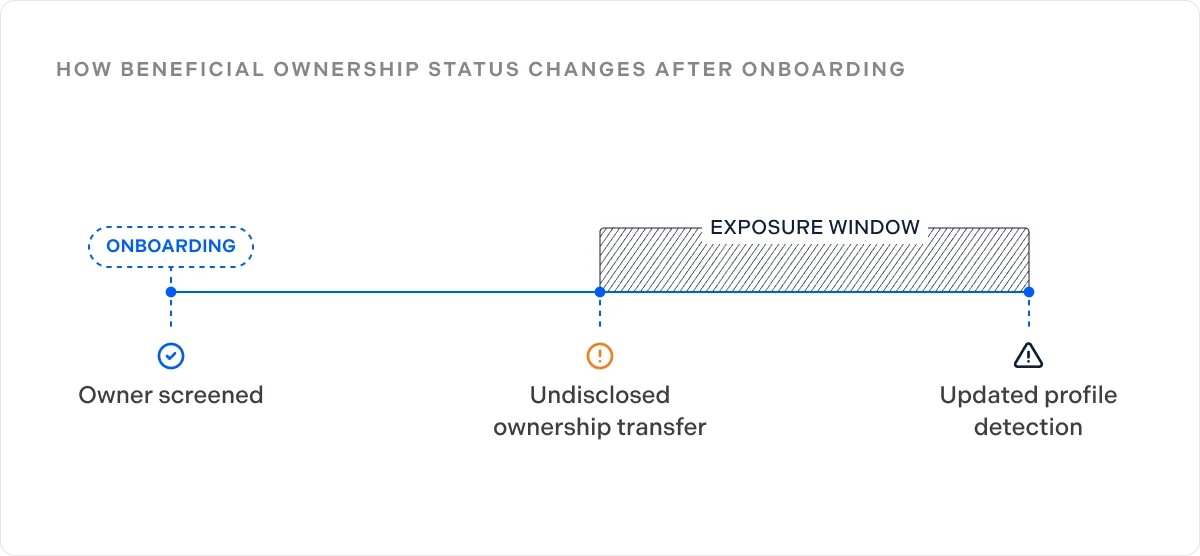 Read more: Customer Risk Assessment: Everything You Need to Know
Sigma360 and beneficial ownership verification
Sigma360's enhanced due diligence capability is built around the verification problem that registries can’t solve. Public filings show a declared owner, but Sigma360's proprietary derived intelligence identifies the shared addresses, shared directors, nominee relationships, and indirect network links behind that declaration that standard screening tools don’t reach. With layered or offshore structures, Sigma360's derived intelligence produces a file built to answer the examiner's question of how control was traced and what the evidence showed. Compliance teams at Tier 1 banks, global financial institutions, fintechs, payments firms, asset managers, and regulated corporates use the platform to address each stage of the verification workflow. Here’s what the platform handles:
- Checking identified beneficial owners against global sanctions lists and PEP registries through Sanctions Screening
- Running adverse media review on beneficial owners using Sigma360's Adverse Media Summary, which consolidates related news into a single contextualized risk picture
- Maintaining current ownership profiles through continuous monitoring via Perpetual KYC, detecting changes in ownership structure without waiting for customer disclosure
- Documenting every step of the identification and verification process through timestamped, auditable case records
Speak to a compliance expert to see how Sigma360 handles beneficial ownership verification and third-party risk management across complex entity structures.
FAQ
What is the difference between a legal owner and a beneficial owner?
The legal owner is the person listed on the official record. The beneficial owner is the natural person who ultimately controls or profits from the asset behind that record. They can be the same person, but in layered corporate structures, nominee arrangements, or trust relationships, they often aren’t.
Does a beneficial owner have to hold 25% or more of a company?
Control can exist below the 25% threshold through voting agreements, director appointment rights, or other means of influence. The 25% figure is the most widely adopted starting point, and regulators can apply lower levels where risk warrants it. Under the EU AMLR, regulators can lower it further to 15% for high-risk sectors from July 2027.
Are US companies still required to report beneficial ownership to FinCEN?
Domestic US companies are permanently exempt following the August 2026 FinCEN final rule, which made permanent the exemptions first introduced by the March 2025 interim final rule. Only foreign entities registered to do business in a US state must file, and they’re not required to include US persons among the reported owners.
Why can't compliance teams just rely on corporate registries?
Registries record what companies declare but have no mechanism to verify it or see through nominee arrangements, offshore holding structures, or outdated filings. Verification requires independent evidence beyond what the filing shows: derived intelligence, corporate registry cross-referencing, and adverse media.
How does beneficial ownership connect to ongoing monitoring obligations?
Beneficial ownership can change at any point in a customer relationship, and regulators expect institutions to detect those changes and document how the risk profile was updated in response. For higher-risk corporate customers, periodic review cycles are no longer sufficient. Ongoing, automated monitoring is the expected standard.
How does beneficial ownership work for trusts?
A trust has multiple relevant persons: the settlor, any trustee with discretionary authority, the protector if one exists, and any named beneficiaries with a fixed entitlement. Each must be identified and screened to the same standard applied to a direct corporate owner.
Can an institution outsource beneficial ownership verification to a third party?
Institutions can delegate this to fund administrators or compliance consultants, but the regulatory obligation remains with the institution. The FCA's July 2026 review found that some firms outsourcing EDD functions couldn’t demonstrate effective oversight of how those checks were performed.

