
Every regulated institution has customers who passed identity verification and still shouldn’t have been onboarded. KYC screening is the check that runs after identity is confirmed, matching a customer's details against sanctions lists, PEP registers, adverse media, and ownership data to determine if the institution is permitted to serve them. The FCA's 2024/25 enforcement data records over £186 million in fines across 37 Final Notices, a volume that reflects persistent weaknesses in financial crime controls across regulated firms. The same failures appear in enforcement notices year after year, at institutions that had screening programs in place. This guide explains what KYC screening checks, how the process works, and where most failures originate.
Key takeaways
- KYC screening checks five data sources, and beneficial ownership is where exposure goes undetected longest
Sanctions lists, PEP registers, and adverse media are the starting point. Internal records and ownership structure are where most programs have the weakest coverage, and where an entity blocked under the OFAC 50 Percent Rule will never appear by name.
- Match resolution and decision documentation are where audit risk accumulates
Generating an alert and closing it correctly are two separate problems. A discounted match with no documented reasoning carries the same regulatory weight as a missed match, and regulators examine what happened to each alert, not only that it was generated.
- Fuzzy matching thresholds are a consequential control that most programs never formally set
The vendor default determines how many names the engine flags and how many it misses. Thresholds set too loose bury real hits under alert volume. Set too tight, they miss transliterated names on the same list.
- Regulators expect rescreening to run continuously, not only at onboarding
A customer clean at onboarding doesn’t stay that way if they’re designated six months later. Programs that run only periodic batch rescreening leave that exposure undetected between cycles.
- Sigma360 reduces false positives by up to 93% and attaches documented reasoning to every discounted hit
Sigma360’s Match Agent runs on proprietary intelligence across 100B+ data points and 150+ corporate registries, so the audit trail builds as the program runs.
What KYC screening checks
KYC screening draws on five data sources. Most programs handle the first three adequately, but internal records and beneficial ownership are where exposure goes undetected longest. The table below covers what each source catches, what it misses on its own, and what addresses the exposure.
| Data source | What it catches | What it misses | What closes the exposure |
| Sanctions and watchlists | Designated parties, blocked entities, restricted individuals | Entities blocked by ownership under the 50 Percent Rule | Beneficial ownership resolution |
| PEP registers | Domestic and foreign PEPs, family members, close associates | Risk that develops after PEP status is established | Ongoing adverse media monitoring |
| Adverse media | Pre-designation allegations across financial crime, corruption, and fraud | Non-English-language coverage, paywalled sources, older articles | Multi-language, multi-source screening with materiality scoring |
| Internal records | Previously declined or exited customers and flagged counterparties | Internal risk records siloed from the active screening workflow | Integration of internal lists into the screening configuration |
| Beneficial ownership | Indirect exposure through controlled or nominee entities | Opaque multi-layer structures requiring active registry investigation | Entity resolution across corporate registries |
Sanctions screening is the only check that carries strict liability. Dealing with a designated party is a breach regardless of intent under both regimes, unlike every other KYC check where risk tolerance and materiality judgments apply. FATF Recommendation 6 requires targeted financial sanctions to be implemented without delay, and regulators don’t accept good-faith error as a defense. OFAC FAQ 399 establishes that an entity owned 50% or more in aggregate by blocked persons is itself prohibited, even when it doesn’t appear on the SDN List. Because ownership aggregates, two blocked persons each holding 25% produce a blocked entity that never appears on any published list, and name-only screening returns a clean result on a prohibited counterparty. Catching it requires beneficial ownership resolution, not a better name-matching engine. Read more: Adverse Media Screening Guide: Definition & Importance
How KYC screening works
KYC screening typically runs through five stages:
- Capturing screenable data at onboarding: The cycle starts by collecting the customer’s full legal name in a consistent format, date of birth, nationality, and for corporate customers, the directors and identified beneficial owners. Names captured with honorifics attached, or dates of birth left blank because the form allowed it, degrade every screening run for that customer from that point on.
- Running the match against selected lists: The engine compares captured data against each loaded list using exact or fuzzy matching, depending on configuration. Sanctions lists normally run fuzzy because designated parties don’t spell their names predictably.
- Resolving possible matches: Each alert requires an analyst to compare the customer's full record against the list entry and reach a determination: true match, false positive, or insufficient information. Resolution quality depends heavily on how much context arrives with that alert.
- Escalating and recording the decision: A confirmed sanctions match freezes the relationship and triggers a report. PEP matches require enhanced due diligence, with senior management approval mandatory for foreign PEPs and required for domestic PEPs where risk is assessed as high. Any alert discounted as a false positive requires documented reasoning, because a true match wrongly closed is the most serious outcome in AML screening.
- Rescreening the book continuously: Every list update must run against the entire customer base. Institutions skip this stage when volumes grow, and continuous rescreening is what catches customers designated months after a clean onboarding.
Audit risk tends to accumulate at the match resolution and decision documentation stages, and it’s where most programs prove hardest to defend under regulatory review. 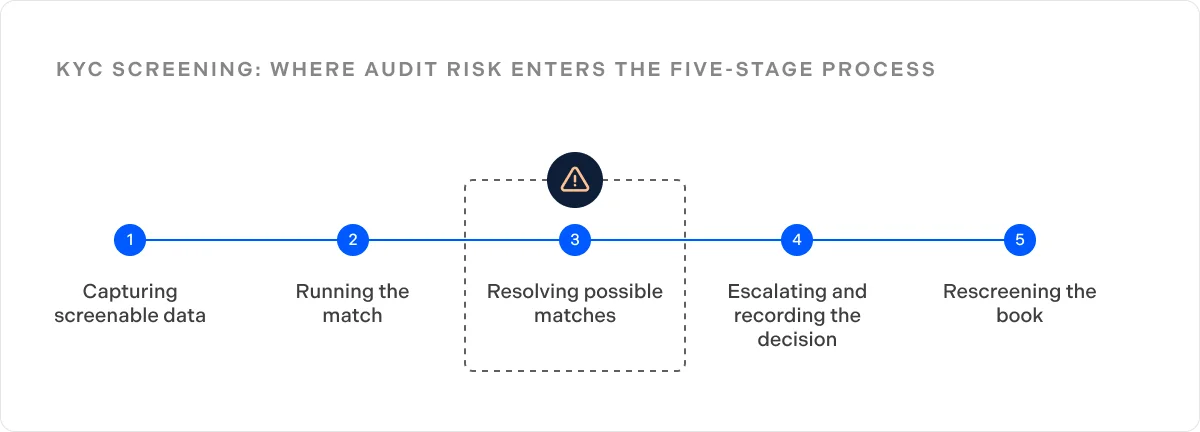
KYC screening vs. transaction screening
The Wolfsberg Group Guidance on Sanctions Screening identifies customer screening and transaction screening as the two main controls most financial institutions deploy, each covering exposures the other doesn’t. The table below shows how the two controls differ.
| KYC screening | Transaction screening | |
| What it examines | Customer reference data: names, dates of birth, addresses, ownership | Payment messages in flight |
| When it runs | At onboarding, on list updates, and on data change | At the point of payment |
| What it catches | A prohibited or high-risk customer | A prohibited counterparty, destination, or intermediary |
| What it misses alone | A clean customer paying a sanctioned third party | A sanctioned customer transacting only domestically |
A customer who passes KYC screening can still send funds to a designated party, and an institution relying only on transaction screening has no verified record of who it has onboarded. Running one without the other is a documented control failure. Read more: What Is Watchlist Screening? [Everything You Need to Know]
When KYC screening is required
KYC screening must run at specific points across the customer lifecycle. Most institutions manage onboarding adequately, but the post-onboarding triggers are where enforcement findings accumulate. The table below covers when each trigger applies and what the record must show.
| Trigger | When it applies | What the record must show |
| Onboarding | Before the relationship begins | Date, database version, match or no-match result, disposition, and reasoning for any discounted hit |
| Continuous rescreening | Continuously, because lists update without notice and a customer clean on Monday can be designated on Tuesday | Evidence of screening runs, including the specific lists queried and the date |
| Customer data changes | New director, change of address, revised ownership structure, or updated identity documents | Evidence of a fresh screen triggered by the change, with results reviewed and dispositioned |
| Material relationship changes | New product, new jurisdiction, significantly changed transaction profile | Evidence that the expanded scope was assessed and the risk rating updated |
The FinCEN Customer Due Diligence Rule and FATF Recommendation 10 both address the ongoing monitoring obligation. Screening only at onboarding and during scheduled periodic reviews leaves months in which a designation can go undetected in the institution's book. Read more: Customer Risk Assessment: Everything You Need to Know
What regulators consistently find in KYC screening programs
The four failure modes below account for most of what enforcement actions document.
Poor data quality in captured records
The Wolfsberg Group's sanctions screening guidance states that screening effectiveness depends on the type, availability, completeness, and quality of the data an institution holds. Records with misspelled names, missing dates of birth, or incomplete addresses can’t be screened accurately by any engine. Because screening runs on what was captured at onboarding, data collection is itself a screening control.
Fuzzy matching thresholds set at a default nobody documented
Fuzzy matching lets a screening engine catch "Mohammed" against "Muhammad," which is necessary because designated parties don’t transliterate their names consistently. Most institutions inherit a vendor default and never revisit it, leaving the most consequential setting in the program undocumented and unowned. A threshold set too tight misses names from non-Latin-script jurisdictions, and one set too loose fills the queue with obvious non-matches that train analysts to close quickly and stop reading carefully.
False negatives overlooked in favor of false positive management
Reducing false positives is worthwhile work because high alert volume genuinely degrades review quality, but a program optimized purely for volume reduction can miss a more consequential failure. Overly tight thresholds and narrow adverse media coverage cause the program to stop surfacing real risk. Missing beneficial ownership data adds a third blind spot that no alert volume reduction will fix. False positives frustrate analysts, but false negatives stay invisible until an enforcement action makes them visible.
Alert volume that buries real hits
At institutions running poorly calibrated screening systems, false positive rates run high enough that analysts clear alerts on reflex, not on reasoning. The 400th false positive of the day gets three seconds rather than three minutes of attention, and the one genuine hit in the queue looks identical to every irrelevant one before it. Reducing false positives in AML screening is a detection quality requirement, not an operational convenience. 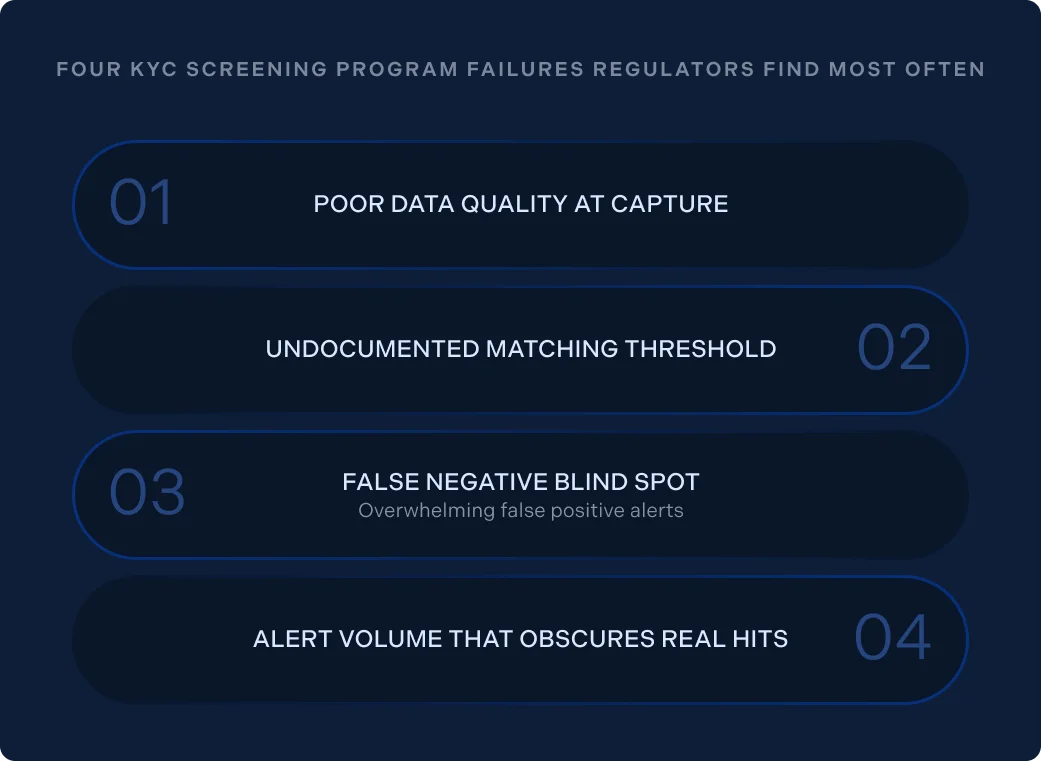
How Sigma360 addresses KYC screening
Sigma360 runs on 100B+ data points across 150+ corporate registries with proprietary intelligence, so alias coverage, transliteration handling, and entity relationship resolution reflect data the platform controls and maintains directly. Every screening decision produces documented reasoning by default, which means the audit trail builds as the program runs. Banks, fintechs, payments firms, asset managers, and regulated corporates use the platform to run KYC screening programs that reduce false positives by 93% in proof-of-concept testing and cut manual match reviews by up to 90%. Four capabilities address the failure points covered in this article:
- Match Agent: Scores and auto-clears identifiable false positives before analyst review, with per-institution thresholds and explainable logic attached to each discounted hit, so cleared matches leave an auditable record with documented reasoning
- Entity Summary: Pulls KYC data, watchlist hits, adverse media, corporate registry detail, and network relationships into a single structured record for each entity, so analysts have the full picture at the match resolution stage
- Adverse Media Summary: Consolidates related coverage into a single structured story grouped by event and materiality, replacing scattered article-level results with an output analysts can assess, act on, and record
- Perpetual KYC: Monitors every customer against live sanctions lists, PEP registers, registries, and adverse media on a continuous basis, so a designation or adverse media event triggers an alert when it occurs rather than at the next scheduled review date
Request a demo to see the platform's match resolution and continuous monitoring in practice.
FAQ
Does KYC screening work the same way for individuals and legal entities?
Not exactly. Individual screening matches name, date of birth, and nationality, while entity screening also has to resolve the ownership structure and screen each beneficial owner separately. A legal entity with a clean name can still be owned by a sanctioned individual that a name-only check won’t surface.
Why does the same name produce different screening results across platforms?
Match quality depends on how a platform handles aliases, transliterations, and name-order variation. A name written in Arabic, Cyrillic, or Chinese generates multiple romanized forms, and two platforms screening the same input against the same list can return different results if one applies phonetic and transliteration matching and the other doesn’t.
What is the difference between a false positive and a false negative in KYC screening?
A false positive is an alert on a name that’s not the listed party. A false negative is a missed match on a name that is. False negatives carry the larger exposure because they stay invisible until an examination or enforcement action makes them visible.
What data does an institution need to screen customers effectively?
For individuals: full legal name, date of birth, nationality, and country of residence. For entities: legal name, jurisdiction of incorporation, and beneficial ownership structure. A record missing a date of birth leaves the engine matching on name alone, which raises both false positives and the risk of missing a true match on a common name.
How often does KYC screening need to run after onboarding?
The FinCEN CDD Rule requires ongoing monitoring but prescribes no fixed rescreening frequency, leaving the schedule to each institution's risk-based policies. Continuous monitoring against live data feeds is the stronger operational approach because it triggers an alert on a sanctions designation or PEP status change when it occurs and doesn’t leave exposure undetected until the next scheduled run.

