
Financial crime risk management (FCRM) governs how financial institutions manage their exposure to money laundering, fraud, sanctions violations, and terrorist financing across every stage of the customer lifecycle.
When programs are well-designed, controls connect. Screening flags a risk, monitoring tracks it, investigations resolve it, and every decision is documented. However, most programs run those controls in isolation, and risk that should be caught in one system waits for the next scheduled review in another.
In October 2024, FinCEN issued its largest-ever penalty against a US depository institution ($1.3 billion) after finding that TD Bank had willfully failed to file suspicious activity reports on thousands of transactions totaling around $1.5 billion, the result of a decade of program-wide compliance failures.
This guide explains how FCRM works in practice and what it takes to build a program that detects real risk and holds up under examination.
Key takeaways:
- FCRM and FCC are distinct disciplines
Compliance meets the regulatory minimum, while FCRM is the active discipline of understanding where actual exposure is and keeping controls calibrated to it. - Most program failures trace back to program design
Fragmented data, point-in-time screening, and miscalibrated controls are the most common examination findings, regardless of which tools the program uses. - Risk-based programs allocate scrutiny proportionally
Applying the same thresholds across all customers concentrates effort in the wrong places and leaves high-risk relationships under-scrutinized. - Program effectiveness requires different metrics than regulatory outputs
False positive rate, alert-to-case conversion, and control coverage indicate whether an FCRM program is performing. Filing SARs and clearing alerts confirm it is running. - Integrated platforms make FCRM work in practice
Sigma360 connects screening, monitoring, investigation, and audit trails into one program so risk intelligence reaches the right analyst at the right time.
What financial crime risk management covers
A mature FCRM program covers eight interconnected functions, each addressing a different point of exposure across the customer and counterparty lifecycle.
The core components of an FCRM program are:
- Risk assessment: Identifying the specific financial crime risks an organization faces based on its customer base, products, geographies, and transaction volumes; providing information on how controls are calibrated and where resources are concentrated
- Customer due diligence (CDD) and KYC: Verifying customer identity, understanding the nature of the business relationship, and assessing the customer’s risk profile at onboarding and throughout the lifecycle
- Sanctions and watchlist screening: Screening customers, counterparties, and transactions against government-issued sanctions lists, politically exposed persons (PEPs) databases, and adverse enforcement records to identify prohibited relationships or restricted activity
- Adverse media monitoring: Scanning global news and public records for negative signals that may indicate financial crime exposure, including fraud allegations, regulatory enforcement actions, corruption investigations, and criminal proceedings
- Transaction monitoring: Using rules-based and AI-driven systems to identify anomalous patterns in payment activity and route them to analysts for review and potential reporting
- AML investigations: Reviewing flagged activity, gathering supporting evidence, making disposition decisions, and filing suspicious activity reports (SARs) where required
- Perpetual KYC: Running continuous customer monitoring so that changes in sanctions exposure, ownership structure, or adverse media trigger timely risk reviews instead of waiting for the next scheduled check
- Regulatory reporting: Filing currency transaction reports (CTRs), SARs, and other mandatory disclosures with the relevant financial intelligence units in each jurisdiction
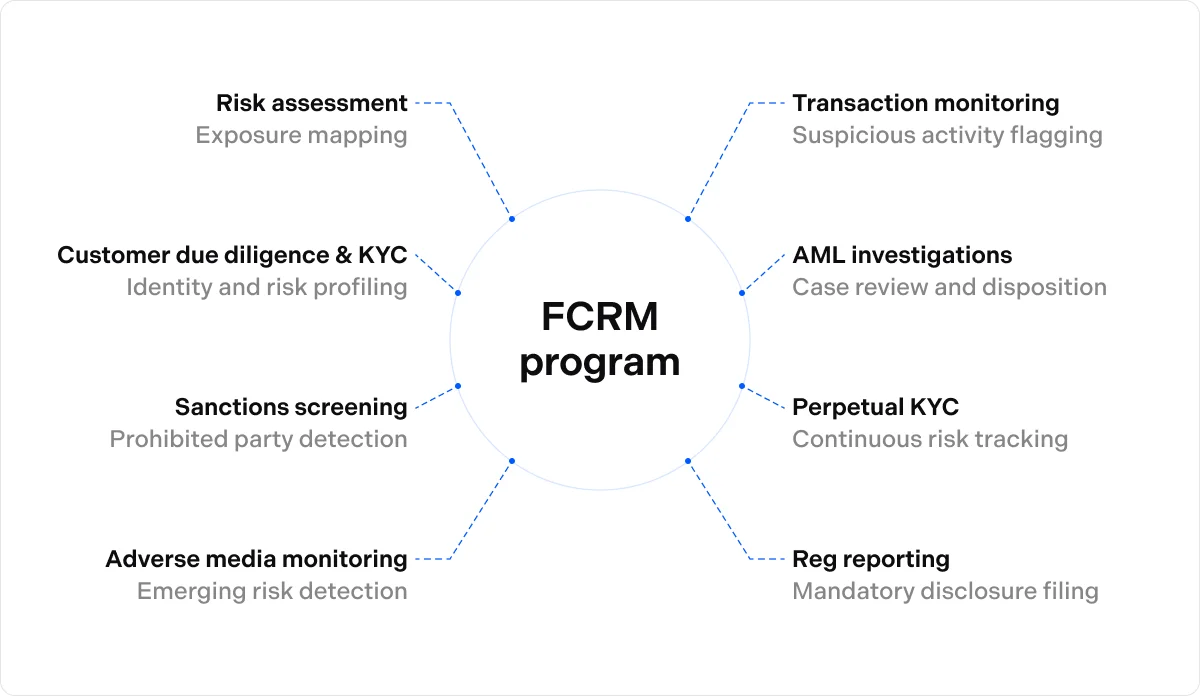
These components do not operate independently. An effective FCRM program connects them so that risk intelligence flows between controls rather than accumulating in separate systems.
FCRM vs FCC: What’s the difference?
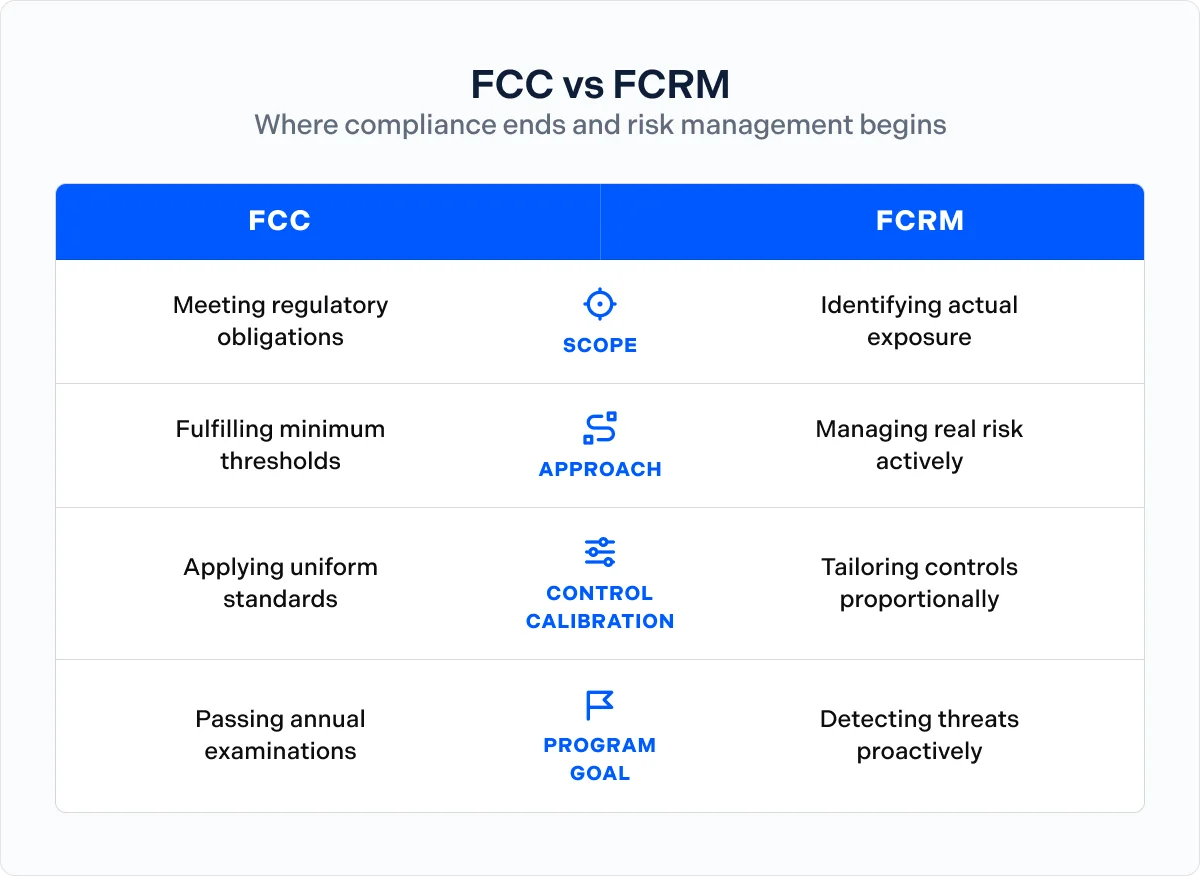
Financial crime compliance (FCC) covers the legal and regulatory obligations institutions must meet. That means maintaining an AML program, screening against sanctions lists, filing SARs, and conducting customer due diligence. In other words, FCC defines the floor: the minimum the law requires.
Financial crime risk management is the active discipline of understanding where an organization’s actual exposure is, how well its controls perform against that exposure, and what needs to change when the risk environment evolves.
The difference is most obvious in how programs are built and where controls are focused.
Compliance-led programs tend to apply the same thresholds uniformly, screening everyone according to one standard and running identical monitoring rules across all transaction types. Conversely, risk-led programs allocate controls proportionally, concentrating scrutiny where risk concentration is highest and scaling back where it is lower.
The main categories of financial crime
The table below outlines the main categories of financial crime, the typical execution of each, and the controls an FCRM program uses to address them.
| Financial crime type | Description | Primary regulatory focus |
| Money laundering | Concealing the proceeds of criminal activity by moving funds through legitimate financial channels | AML programs, transaction monitoring, SAR filing |
| Terrorist financing | Raising and transferring funds to support terrorist activity, often through small transactions designed to avoid detection | CFT controls, sanctions screening, PEP monitoring |
| Sanctions evasion | Circumventing economic sanctions through shell companies, correspondent relationships, or misrepresented transactions | OFAC, UN, EU, and UK sanctions screening |
| Fraud | Obtaining financial benefit through deception, including identity fraud, invoice fraud, and account takeover | Customer verification, transaction monitoring, fraud monitoring |
| Bribery and corruption | Making improper payments to influence business or government decisions, often linked to PEPs and state-owned enterprises | EDD, PEP screening, adverse media monitoring |
| Tax evasion | Deliberately misreporting income or assets to reduce tax liability, often involving offshore structures | Beneficial ownership screening, corporate registry checks |
| Trade-based money laundering | Disguising illicit funds through commercial trade transactions, typically using mis-invoiced goods or services | Counterparty screening, trade finance monitoring |
The exposure profile varies by institution type:
- Banks encounter the full range of financial crime types, from money laundering and sanctions evasion to fraud and trade-based schemes.
- Fintechs and payments companies carry elevated fraud and sanctions risk due to transaction speed and customer volume.
- Asset managers face greater exposure to bribery, corruption, and beneficial ownership complexity.
Across all three, miscalibrated controls are one of the most consistent findings in regulatory examinations.
Where FCRM programs break down
Most enforcement findings trace back to five recurring program weaknesses, regardless of the tools in place.
1. Fragmented data and disconnected systems
When adverse media, sanctions, KYC records, and transaction data are spread across separate platforms, analysts cannot build a complete picture of a customer’s risk. Information that would trigger a review in one system often fails to reach another.
That is a program design problem at its core. Adding more tools without integrating them makes the architecture more complex without making the program more effective.
Read more: How Sigma360 and Stack21 are helping firms escape the Frankenstack trap
2. Point-in-time screening that misses dynamic risk
Periodic KYC reviews and static onboarding checks were designed for a slower risk environment, where customer risk profiles changed infrequently between review cycles.
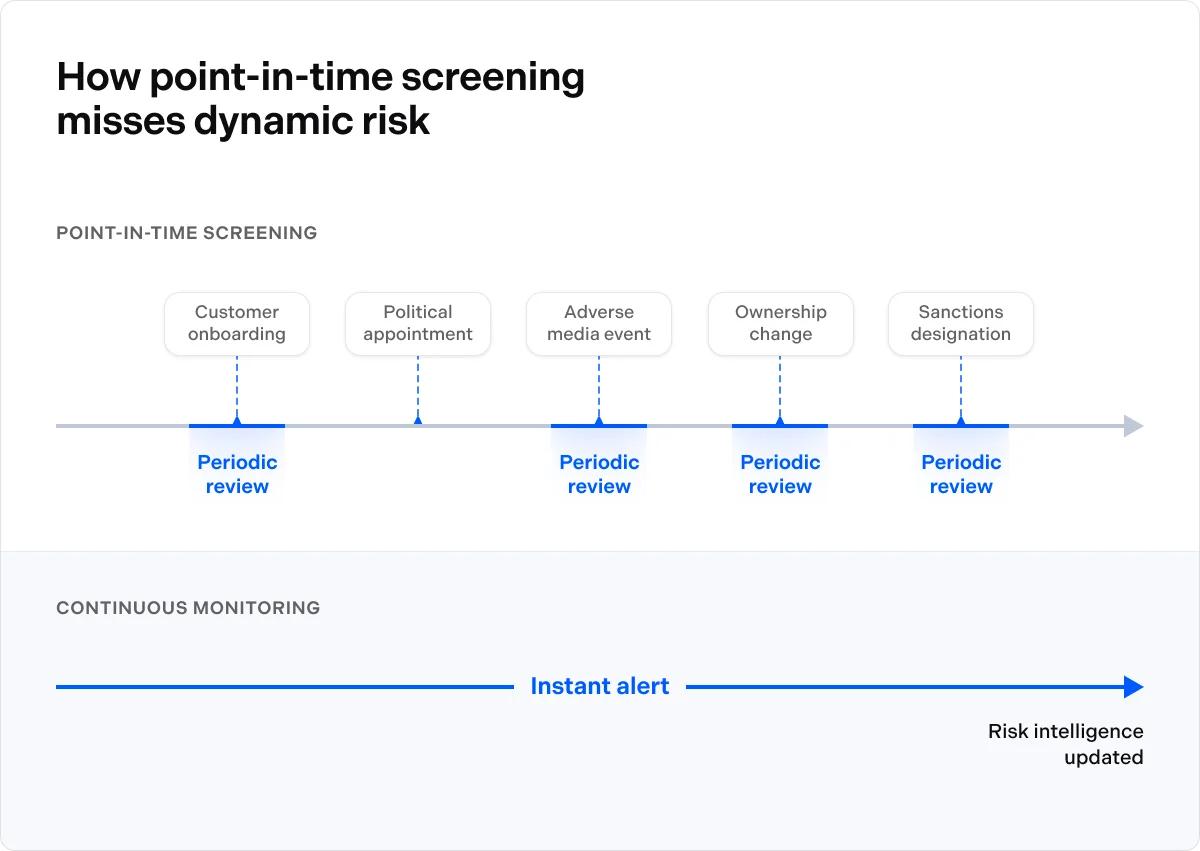
A customer who passes a clean check at onboarding may become a PEP through political appointment six months later, or appear in adverse media coverage of a criminal investigation a year after that.
Programs that rely on scheduled reviews rather than continuous monitoring will consistently lag behind the risk they are meant to manage.
3. Alert volumes that exceed analyst capacity
High false positive rates mean material alerts get buried under a backlog of irrelevant matches, leaving analysts less time for the cases that warrant genuine investigation.
According to a Federal Reserve working paper, large language models applied to sanctions screening reduced false positives by 92% compared with fuzzy matching baselines, illustrating the scale of the problem legacy approaches create.
4. Uniform controls applied to heterogeneous risk
Applying the same screening thresholds, the same monitoring rules, and the same review cadence to all customers regardless of their risk profile is inefficient and counterproductive.
It concentrates analyst effort in low-risk areas while leaving high-risk relationships under-scrutinized, and it is one of the most reliable signals regulators look for during examinations.
5. Institutional knowledge that does not scale
In many compliance programs, experienced analysts carry detailed contextual knowledge about specific customers, counterparties, and risk typologies that is never formally documented. When analysts leave, or when programs need to grow, undocumented knowledge does not transfer.
Documented risk assessments, standardized case notes, and decision records with clear reasoning address that problem directly. They are what makes a program scalable, consistent, and defensible under examination.
What a risk-based FCRM program looks like
Allocating scrutiny proportionally means concentrating controls where actual exposure is highest. For most programs, that requires:
- Segmenting customers by risk tier based on factors including geography, industry, transaction behavior, product type, and ownership structure, and applying different CDD standards, monitoring rules, and review cadences to each tier
- Calibrating screening thresholds to the specific risk characteristics of each customer segment, so that high-risk customers face stricter matching criteria and lower-risk customers do not generate disproportionate alert volumes
- Triggering event-based reviews when a customer’s risk profile changes (new adverse media coverage, a sanctions designation, an ownership change, a variation in transaction patterns) instead of waiting for the next scheduled review cycle
- Designing monitoring rules around the specific financial crime typologies relevant to the institution’s products and customer base, and updating those rules as typologies evolve
- Documenting the reasoning behind risk appetite decisions, control calibration choices, and individual case dispositions, so that the program can demonstrate to examiners not just what it did, but why
The FATF risk-based approach guidance provides the international framework for this approach. FinCEN’s national AML/CFT priorities and the FCA Financial Crime Guide reflect the same expectations across the US and UK, requiring programs to be built around real risk and institutions to demonstrate why each control decision was made.
Read more: Federal Reserve’s proposed risk-based AML/CFT rule
How to measure whether your FCRM program is working
Most institutions track regulatory outputs: SARs filed, alerts reviewed, audits passed. These confirm activity but say nothing about effectiveness.
The metrics that indicate real program performance are:
- False positive rate: The proportion of alerts that close as non-suspicious after review. High false positive rates signal that screening thresholds or monitoring rules are poorly calibrated to the institution’s actual risk profile.
- Alert-to-case conversion rate: The proportion of alerts that escalate to a case requiring investigation. Low conversion rates suggest that most alert volume is low quality, which points to a monitoring design problem.
- Time-to-decision: The average time from alert generation to disposition. Extended review times may reflect understaffing, but more often, they are related to poor data quality, disconnected systems, or unclear escalation paths.
- SAR filing accuracy: The proportion of SARs that are complete, accurate, and filed within required timeframes. Errors and late filings indicate process failures upstream.
- Risk assessment refresh frequency: The regularity with which the institution updates its enterprise risk assessment to reflect changes in its customer base, products, geographies, and the external threat environment. An outdated risk assessment means controls are calibrated to a risk profile that no longer reflects the institution’s actual exposure.
- Control coverage: The proportion of the customer and transaction population that is actively monitored, as opposed to exempt or excluded from controls. Populations left outside active monitoring represent exposure the program cannot see or report on.
Tracking these metrics against program decisions, and using them to drive adjustments, is what separates a program that improves from one that only persists.
Read more: How AI cuts AML delays and regulatory risk
How Sigma360 supports financial crime risk management
Sigma360’s risk intelligence platform addresses the integration challenge at the core of most FCRM programs. Instead of running screening, monitoring, and investigation data through separate tools, it connects them into one view so that risk signals reach the right analyst at the right time.
- Consolidated risk intelligence: Sigma360 analyzes over 100 billion data points across global watchlists, corporate registries, adverse media sources, and proprietary derived intelligence, giving compliance teams a unified, connected view of customer and counterparty risk.
- Continuous monitoring across the portfolio: Sigma360 monitors every customer and counterparty continuously, triggering risk reviews when material changes occur in sanctions exposure, ownership, or media coverage instead of waiting for the next scheduled review cycle.
- AI-driven alert triage: Sigma360’s Match Agent uses entity resolution and AI to clear low-quality false positives before they reach analyst queues, reducing manual match reviews by 90%. The Adverse Media Summary consolidates related news coverage into a single contextualized story so analysts review a coherent risk narrative instead of an unfiltered results queue.
- Investigation efficiency: Sigma360’s Entity Summary generates comprehensive risk summaries at the start of each AML investigation, drawing on KYC data, watchlist records, corporate registry information, adverse media, and proprietary research, so investigators focus on decisions instead of assembling data.
- Audit-ready decision trails: Every analyst decision, alert disposition, and risk review is logged automatically, creating the auditable record that regulators expect and that manual programs struggle to produce consistently.
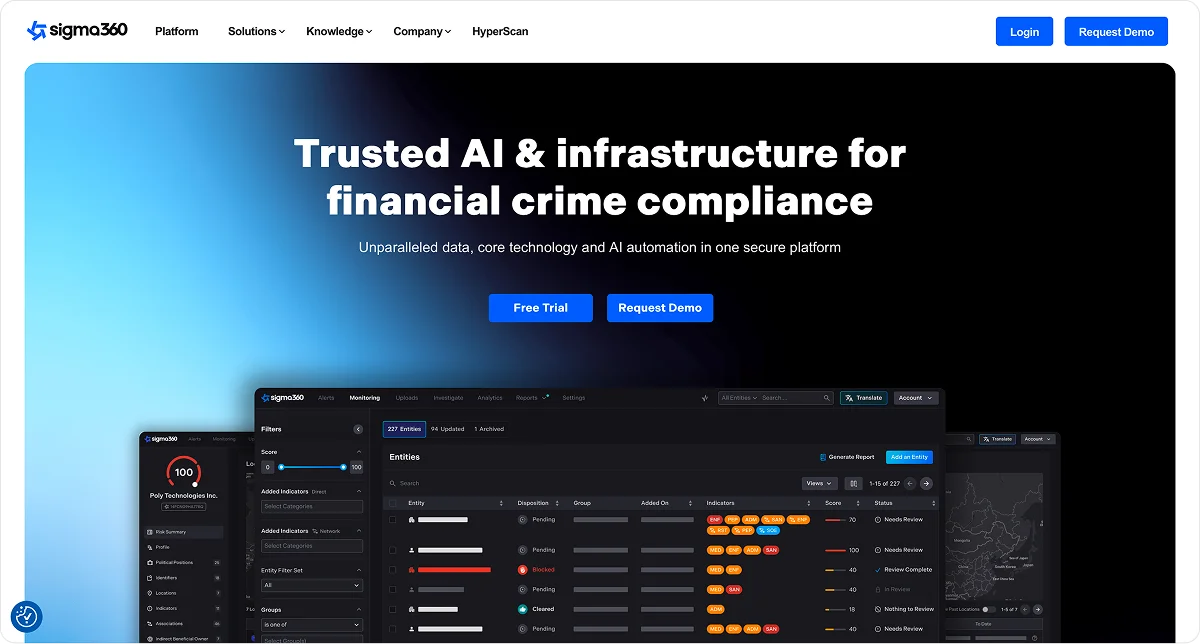
Speak to a compliance expert to see how Sigma360 can connect the components of your FCRM program into one audit-ready intelligence layer or request a demo to see the platform in action.
FAQ
What is the difference between AML compliance and financial crime risk management?
AML compliance covers the specific regulatory obligations institutions must meet, from filing SARs and conducting CDD to screening against watchlists.
FCRM is broader, covering fraud, bribery, sanctions evasion, and other crime types, and focuses on actively identifying and prioritizing exposure instead of meeting the minimum the law requires.
Who is responsible for financial crime risk management within a financial institution?
Accountability for FCRM typically rests with the Chief Compliance Officer or a dedicated financial crime function, with input from risk, legal, technology, and senior management.
How often should a financial crime risk assessment be updated?
Regulators generally expect risk assessments to be reviewed at least annually, and updated whenever material changes occur, such as a new product line, a new market, or a significant change in customer mix.
Institutions with more dynamic risk profiles should build more frequent review cadences into their program design.
What role does technology play in FCRM?
Technology automates high-volume tasks such as screening, alert generation, and evidence collection, and improves the quality of risk intelligence available to analysts. Risk appetite decisions and case dispositions still require human judgment and auditable reasoning regardless of how much automation the program deploys.
What are the most common reasons FCRM programs fail regulatory examination?
Recurring examination findings include outdated risk assessments, monitoring systems not calibrated to the institution’s actual risk profile, incomplete CDD for high-risk customers, and insufficient documentation of risk-based decisions. Most of these failures trace back to program design instead of individual control failures.

