
Most AML programs generate far more alerts than the team can act on. Research shows that only 2–4% of transaction monitoring alerts produce a suspicious activity report, which means compliance teams spend most of their capacity on activity that yields no actionable results. In most programs, the customer risk scoring system drives that imbalance. The same model that floods the queue with low-risk alerts will clear a customer who needed deeper due diligence at the standard tier, while the high-volume account that warranted tighter thresholds runs at default settings until a scheduled review finds it months later, with the exposure already on the books. This guide explains how AML risk scoring models are built, where calibration breaks down, and what it takes to build a program that directs scrutiny to where the risk actually is.
Key takeaways
- AML risk scoring converts customer data into a risk tier that drives every compliance decision downstream
A miscalibrated score propagates errors across the entire program without producing an immediate signal that something is wrong.
- Weighting is the institution's own documented responsibility
No regulator mandates a formula, so the institution must justify every weight, and weights without documented rationale are among the most common targets of examiner scrutiny.
- Rule-based, hybrid, and machine learning models each suit different programs
The right architecture depends on the institution's data quality and risk profile, and on how much explainability the program must demonstrate to regulators.
- Scoring programs most often fail at the design and governance stage
Weighting drift, missing behavioral baselines, and validation treated as a one-time event are the most common failure modes, and all three trace back to decisions made before the model ran in production.
- Tracking key metrics between formal validations is the earliest warning a scoring model has drifted
Alert-to-SAR conversion rate, override frequency, and review cycle adherence each signal a specific calibration failure before the next scheduled validation catches it. Sigma360's risk intelligence platform tracks these indicators continuously across the full customer portfolio.
What is AML risk scoring?
AML risk scoring assigns each customer a risk score reflecting their likelihood of involvement in money laundering or financial crime. This score governs the depth of due diligence at onboarding and how sensitively the relationship is monitored thereafter. Every scoring model must account for two distinct layers of risk, and regulators expect both to be documented separately. Inherent risk is raw exposure before any controls are applied, whereas residual risk is what remains after controls are applied and their effectiveness is tested. AML risk scoring isn’t the same as an enterprise-wide AML risk assessment. The enterprise assessment evaluates institutional exposure across the entire business (products, geographies, channels, customer segments), while customer risk scoring translates that institutional picture into a per-customer decision. They feed each other but carry different documentation obligations. 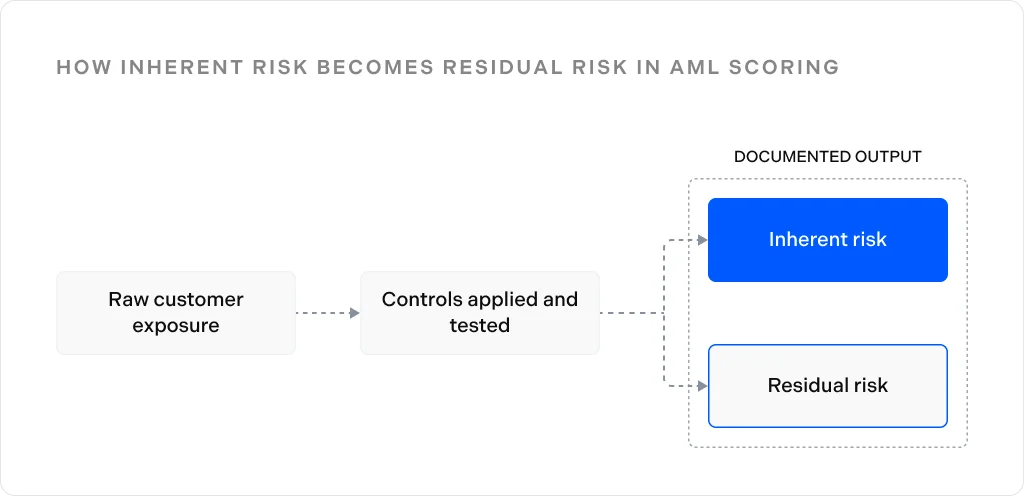
What AML risk scoring measures
The final score draws on four input categories, each contributing a weighted value. This table covers each category's key inputs and the reason it signals elevated risk:
| Risk factor | What it measures | Why it signals risk |
| Customer and entity | PEP status, legal form, ownership structure, source of funds, adverse media | Criminals more frequently exploit complex structures and high-risk profiles for layering and concealment |
| Geographic | Country of residence, nationality, incorporation jurisdiction, operational footprint | Some jurisdictions carry significantly elevated ML/TF risk due to regulatory weakness, corruption, or sanctions exposure |
| Product and service | Cash-intensive products, private banking, non-face-to-face onboarding, prepaid instruments | Higher-anonymity products and delivery channels create greater opportunity for abuse |
| Transaction and behavior | Transaction volumes, cross-border flows, counterparty patterns, deviation from account baseline | Behavior-based signals capture how a customer's risk profile evolves after onboarding, which static declarations at the point of entry can’t |
Geographic risk multiplies across dimensions rather than averaging out. When a customer's country of incorporation, source of wealth location, and counterparty domicile each carry elevated risk independently, those risks should reinforce each other in the model, not wash out to a midpoint. A model that averages geographic signals will systematically understate exposure for customers with complex cross-border footprints. When a customer's product usage changes, it’s a risk signal in itself that warrants score recalibration independent of transaction behavior. For instance, a customer who opens a standard savings account and later begins using prepaid cards and digital wallets has shifted their product exposure in a way the original score no longer reflects. Programs that only recalibrate in response to transaction anomalies miss product-level risk changes entirely.
How an AML risk scoring model is built
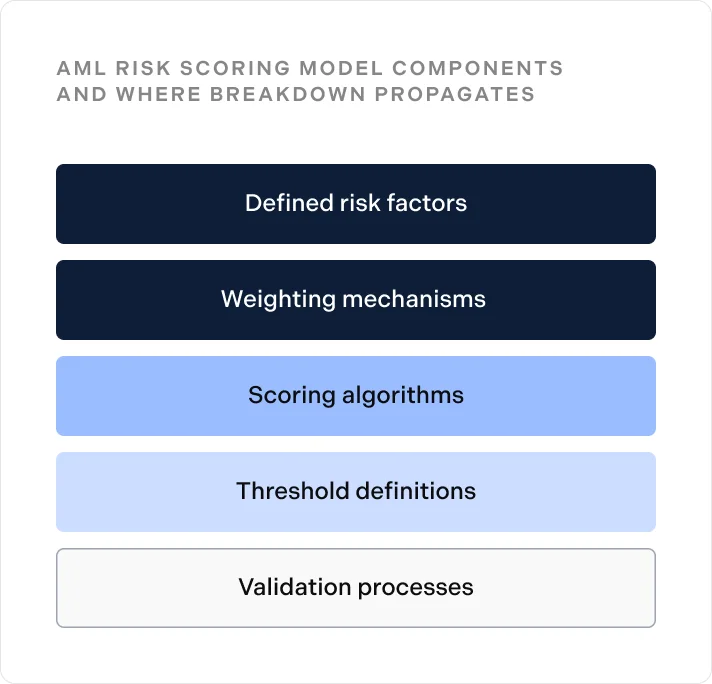
Five components make up the architecture of any functional AML risk scoring model, regardless of underlying technology:
- Defined risk factors: The inputs with documented correlation to money laundering behavior. Rather than a generic industry checklist lifted from regulatory guidance, the selection should reflect who the institution serves and what products it offers.
- Weighting mechanisms: The relative importance assigned to each factor, and where most examination findings originate. FATF and the FFIEC BSA/AML Examination Manual set no mandated formula, so the documented justification for every weight must come from the institution itself. Inherited weights or vendor defaults rarely survive scrutiny without one.
- Scoring algorithms: The logic that aggregates weighted factors into a single numerical output or categorical tier. The result must be reproducible: two analysts running the same data through the same model should reach identical results, because inconsistency across analysts is itself a regulatory finding.
- Threshold definitions: The boundaries that translate a score into a risk tier and determine which controls follow. Thresholds set too broadly flood the analyst queue with over-classified accounts, while those set too narrowly let genuine exposure pass through at standard scrutiny levels.
- Validation processes: The ongoing confirmation that the model performs as designed, but calibration has a shelf life. Weights built for one population become inaccurate as the institution grows into new segments or new markets, and no automated monitoring detects that drift unless the institution builds it into the governance framework.
 Read more: Customer Risk Assessment: Everything You Need to Know
Scoring model types: Rule-based, hybrid, and machine learning
Model architecture is a compliance decision as much as a technical one. The right choice depends on the institution's data infrastructure, risk profile, and the explainability standard the regulatory environment demands. Here’s how the scoring model types compare across the dimensions that count most for regulated AML programs:
| Model type | How it works | Strengths | Limitations | Best suited for |
| Rule-based | Fixed weights applied to predetermined criteria | Produces transparent, auditable outputs that are straightforward to explain to regulators | Can’t adapt to patterns not anticipated when rules were written | Institutions requiring high explainability; early-stage programs |
| Machine learning | Detects complex relationships across many variables; improves as new data arrives | Catches emerging typologies; reduces false positives | Opaque decision logic creates examination risk and demands rigorous data governance | High-volume programs with mature data infrastructure |
| Hybrid | Applies mandatory rule sets for compliance; uses an ML layer to detect emerging patterns | Balances explainability with adaptability | Requires governance to prevent qualitative overrides from eroding the quantitative model | Most large regulated institutions |
Most mature compliance programs settle on a hybrid approach, and regulators expect to find it in high-volume environments. Rule sets cover mandatory classifications (a confirmed PEP designation carries a minimum risk tier regardless of how other factors score), while the ML layer identifies emerging typologies that static rules would miss. The explainability requirement isn’t optional in any major jurisdiction. If a scoring model can’t produce a traceable record of which factors and weights produced a specific customer's risk tier, it creates examination exposure regardless of how well the underlying methodology performs. Read more: AI in AML Compliance: Benefits, Risks, and Governance
Four ways AML risk scoring programs fail
Most examination findings in this area trace back to four design and governance failures made before the model ran in production.
Weighting drift
A model calibrated to the institution's population at launch will gradually misrepresent risk as the portfolio evolves. The model itself doesn’t break; the institution it was built to describe has changed. Without a defined review cadence, compliance teams are scoring against a population that no longer exists.
Risk-based in name only
The US Treasury's 2024 National Risk Assessment on Money Laundering uses this phrase to characterize programs that apply uniform oversight regardless of what their scores produce. A risk-based approach requires directing enhanced scrutiny to customers who genuinely carry elevated risk. A model that generates high-risk classifications too broadly, or that compliance teams routinely override without documentation, can’t demonstrate that outcome.
Missing behavioral baselines
Without a reference point for normal activity, a scoring model can’t distinguish a genuine anomaly from unusual-but-lawful behavior. The first 90 days of a customer relationship are the window many institutions use to establish each customer's behavioral baseline: transaction frequency, typical counterparties, geographic footprint. Programs that skip this step end up calibrating alert thresholds against industry averages instead of the individual customer's established pattern.
Validation treated as a launch event
Model accuracy degrades without warning when validation is a one-time exercise. The FinCEN CDD Final Rule requires covered institutions to maintain risk-based procedures, and examiners evaluate how well a scoring framework remains calibrated against the institution's actual risk exposure. Annual validation is the floor most examiners expect, consistent with model risk governance frameworks including SR 26-2. An out-of-cycle review should follow any material change to the customer base, product mix, or regulatory environment. If your last validation predates a significant change to your portfolio, it may no longer reflect real program performance. 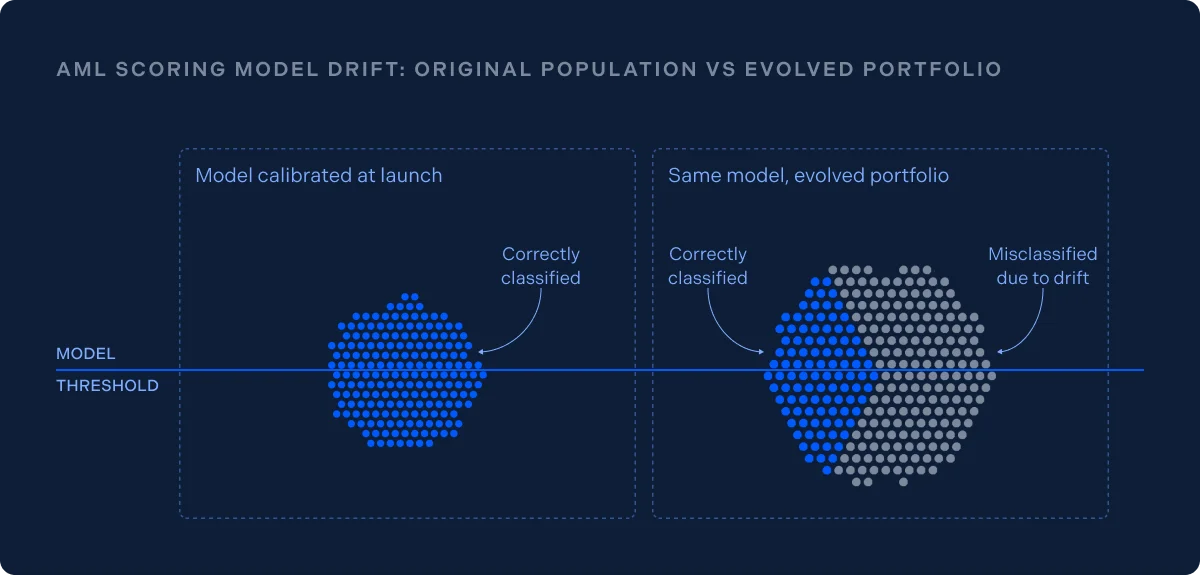 Read more: How to Reduce False Positives in AML Screening
Key risk indicators for AML scoring programs
Between formal validation cycles, metrics provide the earliest signal that something in the model has drifted. These five are the most actionable early indicators of model miscalibration:
- High-risk customer ratio: The percentage of the portfolio classified as high-risk. A ratio that rises over time without a corresponding change in business model or customer mix signals threshold miscalibration.
- Alert-to-SAR conversion rate: The share of generated alerts that escalate to a suspicious activity report. A persistently low rate indicates the model is producing volume without directing scrutiny to genuine risk.
- Override frequency: The rate at which analysts manually reclassify customers away from their model-assigned tier. Frequent overrides in one direction point to a systematic scoring error the next validation cycle should investigate.
- Review cycle adherence: The percentage of high-risk customers whose periodic reviews are completed on schedule. Slippage here points to analyst capacity strain from over-classification.
- Model validation pass rate: The proportion of back-tested scoring decisions that align with subsequent case outcomes. Declining accuracy over successive validation cycles confirms weighting drift.
Read more: AML Automation Guide: Benefits, Tools & Best Practices
What Sigma360 brings to AML risk scoring
 Most AML scoring failures trace back to weak data quality, poor calibration, or decisions that leave no defensible audit trail. Sigma360's risk intelligence platform addresses each issue within the scoring workflow.
Data quality
Accurate scoring depends on complete, well-resolved input data free of entity ambiguity. That’s why Sigma360:
- Pulls entity data from 100B+ data points and 150+ corporate registries into a single scoring environment, so the inputs feeding each risk tier reflect the customer's complete risk picture, including ownership chains and network connections that direct-indicator screening misses
- Monitors adverse media through the Adverse Media Screening module, consolidating related articles into a single risk narrative per entity to improve input accuracy without inflating review volume
- Applies entity resolution via the Match Agent across name variations, transliterations, and aliases, cutting low-confidence matches before they distort risk tiers
Calibration
A model that can’t be recalibrated quickly becomes inaccurate as the portfolio changes. Here’s how Sigma solves it:
- Enables no-code threshold and weight adjustment, so compliance teams recalibrate risk factors as their portfolio evolves without engineering involvement and without losing the documented rationale behind each change
- Tracks the full customer portfolio continuously through Perpetual KYC, generating alerts when risk status changes between formal review cycles and directly addressing the weighting drift and stale-baseline failure modes covered above
Auditability
Every scoring decision needs a traceable record that holds up when examiners ask how a specific customer reached their risk tier. Here’s how Sigma helps build it:
- Logs every scoring decision, analyst override, and threshold change through AI360, giving compliance teams a complete traceable record of which inputs and weights produced any customer's risk tier
- Routes customers classified as high-risk directly into enhanced due diligence workflows, with the audit trail intact from the initial score to the EDD outcome
Request a demo to see how Sigma360's data coverage and configurable risk controls apply to your scoring program.
FAQ
What is the difference between a customer risk score and a transaction risk score?
A customer risk score rates the overall risk a customer presents across their identity, geography, products, and expected behavior. A transaction risk score rates a specific payment event against behavioral signals and real-time context, and the two run as separate controls with distinct inputs and outputs.
Can the same customer carry different risk scores across different products or business lines?
Yes. A retail relationship and a private banking relationship with the same customer may score differently because the product exposure and expected activity differ by business line. Most institutions maintain separate scoring frameworks per business line and reconcile them at the enterprise level.
What should happen to a customer's risk score when their beneficial ownership changes?
It should trigger an immediate reassessment outside the normal review cycle. New ownership may introduce PEP exposure, sanctions links, or high-risk jurisdictions that were absent at onboarding.
How should a scoring model respond when a low-risk customer appears in adverse media?
The adverse media event should recalibrate the score and trigger the appropriate follow-on action: enhanced due diligence, tighter monitoring thresholds, or a full relationship review. Examiners look for evidence that the program detected the change and acted on it, not that the original score was right.
Do risk scores need to be consistent across business lines within the same institution?
The methodology should be consistent in structure, but weights and thresholds can legitimately differ by business line to reflect each line's actual risk profile. Examiners flag inconsistency at the methodology level. Weight differences that are documented and justified don’t draw findings.

