
PEP screening identifies customers, counterparties, and their associates who hold or have recently held prominent public functions (senior government roles, judicial appointments, military commands, executive positions at state-owned enterprises) and flags them for the heightened scrutiny those roles require under AML regulations. A confirmed match still requires accurate risk scoring and a documented decision that holds up years later in an examination, and that’s where most programs remain exposed. Transparency International's 2025 Corruption Perceptions Index, published in February 2026, found that more than two-thirds of countries fail to score above 50, with the global average falling to 42, its lowest point in more than a decade. This guide covers how PEP screening works in practice and where programs tend to break down, from the mechanics of matching to the documentation standard that survives regulatory scrutiny.
Key takeaways
- PEP screening covers more than the named customer
Beneficial owners, directors, authorized signatories, and counterparties all need to be screened, and each category carries its own obligations.
- Relatives and close associates are where most programs have the weakest coverage
Structured PEP databases often lag on RCA relationships, making adverse media monitoring the more reliable signal for network-linked exposure.
- Former PEP status doesn’t end when someone leaves office
Regulators in the EU and UK require at least 12 months of continued enhanced due diligence after departure, and the actual period depends on role seniority, jurisdiction, and ongoing adverse media.
- What regulators examine is whether decisions are documented and justified
Regulators examine whether decisions are documented and justified, and institutions that screened correctly but failed to record subsequent status changes have faced enforcement on the same grounds as those that never screened.
- Sigma360 brings PEP screening, adverse media monitoring, and perpetual KYC into one connected program
Sigma360 is built for institutions where PEP risk is highest, connecting every control in a single entity record so analysts work from one view rather than multiple tools.
What is PEP screening?
PEP screening checks customers, counterparties, and their associates against structured PEP databases. The goal is to identify individuals whose public roles place them in a higher-risk category for financial crime and apply the enhanced due diligence that AML regulations require when a match is confirmed. Regulators in most jurisdictions require institutions to identify PEPs at or before onboarding and apply due diligence proportionate to the risk the individual's role and jurisdiction present, with that obligation continuing for as long as the relationship does. PEP screening sits within the customer due diligence framework and feeds directly into perpetual KYC obligations. A confirmed match opens a higher-scrutiny track that runs for the life of the relationship. Read more: PEP and Sanctions Screening: A Complete Guide for 2026
Who counts as a PEP?
FATF Recommendation 12 defines three core categories (foreign PEPs, domestic PEPs, and international organization PEPs), but most compliance programs extend that to five by treating family members and close associates as a distinct category with its own screening and monitoring obligations. Here’s an overview of all categories:
| Category | Examples | EDD obligation |
| Foreign PEPs | Heads of state, ambassadors, senior foreign ministry officials | Mandatory in all cases |
| Domestic PEPs | Members of parliament, senior judges, senior law enforcement, state enterprise executives | Risk-based |
| International organization PEPs | Senior officials of the UN, IMF, World Bank, EU, NATO | Risk-based |
| Family members | Spouses, children, parents, and siblings of any PEP | Same as the named PEP |
| Close associates (RCAs) | Long-term business partners, personal advisors, known intermediaries | Same as the named PEP |
In most screening programs, relatives and close associates (RCAs) have the weakest coverage. FATF Recommendation 12 requires institutions to take reasonable measures to identify them, but structured databases struggle to keep pace. RCA records are often sparse, and relationship types are left unrecorded. Adverse media monitoring fills the gaps list-based sources miss, because a business associate named in a financial crime investigation or a family member linked to a state contract dispute will appear in public reporting well before a structured database records the connection. Read more: PEP and Adverse Media Monitoring: Connection and Differences
How PEP screening works
Six stages make up a complete, regulator-ready PEP screening program: 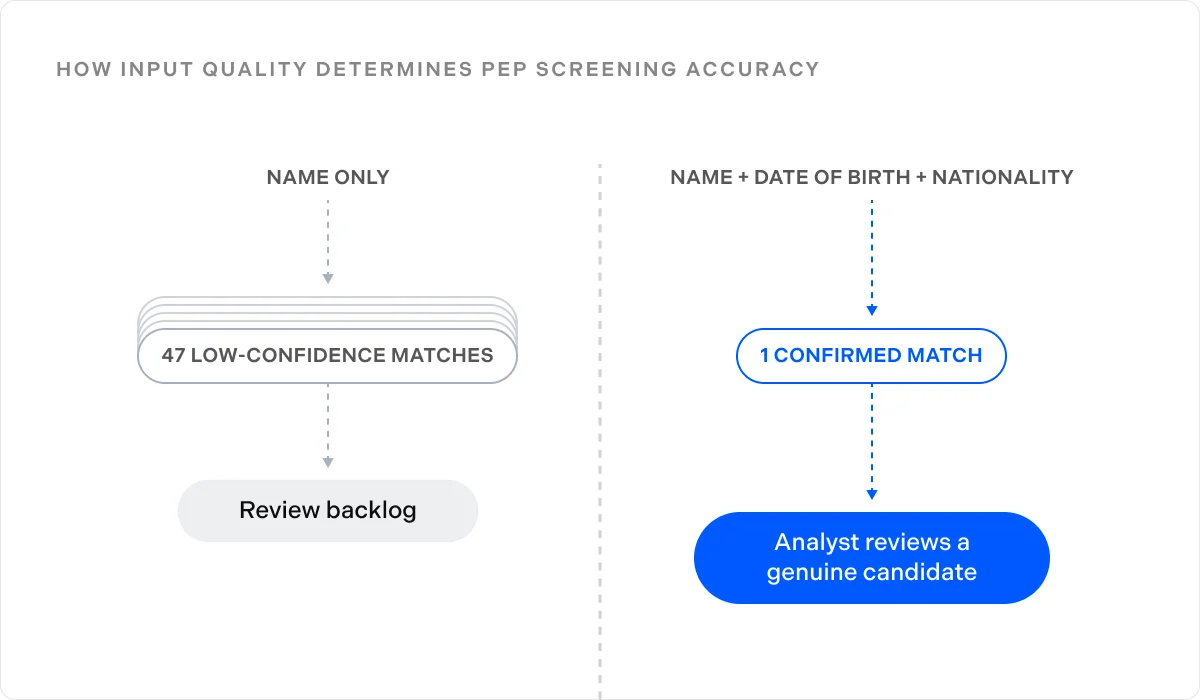
- Collect and verify identity data: Start with clean inputs, including full name, date of birth, nationality, and country of residence, plus beneficial ownership details for corporate customers. A name submitted without a date of birth is the single biggest source of false positives in match results.
- Screen against PEP databases: Run the collected data against commercial PEP databases using fuzzy matching logic that handles name variations and transliterations from non-Latin scripts, including aliases that may not appear in the original record. Simple exact-match searches miss genuine PEPs whose names appear in variant or transliterated form, which is why the fuzzy approach is the baseline requirement for credible screening.
- Score and categorize the risk: Assess the individual's role, jurisdiction, and proximity to public funds, then assign a risk classification of low, medium, or high. A match is an input to that judgment, not the judgment itself.
- Apply enhanced due diligence: Under FATF Recommendation 12, foreign PEPs require enhanced due diligence in all cases. Domestic and international organization PEPs require it where the relationship is assessed as higher risk. In both cases, EDD requires source of wealth and funds verification, documentation of the relationship's purpose, and senior management approval before the relationship opens or continues.
- Document the decision: Record the identifiers used, the match outcome, the risk rationale, the EDD steps completed, and the approval obtained. Without this record, the screening is unverifiable when an examiner asks for it.
- Monitor on an ongoing basis: Ongoing monitoring rescreens against database updates and flags adverse media developments across the lifetime of the relationship, catching newly appointed PEPs before they emerge through other channels. PEP status can change overnight, and the monitoring cadence needs to match that pace.
Who needs to be screened beyond the customer
Limiting PEP screening to the named account holder is one of the most common program design errors. A defensible program extends coverage to four categories of parties:
- Ultimate beneficial owners (UBOs) at or above the 25% ownership threshold required under EU, UK, and US rules
- Directors and officers of corporate customers, regardless of ownership stake
- Authorized signatories with control over the account or relationship
- Counterparties and transaction beneficiaries in cross-border payments and correspondent banking flows
Clearing the named customer without screening their beneficial owners leaves an exposure that a regulator will find. For banks and payments firms, watchlist screening obligations extend to the originator, the counterparty, and the beneficiary across each payment. Correspondent banking chains concentrate PEP-linked fund movement at exactly those three points. 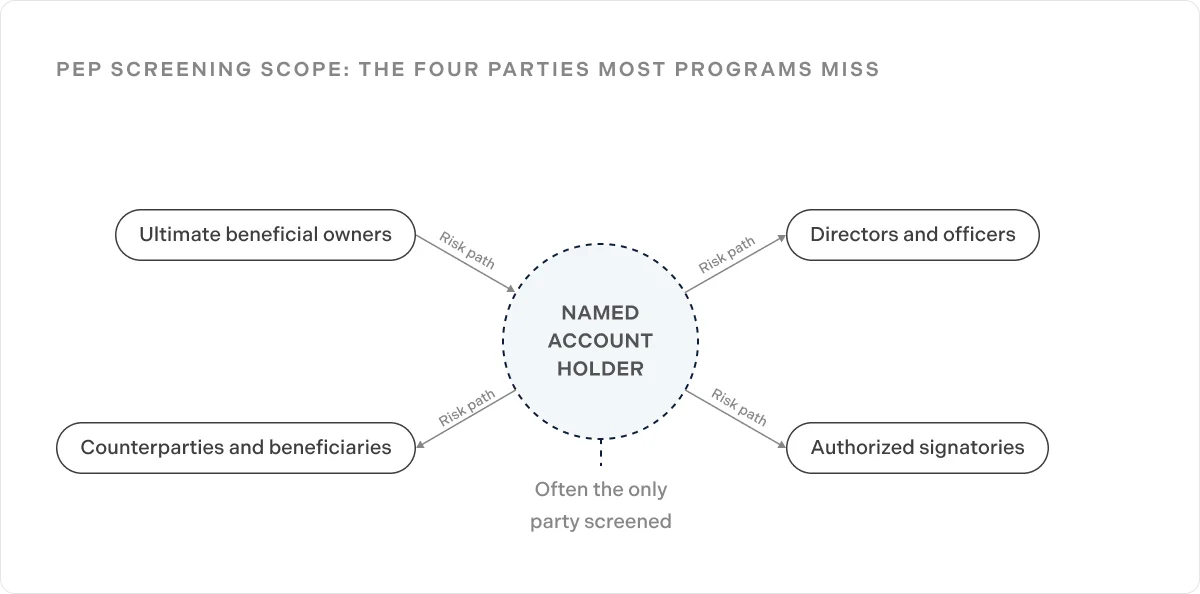
How to evaluate a PEP database
PEP database quality varies considerably across providers, and the differences often remain hidden until an examination exposes them. What gets scrutinized at that point is whether the data underlying those screening decisions was reliable enough to support them. Data reliability is measured by six criteria:
- Coverage that reaches all relevant jurisdictions, including emerging markets and high-risk countries where official records are limited and public data is sparse
- Update frequency that reflects the pace of real-world appointments and departures, with daily or more frequent refreshes
- RCA population that includes family members and known close associates, with relationship types recorded against each entry
- Historical data that retains former PEPs with their departure date and a former PEP status indicator for the post-departure monitoring period
- Name variation handling that captures aliases, alternate spellings, and transliterations across non-Latin scripts
- Source attribution that allows the institution to demonstrate where each data point originated, which becomes the evidentiary basis when an examiner questions a screening decision
A database meeting those criteria may cost more to license than a consolidated third-party list, but the cost of inadequate data becomes apparent when a regulator asks why a PEP who entered office three months before the examination never generated an alert.
How long PEP status applies
FATF Recommendation 12 sets no fixed end date for former PEP status. Institutions must assess residual risk and maintain EDD for as long as that risk warrants, a deliberately open standard that most jurisdictions have anchored by a practical floor. The EU AML Regulation and the UK Money Laundering Regulations 2017 each require at least 12 months of continued EDD after departure, after which a risk-based assessment determines whether the heightened treatment continues. How long scrutiny extends beyond this minimum depends on the seniority of the role held and the corruption environment of the jurisdiction. When adverse media has emerged since departure, or the individual has moved into a position that still draws on their former connections, the risk profile differs from that of someone who has left public life entirely. Perpetual monitoring should continue beyond the minimum window, because conduct risk and adverse media from a prior role can emerge long after departure. The declassification decision requires documentation with the same rigor as the original PEP designation. Institutions that downgrade former PEPs to standard risk without a recorded rationale face the same examination exposure as those that never flagged the relationship at all. The record should set out what was assessed and found, and the institution's reasoning for concluding the risk had diminished to a level that warranted the change. 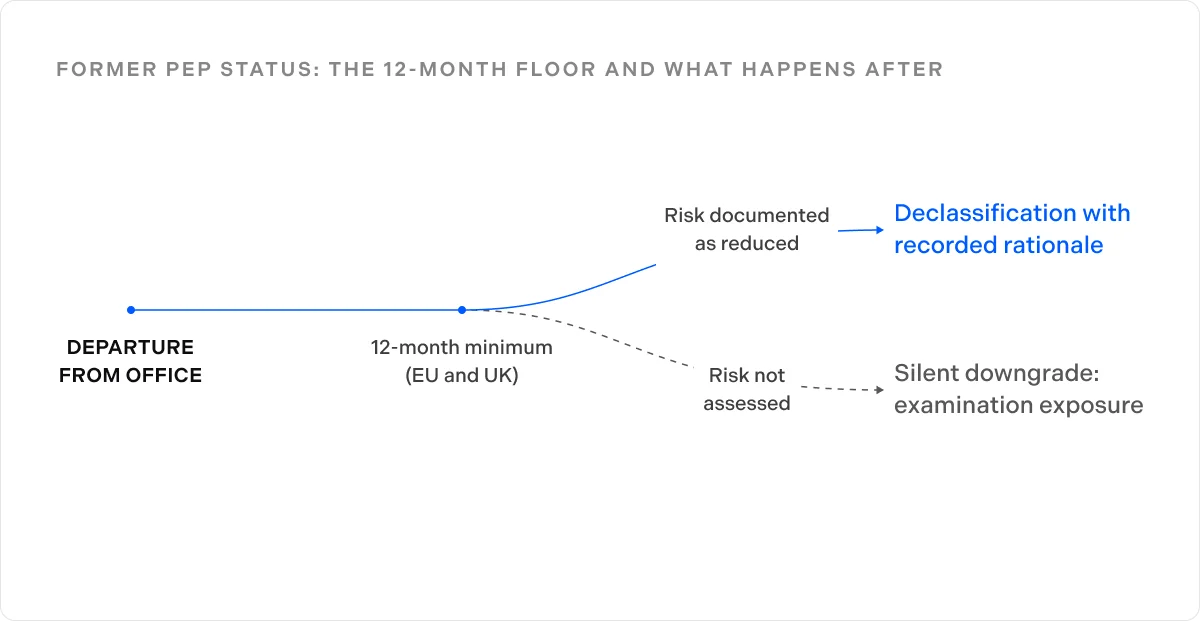
What regulators examine: The audit trail
Regulators assume a PEP program has screening software in place, so they focus on whether decisions are justified and whether the documentation shows how they were reached. The FFIEC BSA/AML Examination Manual and the EBA Risk Factors Guidelines both make it clear that documentation is the substance of compliance. A defensible PEP decision trail must contain:
- The data used for screening, including the identifiers passed to the matching engine
- The match result and the confidence level or scoring methodology applied
- The risk assessment rationale for the customer's assigned risk classification
- The EDD steps completed, covering source of wealth verification, source of funds verification, and the outcome of each step
- The senior management approval, with the approver's name, role, and approval date
- All subsequent monitoring alerts, the analyst's adjudication of each, and the resolution date
Institutions that completed their initial screening but failed to document subsequent PEP status changes or monitoring alerts have faced enforcement on the same grounds as those that never screened at all. When regulators examine a program, they read the audit trail as a documented record of every decision the compliance team made and the reasoning that supported each one.
How Sigma360 handles PEP screening
 Sigma360's risk intelligence platform brings PEP screening, adverse media monitoring, sanctions and watchlist screening, and perpetual KYC into one connected entity record. When a PEP match and an adverse media development appear on the same counterparty, analysts work from one consolidated view rather than piecing together findings from separate tools. Three capabilities address those weaknesses directly:
- Match Agent resolves entity identity before an alert reaches the analyst queue, applying entity resolution across name variations, transliterations, date-of-birth fields, and ownership structures, so analysts are reviewing genuine matches, not clearing name collisions.
- Adverse Media Summary consolidates open-source coverage of a PEP and their associates into a structured narrative organized by theme and time period, giving analysts the conduct context and RCA-linked exposure that list-based databases can’t provide.
- Perpetual KYC monitors the full relationship portfolio as data changes in public reporting, catching new PEP designations and status changes on the data's schedule rather than waiting for a periodic review.
Sigma360 covers 100B+ data points and 150+ corporate registries, backed by SOC 2 Type II and ISO/IEC 27001:2022 certification and 99.9% uptime. Request a demo or speak with a compliance expert to run PEP screening across your full portfolio.
FAQ
Who owns PEP screening decisions within an institution?
Compliance owns the process and the documentation standard, while the business line that holds the relationship owns the accuracy of the customer data that feeds into it. Under FATF Recommendation 12, senior management approval is required for every confirmed PEP relationship before it opens or continues.
Does a false positive on a PEP match still need to be documented?
Yes. Every match requires a documented disposition, whether it resolves as a genuine hit or a cleared false positive. An undocumented clearance carries the same audit exposure as an undocumented confirmed match.
What is the difference between PEP screening and PEP monitoring?
Screening is a point-in-time check that establishes whether someone qualifies as a PEP. Monitoring is the ongoing obligation throughout the relationship, and FATF Recommendation 12 requires both.
Does a customer self-identifying as a PEP satisfy the screening obligation?
No. Institutions must verify PEP status independently against structured databases, covering the named individual, their beneficial owners, and known associates. Self-disclosure informs the risk assessment but doesn’t replace the check.
Does a PEP match on a beneficial owner trigger the same EDD as a match on the account holder?
Yes. The EDD obligation follows the PEP status, regardless of where in the relationship structure it appears. A beneficial owner identified as a PEP requires the same source of wealth verification and senior management approval as the named account holder.
What is the difference between a PEP database and a watchlist?
A PEP database flags elevated risk and triggers a risk-based review with no automatic legal consequence. A watchlist flags legal restrictions such as sanctions or asset freezes, and a confirmed match requires a mandatory compliance response with no discretion to proceed.

