
Agentic AI is the fastest-moving category in financial crime compliance right now, and Bretton AI is one of its most visible entrants.
After rebranding from Greenlite AI in February 2026, the platform deploys AI agents that automate financial crime compliance workflows inside existing infrastructure.
Agent automation and risk intelligence are not the same thing, however, and the difference shapes any honest Bretton AI vs. competitors evaluation, because Bretton does not supply the underlying screening data or entity intelligence its agents act on.
According to Wolters Kluwer’s Q1 2026 Banking Compliance AI Trend Report, 61% of financial institutions have either deployed AI or are actively piloting it for compliance workflows, yet only 12.2% describe their AI strategy as resourced and well-defined.
Programs with weak data at the source, fragmented vendor stacks, or false-positive problems rooted in the data layer will not find those problems solved by automating the investigation on top of them.
Here is how Sigma360 evaluates five alternatives, and where each one falls short.
Key takeaways:
- Bretton AI automates investigations but does not supply the data those investigations run on
Its agents are only as good as the alerts your existing screening system generates, which is the critical distinction for any institution choosing between adding an agent layer and replacing the stack.
- The five alternatives cover five different root causes
WorkFusion and Silent Eight address throughput. Ripjar and ComplyAdvantage address data quality and coverage. Sigma360 addresses throughput, data quality, and fragmentation together. Choosing the right category is more important than choosing the right vendor within a category.
- The EU AMLR and FinCEN’s proposed rule are raising the bar for AI-assisted compliance decisions
Both require decisions that are explainable and traceable. Agent-layer tools that cannot produce a complete record of AI reasoning, distinct from the analyst action, will face increasing scrutiny from 2027 onward regardless of performance.
- Sigma360 is the only platform here where proprietary data, AI agents, and the full investigation workflow are the same vendor’s responsibility
No other platform on this list combines all three, which means a second vendor is always required to complete the compliance workflow.
How we evaluated Bretton AI vs. competitors
Each platform was assessed against five criteria, weighted to reflect where financial crime compliance tools most visibly diverge:
- Data ownership and intelligence depth (30%): Proprietary data coverage across sanctions, PEPs, adverse media, and corporate registries, and the extent of vendor control over the intelligence layer compared to coverage licensed from third-party feeds
- False positive performance and AI explainability (25%): Entity resolution methodology, client-reported production false positive rates, and the ability to produce auditable AI-assisted decisions under FATF Recommendation 10 and its national implementations
- Workflow completeness (20%): Coverage across screening, adverse media, ongoing monitoring, and EDD within a single environment, with no dependency on a second vendor to complete the program
- Deployment realism and integration fit (15%): Time to go live, API availability, and compatibility with existing case management and KYC infrastructure
- Independent validation and segment evidence (10%): Verified deployment evidence across the buyer profiles each vendor claims to serve, cross-referenced against Chartis, Everest Group, and primary regulatory and industry sources
The 5 best Bretton AI competitors in 2026
The platforms below represent five different architectural approaches to financial crime compliance. Here is how they compare:
| Platform | Type | Data Foundation | False positive approach | Best for | Deployment model |
| Sigma360 | Unified risk intelligence platform | Proprietary: 100B+ data points, 150+ registries, 4.5M articles/month | Match Agent reduces manual match reviews by up to 90%; network graph across sanctions, PEPs, adverse media | Tier 1 banks, global financial institutions, fintechs, payments firms, asset managers, and regulated corporates | Low-code, deploys in weeks |
| ComplyAdvantage | AI-native screening platform | Proprietary risk intelligence layer: direct source ingestion, no third-party licensing | Dynamic risk scoring; real-time OFAC update cadence | Fintechs and mid-market teams prioritizing fast API deployment | API-first, fast |
| WorkFusion | AI digital workers platform | No proprietary data layer; agents act on existing screening system outputs | Pre-built agents trained on Level 1 and Level 2 alert patterns | Institutions scaling alert review volume without replacing existing infrastructure | Enterprise, integrates with existing AML stack |
| Ripjar | Risk screening and intelligence platform | ULTRA intelligence engine: sanctions, PEPs, watchlists, adverse media in one environment | AI Risk Profiles reduce analyst workload; Screening Assistant triages alerts | Compliance teams running screening and investigation in a single environment | Enterprise, custom |
| Silent Eight | Policy-bound agentic AI platform | No proprietary data layer; agents execute decisions using institution’s own policies and risk frameworks | Policy-bound agents enforce consistent decisioning; full auditability on every action | Institutions needing governed, auditable AI decisioning across high-volume sanctions, AML, and CDD workflows | Enterprise, integrates with existing compliance stack |
1. Sigma360
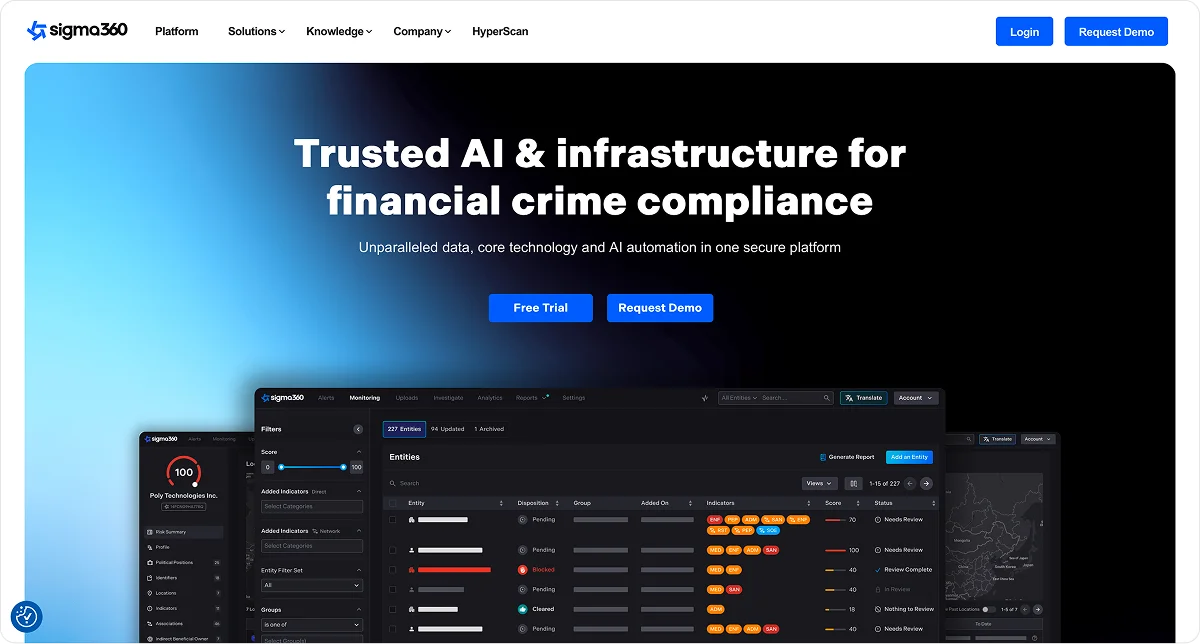
Unlike most agentic AI tools, which automate investigation workflows over third-party screening data, Sigma360 runs its AI agents on intelligence the platform owns.
Chartis Research placed Sigma360 first on technical capability across both screening and adverse media in its 2026 RiskTech Quadrant evaluation, and ranked it #1 in both Adverse Media Solution and Adverse Media Data in the FCC50 2026 for the second consecutive year.
The platform’s proprietary intelligence covers 100B+ data points, 150+ corporate registries, and 4.5M articles processed monthly, giving AI-assisted compliance decisions a depth of coverage that externally licensed data feeds cannot match.
Key features
- Adverse Media Agent groups related articles by materiality and match strength, cutting manual adverse media review time by up to 99%.
- Match Agent clears false-positive alerts using entity resolution and configurable AI scoring, with explainable recommendations or auto-close per-institution thresholds.
- EDD Agent synthesizes watchlist, registry, KYC, and adverse media data into standardized investigation reports.
- AI360 Oversight Dashboard logs every AI action and analyst override for regulatory examination.
- Perpetual KYC triggers alerts when a risk-relevant event occurs for an already-onboarded entity.
Best for
Sigma360 is best for global financial institutions, Tier 1 banks, fintechs, asset managers, payments firms, and regulated corporates, with SOC 2 Type II and ISO/IEC 27001:2022 certification and 99.9% uptime.
Why Sigma360 is the strongest Bretton AI alternative
Institutions running agents on top of a weak screening environment accelerate a compromised triage process without fixing the underlying data problem. Sigma360 removes that dependency and, as a result, a global payments leader documented $1M in annual savings and a 93% reduction in false positives after deployment.
2. ComplyAdvantage
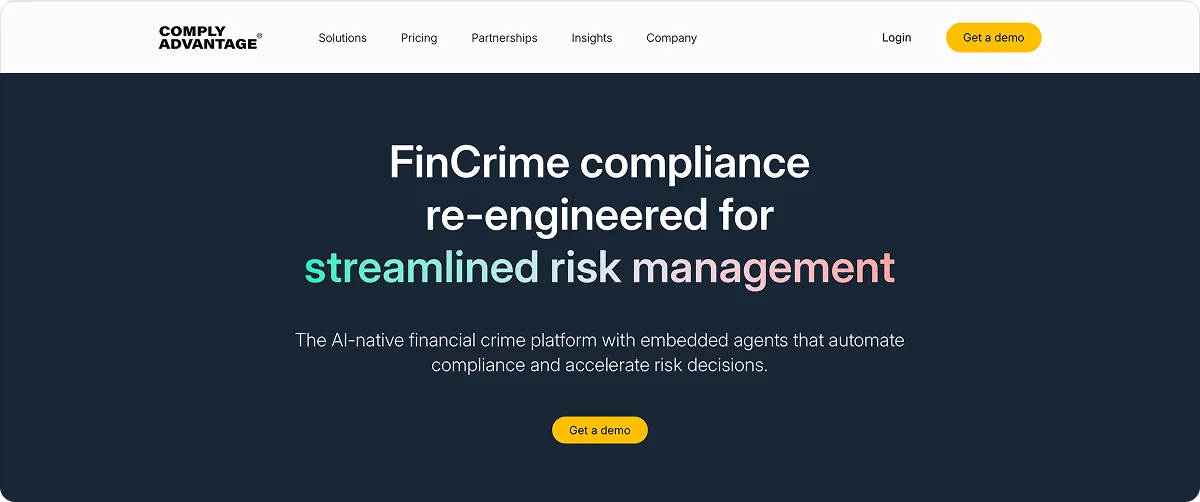
ComplyAdvantage Mesh is an AI-native financial crime risk platform built on a proprietary risk intelligence layer that owns its data pipeline from source ingestion to alert generation, without licensing through intermediaries.
The company reports it ingests more than 30 million documents per day directly from sanctions lists, PEP registers, and adverse media, achieving a 15-minute average update cadence for OFAC sanctions designations.
Its differentiation is data ownership and screening speed, and the platform does not combine that data layer with AI investigation agents or a full EDD workflow.
Key features
- Risk intelligence layer connecting 23 million entities, surfacing indirect relationships that static databases miss
- Sub-second API response times built for real-time payment rails
- Customer, company, and payment screening alongside transaction monitoring in one environment
- Starter plan from $99/month, the only platform on this list with a public entry-level pricing tier
Best for
This solution may be suitable for fintechs and mid-market compliance teams that need fast API deployment and real-time proprietary screening data without having to build a multi-vendor data stack.
Why ComplyAdvantage is a good Bretton AI alternative
Agent-layer tools inherit their alert quality from the underlying screening system. ComplyAdvantage controls that layer end-to-end, from raw source ingestion to alert generation, removing the upstream data problem that limits pure agent-layer platforms.
EDD and case investigation run outside Mesh, however, so programs that need a complete workflow from screening through investigation will require a second system.
3. WorkFusion

WorkFusion, now a UiPath company following its February 2026 acquisition, deploys purpose-built AI agents for financial crime compliance that perform Level 1 and Level 2 analyst functions inside existing infrastructure without replacing it. The platform is deployed by 10 of the top 20 banks globally, per the company.
Key features
- Pre-built AI agents calibrated to each institution’s policies and SOPs, covering L1 and L2 review without custom development
- Full alert disposition workflow from triage through documentation, producing investigation-ready output for analyst sign-off
- Documented, explainable decisions on every case action for regulator review and audit examination
- Scalable agent capacity without adding headcount, with enterprise customers reporting savings exceeding $100M, per WorkFusion
Best for
WorkFusion can be a good choice for large banks that need to expand analyst capacity inside an existing screening and case management environment.
Why WorkFusion is a good Bretton AI alternative
WorkFusion’s pre-built AI agent library, combined with UiPath’s orchestration infrastructure, offers a more mature agentic deployment pathway than Bretton AI.
Both platforms share the same underlying constraint, however, as agent output quality depends directly on the signal quality of the alerts those agents receive.
4. Ripjar
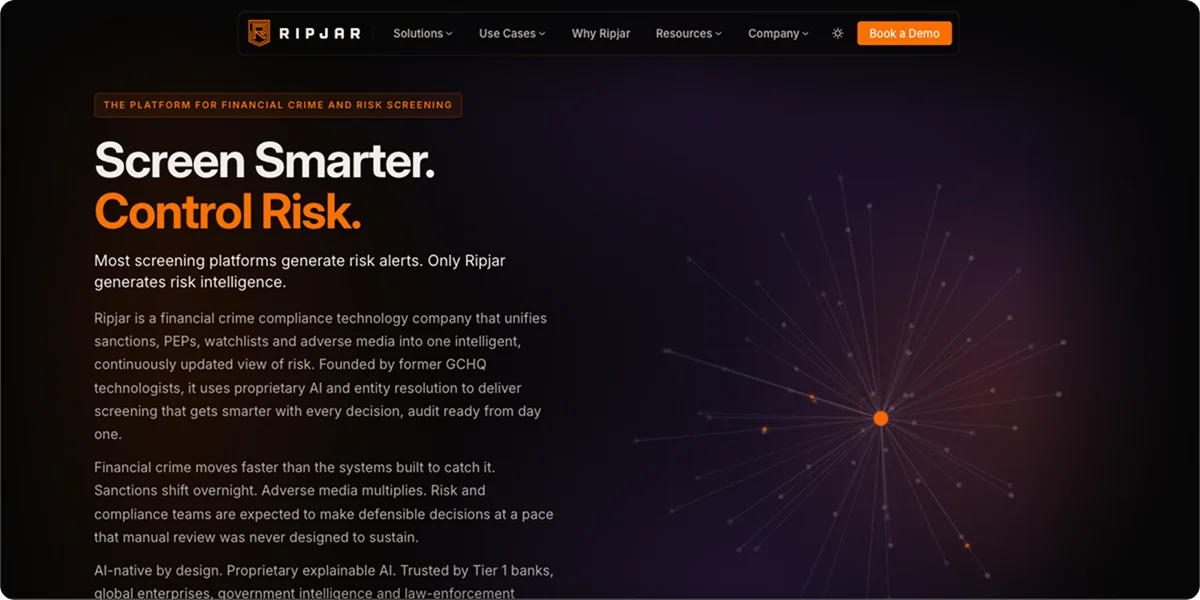
Ripjar unifies sanctions screening, watchlist monitoring, PEP checks, and adverse media into a single risk intelligence environment powered by its proprietary ULTRA intelligence engine.
Founded by veterans of GCHQ and protecting 300+ organizations globally, per the company, Ripjar Screening handles enterprise AML screening while Ripjar Labyrinth covers threat investigation.
EDD workflows and ongoing portfolio monitoring fall outside that environment, making it a strong screening and investigation platform for teams whose compliance scope does not extend to full lifecycle coverage.
Key features
- AI Risk Profiles capturing secondary identifiers from unstructured text, reducing analyst workload by up to 10x, according to Ripjar
- Screening Assistant alert triage that escalates genuine risk, closes irrelevant alerts, and documents every decision in a complete audit trail
- Dynamic Risk Profiles fusing structured and unstructured data and preserving prior decisions and analyst rationale across screening cycles
- Labyrinth threat investigation workflows with intelligence-grade data protection, built on the platform’s GCHQ heritage
Best for
Ripjar’s solution is best for compliance teams who need screening and investigation in one environment due to the high volume of adverse media alerts and inconsistent analyst outputs.
Why Ripjar is a good Bretton AI alternative
Ripjar’s ULTRA engine and persistent entity memory address the specific problem pure agent tools leave unresolved, namely adverse media signal quality and profile continuity.
Its adverse media screening and watchlist coverage are strong for programs whose primary challenge is signal quality and whose compliance scope stops short of full lifecycle EDD and monitoring.
5. Silent Eight
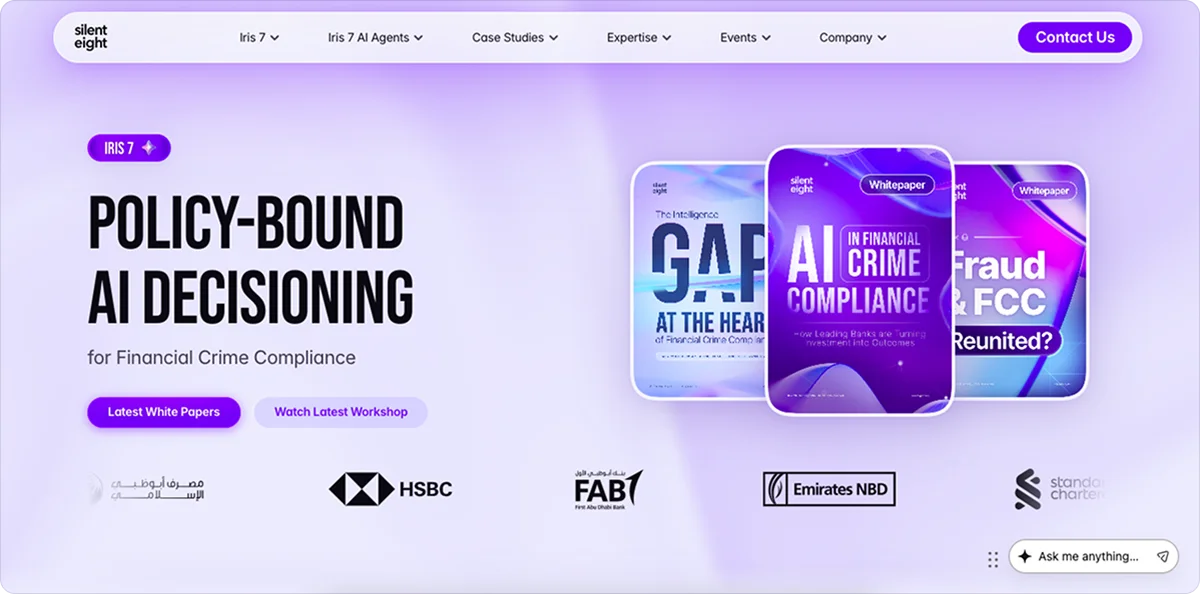
Silent Eight’s Iris 7 platform deploys policy-bound AI agents across sanctions screening, AML alert adjudication, fraud, trade surveillance, and complex due diligence workflows.
Each decision is traceable to the specific policy rule, data input, and reasoning step that produced it.
The company has operated in live Tier 1 financial institution environments since 2018, with clients including HSBC, which integrated the platform into its global financial crime compliance infrastructure.
Key features
- Modular agents scoped to specific workflow stages, from Level 1 alert triage through complex multi-source due diligence
- Single agentic architecture across name screening, transaction monitoring, AML investigations, fraud, and CDD without separate point tools, the company states
- Human-in-control model keeping analysts accountable for final decisions while agents handle data gathering, synthesis, and structured output
- Regulator-ready traceability on every decision, with reasoning, policy reference, and evidence documented for audit examination
Best for
This option best suits regulated institutions with well-documented compliance policies that need governed, auditable AI decisioning across high-volume sanctions, AML, and CDD workflows.
Why Silent Eight is a good Bretton AI alternative
Silent Eight’s production history at Tier 1 institutions provides a documented regulatory track record that Bretton AI’s more recent enterprise deployments have not yet accumulated.
Architecturally, both platforms share the same underlying constraint, as neither supplies the risk data its agents act on.
Which Bretton AI competitor is right for you?
The critical question in this evaluation is architectural: Does your compliance program need automation on top of what you already have, or a better foundation first?
Agent-layer tools (Bretton AI, WorkFusion, Silent Eight) assume the alerts your existing screening environment generates are worth automating. If your false-positive rate is high, your adverse media quality is inconsistent, or your entity data is fragmented, adding agents accelerates a process that is already producing incorrect inputs.
If investigation throughput is the constraint and your screening data is sound, both WorkFusion and Silent Eight are a good fit. WorkFusion suits volume-heavy environments, while Silent Eight suits institutions where policy-bound auditability is the primary governance requirement.
If adverse media quality or data coverage is the problem, Ripjar addresses signal quality and profile continuity. ComplyAdvantage, on the other hand, addresses source-level data ownership, from ingestion to alert generation.
If the program needs unified data, agents, and workflow, Sigma360 is the only platform on this list where the data and the agents are the same vendor’s problem. That means false positive reduction, investigation speed, and audit defensibility improve together rather than being optimized separately across vendors.
Request a demo to see how Sigma360 performs against your specific compliance requirements.
FAQ
Is Bretton AI the same as Greenlite AI?
Yes. The company rebranded from Greenlite AI to Bretton AI in February 2026, alongside a $75M Series B led by Sapphire Ventures.
Does Bretton AI work with any AML system, or only specific platforms?
Bretton AI is designed to integrate with existing AML and case management infrastructure rather than replace it. Institutions should verify compatibility with their specific stack directly with the vendor before procurement.
What do the EU AMLR and FinCEN effectiveness rules mean for AI compliance tools?
The EU AMLR, applying from July 2027, requires that AI-assisted compliance decisions be explainable and traceable. FinCEN’s proposed effectiveness-based rule is still advancing and would shift the compliance standard from technical process adherence to demonstrable outcomes.
Does Bretton AI publish pricing?
No. Pricing is available only through a direct sales engagement. The only platform on this list with public entry-level pricing is ComplyAdvantage, which starts at $99.99/month.
Does Bretton AI offer managed services?
Yes. In July 2026, Bretton AI launched a managed services model that combines its AI platform with a dedicated US-based operations team, giving institutions an alternative to building an in-house AI compliance function from scratch.

