
AI in financial crime compliance is used to replace manual alert reviews, fragmented data, and slow investigations with automated screening, continuous monitoring, and AI-generated risk summaries.
Financial crime compliance costs financial institutions in the US and Canada $61 billion annually, most of it absorbed by alert reviews, investigation reports, and customer due diligence that analysts handle one case at a time.
That workload was already unsustainable before fraud-related INTERPOL Notices and Diffusions surged by 54% since 2024, and it is why many financial institutions have already deployed or are actively piloting AI.
If your compliance team is weighing AI adoption, this guide breaks down where it works, what regulators expect, and how to build a program that holds up to scrutiny.
Key takeaways:
- The matching problem in sanctions screening is harder than it looks
Name variations, aliases, and layered ownership structures trip up rule-based systems in ways that are easy to underestimate. AI-based scoring handles the ambiguity that rules cannot.
- Most programs fall short on governance, not technology
Only 55% of compliance professionals feel ready for AI regulatory requirements. In most cases, the problem is documentation and model oversight, not the AI itself.
- Where you start determines how fast you see results
Institutions that begin with alert triage and other high-volume, repetitive work tend to see results fastest. Moving to investigation support before screening is stable rarely pays off.
- Data quality is the prerequisite most teams skip
Fragmented records and incomplete transaction history degrade AI accuracy before it has a chance to deliver.
- Sigma360 brings the data, screening technology, and agentic AI that compliance teams need into one platform
Most providers offer one or two of those layers separately. Sigma360 builds all three together, designed specifically for financial crime compliance.
What AI in financial crime compliance actually means
The term AI covers four distinct techniques in financial crime compliance, each applied to a different part of the workflow, and using the wrong one in the wrong place is where most programs fall short.
In practice, each technique has a specific job:
- Machine learning detects patterns across large volumes of transaction and customer data, scoring risk and surfacing behavioral anomalies that static rules miss.
- Natural language processing (NLP) reads unstructured text (news articles, court filings, regulatory disclosures) and extracts meaning that keyword searches cannot.
- Entity resolution matches records across inconsistent name formats, transliterations, and data sources to determine whether two entries refer to the same real-world entity.
- Generative AI consolidates fragmented data into structured summaries and drafts investigation narratives, compressing hours of manual work into minutes.
Matching the right technique to the right workflow starts with understanding what the existing system cannot do.
Why legacy systems can no longer do the job
Traditional compliance programs were built on static thresholds, fixed keyword lists, and overnight batch processing. Those systems made sense when transaction volumes were lower and financial crime moved more slowly, but neither condition holds now.
Financial institutions now operate across dozens of jurisdictions in real time, and rule-based systems were never designed for that environment.
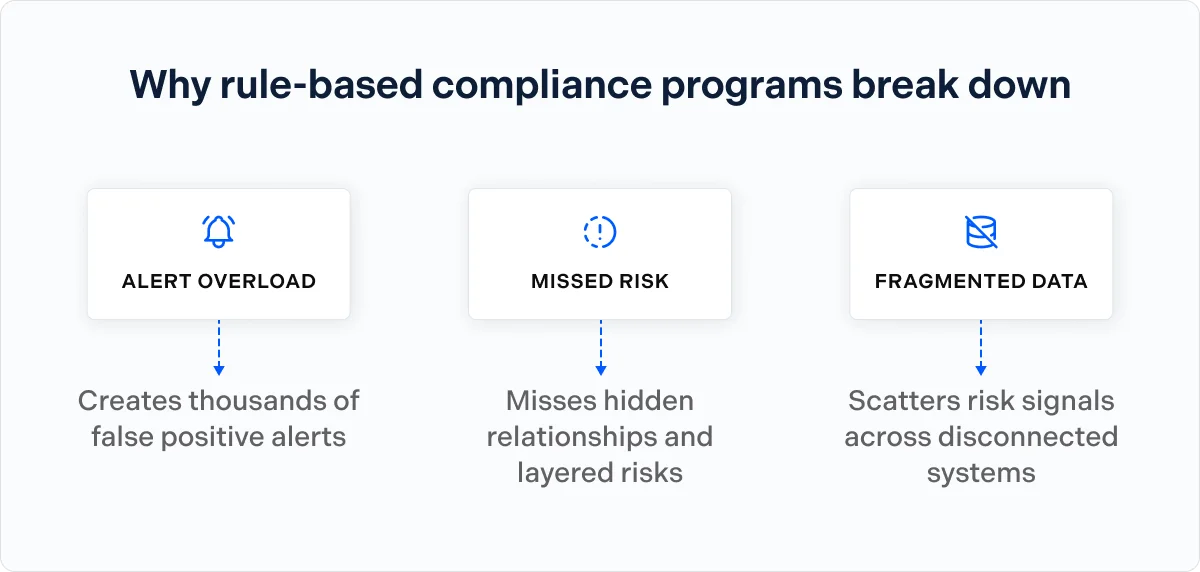
Three problems show up consistently across all of them:
- Alert overload: Rule-based transaction monitoring generates thousands of alerts a day. The vast majority are false positives, and clearing them manually consumes most of an analyst’s working time.
- Missed risk: Static rules catch known patterns but miss the indirect connections, layered ownership structures, and synthetic identities that characterize modern financial crime.
- Fragmented data: Risk signals sit across multiple systems, spanning sanctions lists, adverse media sources, corporate registries, and transaction records, with no unified view.
An ACAMS survey found that 52% of financial crime professionals cite outdated legacy technology and fragmented data infrastructure among their top operational risks. For most teams, the result is alert queues that never fully clear, risk signals scattered across disconnected systems, and analysts who spend more time on administration than investigation.
Key use cases of AI in financial crime compliance
Every area of financial crime compliance has a point where manual work overwhelms the team, and these five are where AI makes the biggest difference:
| Use case | The problem | What AI does |
| Adverse media screening | Keyword search returns thousands of irrelevant results. Analysts spend hours on manual triage. | NLP filters for entity relevance and materiality, reducing the queue to high-signal alerts. |
| Sanctions and watchlist screening | Name matching generates high false positive rates. Aliases and transliterations create additional matching errors. | Entity resolution scores match probability and return only alerts above a defined confidence threshold. |
| AML investigations | Analysts pull data manually from multiple systems and write narratives from scratch. | Generative AI consolidates data into structured entity summaries with audit-ready documentation. |
| Enhanced due diligence | Data gathering from registries, media, and sanctions sources is sequential and time-consuming. | AI runs data collection in parallel and generates structured risk summaries before analyst review begins. |
| Perpetual KYC | Periodic reviews miss risk changes that occur between cycles. | Continuous monitoring detects status changes across watchlists, media, and registries as they happen. |
Adverse media screening
Adverse media screening is among the most labor-intensive compliance workflows, and the manual workload starts at the search stage.
With keyword-based screening, a search on a common name against a large news corpus can generate hundreds of hits, most of them with no connection to the entity under review. Analysts spend hours sorting through articles that have nothing to do with financial crime risk.
NLP models first assess whether an article is about the specific entity being screened, and materiality scoring then determines whether the risk described, including fraud, sanctions, corruption, or regulatory action, clears the institution’s threshold.
Together, they reduce the review queue to the alerts that warrant attention.
Case study: How a top 10 global bank reduced adverse media false positives across 50+ countries
A top 10 global financial institution partnered with Sigma360 to overhaul its legacy adverse media screening process, which had created three problems:
- Overwhelming false positives from basic keyword screening
- Alert fatigue from duplicate and irrelevant media hits
- Slow triage increasing compliance risk across a portfolio of millions of customers
Explainable AI and risk scoring replaced manual triage judgment calls. Analysts could see exactly why each article was flagged, which sped up review decisions and reduced the compliance risk across its global operations.
Sanctions and watchlist screening
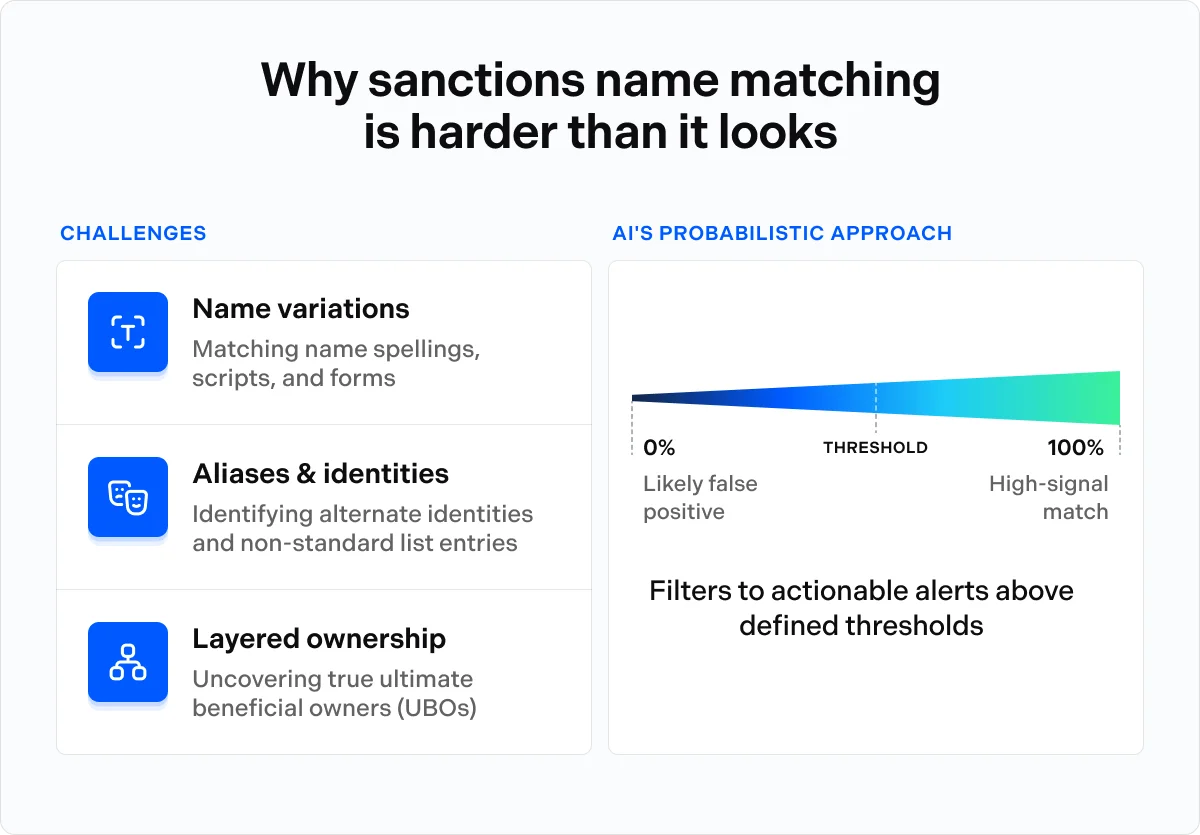
Every sanctions watchlist contains names that appear differently across data sources (different spellings, scripts, transliterations, and aliases), and rule-based systems were not built to handle that variability.
Three specific failure points are:
- Name variations: A single sanctioned individual may have dozens of legitimate spelling variants across Arabic, Cyrillic, and Latin scripts alone, and a rule built around one form will miss the rest.
- Aliases and alternate identities: Sanctioned entities frequently operate under names not captured in standard list entries, and without a way to connect those aliases back to a known entity, the match is never made.
- Layered ownership structures: Corporate vehicles obscure the ultimate beneficial owner (UBO) behind multiple intermediaries, and screening the entity named on an invoice catches nothing if the sanctioned party sits two levels up the ownership chain.
Faced with those limitations, compliance teams end up in an impossible position. If the threshold is tight enough to avoid false positives, it filters out real hits too. Loosening it, on the other hand, floods analysts with results that lead nowhere.
AI-based screening assigns a probability score to each potential match, weighing it against contextual factors, and returning only the results that cross a meaningful threshold.
AML investigations
Building a case for a suspicious activity report (SAR) is one of the most time-intensive workflows in compliance. To investigate a SAR candidate, an analyst typically needs to:
- Pull data from multiple internal systems
- Search external news and registry sources
- Cross-reference ownership structures
- Write a narrative that documents every step
Each of these steps is manual, and together they can consume days of analyst time on a single case. Generative AI pulls everything known about an entity into a single structured summary, drawing on watchlist status, adverse media, corporate registry data, direct and indirect risk indicators, and transaction patterns.
Examiners expect a clear and traceable path from data to decision, and AI-generated summaries paired with governed models deliver that consistently, regardless of which analyst handled the case.
Enhanced due diligence
Enhanced due diligence (EDD) applies to high-risk customers where standard onboarding checks are not enough.
The assessment covers beneficial ownership structures, adverse media across multiple markets, PEP status, regulatory history, and country risk, and pulling all of it together manually is where the process slows down.
Two parts of that workflow are well-suited to automation:
- Data gathering: Registries, sanctions lists, and media sources run in parallel rather than sequentially, compressing hours of sourcing into minutes.
- Risk summarization: Analysts receive a structured summary of key risk signals and assess rather than compile.
The result is an enhanced due diligence process that runs faster without reducing the depth of scrutiny the assessment demands.
Perpetual KYC
Most compliance programs run KYC reviews on a schedule (annually or biennially), which leaves a blind spot between cycles. A customer who was low-risk at onboarding may have appeared in sanctions news six months later, and a scheduled review cycle will not catch it in time.
Perpetual KYC keeps the customer portfolio under continuous watch, firing alerts the moment a risk signal changes. The signals tracked include:
- Watchlist and sanctions status updates
- Adverse media coverage across global sources
- Corporate registry filings and ownership changes
- Regulatory actions and enforcement activity
The benefits of AI in financial crime compliance
AI delivers targeted improvements across the workflows that take the most time and carry the most operational risk.
Five areas stand out:
- Reduced alert volume: Matching and relevance scoring cut the number of alerts analysts need to review, directing attention to real risk signals instead of false positives.
- Faster investigations: AI-generated entity summaries eliminate the hours analysts previously spent gathering data across systems and assembling investigation reports manually.
- Consistent documentation: Every investigation narrative follows a defined structure, producing uniform case files that withstand examiner review regardless of which analyst handled the case.
- Scalable monitoring: A growing customer portfolio no longer requires headcount to grow with it, giving compliance programs room to expand without adding staff proportionally.
- Earlier risk detection: AI flags status changes as they happen, narrowing the window between a risk event and the institution’s response.
Case study: How a global payments firm saved $1 million annually
A global payments company partnered with Sigma360 to automate its screening workflows and saw the results across all five of these areas:
- 93.3% of false positives cleared automatically, with no analyst involvement
- Manual review burden cut enough to project $1 million in annual cost savings
- Screening coverage maintained across a high-volume portfolio without adding headcount
What regulators expect from AI in compliance programs
Across major jurisdictions, regulators now actively endorse AI in compliance programs.
The FCA’s 2024 AI in financial services survey identifies AML and fraud prevention among the areas where organizations perceive the greatest AI benefits. FinCEN’s 2024 proposed rule moves in the same direction, encouraging financial institutions to modernize their AML/CFT programs through responsible innovation while maintaining risk-based controls.
Among the three, FATF’s guidance has been the most specific. Its 2021 report on new technologies for AML/CFT backs AI as a compliance tool while setting a clear bar on explainability and transparency, and its 2025 Horizon Scan on AI and Deepfakes calls on institutions to use AI responsibly to strengthen and protect the integrity of the global financial system.
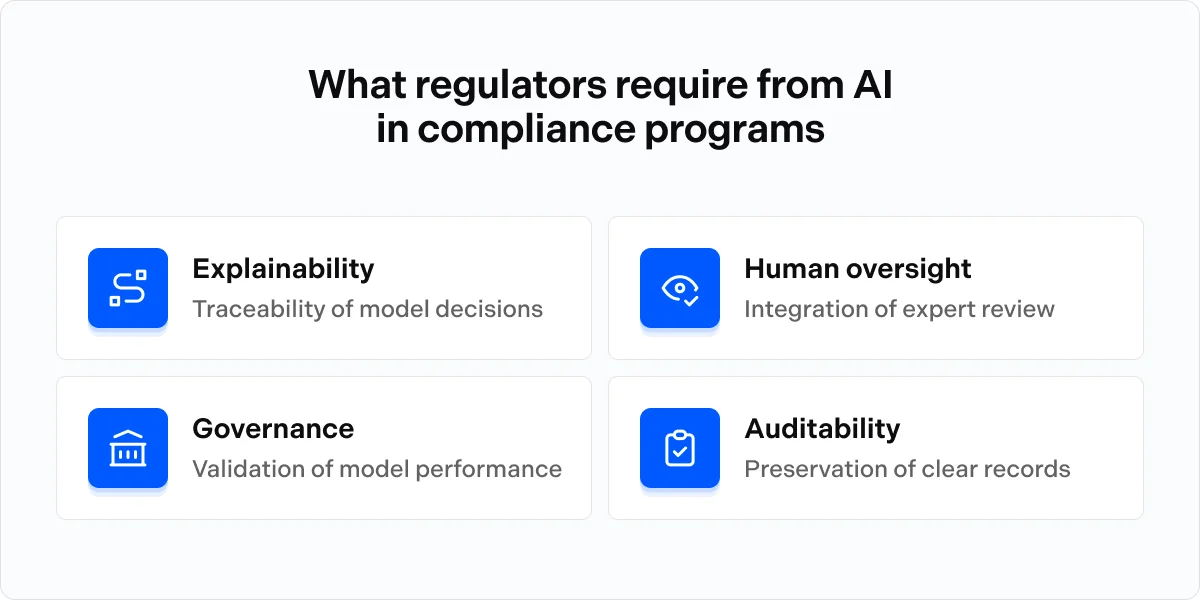
This means meeting four requirements:
- Explainability: AI decisions must be traceable. Institutions need to document how a model arrived at a risk score or a match decision, particularly when that decision feeds a SAR or an account closure.
- Human oversight: AI automates routine decisions. It does not replace human judgment on complex or high-stakes cases, and regulators expect institutions to define where AI acts and where a human reviews.
- Governance: Models need validation, monitoring, and regular review. An AI system that performed well at deployment but has drifted in accuracy presents a regulatory risk.
- Auditability: Every AI-assisted decision should produce a record that an examiner can follow from the original data through to the compliance action taken.
A Kroll survey from 2025 found that only 55% of compliance professionals believe their programs are ready for AI regulatory developments. Most of that unpreparedness comes down to governance and documentation, not technology.
Institutions that build explainability and oversight into their AI programs are better positioned when examiners ask questions.
Read more: Challenges in Implementing AI Governance Frameworks
How Sigma360 supports AI financial crime compliance
Sigma360 is an AI-powered risk intelligence platform built specifically for financial crime compliance, combining three capabilities that most providers offer separately:
- Global risk data: More than 100 billion data points spanning sanctions lists, PEPs, adverse media from 600,000+ publishers, corporate registries across 150+ countries, and proprietary intelligence on shared addresses, directors, and nominee relationships.
- Core screening technology: Configurable sanctions and watchlist screening, adverse media, and EDD screening with entity resolution and risk scoring built to reduce false positives across high-volume portfolios.
- Agentic AI: The AI360 suite includes the Match Agent, which clears false positives autonomously and reduces manual match reviews by up to 90%, the Adverse Media Agent, which consolidates related news into single risk narratives, and the Entity Summary, which compiles watchlist status, registry data, adverse media, and KYC records into one structured profile for AML investigations and beyond.
Teams can configure risk thresholds and workflows without engineering support, which means the platform adapts to policy changes without a development cycle.
Request a demo to see how Sigma360 applies to your program.
FAQ
What risks does AI introduce in financial crime compliance?
The main risks are model bias, data quality problems, and model drift. AI trained on poor or incomplete data produces unreliable outputs, and even well-configured models can lose accuracy over time without regular monitoring.
Can AI be used for transaction monitoring?
Yes. Machine learning models analyze transaction behavior across large volumes and flag deviations from a customer’s normal patterns, catching anomalies that static rules typically miss.
What data quality does AI need to work effectively in compliance?
It needs clean, consistent, and well-governed data. Fragmented customer records and gaps in transaction history degrade model accuracy, which is why most teams need to address data quality before deploying AI at scale.
How should compliance teams evaluate AI vendors?
Check whether the AI is built into the platform or added onto a legacy rules engine. AI that is layered onto a legacy rules engine scores alerts after rules have already produced them. Native AI generates decisions from data directly and adapts faster.
What skills does a compliance team need to work with AI?
Analysts need enough familiarity with AI outputs to question what they see, not accept it at face value. Team members also need to understand model validation, since regulators now expect governance, not just deployment.

