
Money laundering converts criminal proceeds into money that can be spent and invested without causing suspicion. The exact method varies by context and opportunity, but across every typology, dirty money needs to pass through enough layers of legitimate-looking activity to make its origin untraceable. Federal money laundering prosecutions in the United States reached 1,170 cases in fiscal year 2025, up 41% from fiscal year 2021, according to the U.S. Sentencing Commission. Prosecutions capture only a fraction of the actual volume, and the institutions that process these funds bear direct legal responsibility for detecting and reporting suspicious activity before the money moves out of reach. This guide explains what money laundering is and what the law requires of the institutions it passes through.
Key takeaways:
- Third-party liability extends well beyond the criminal
Lawyers, directors, property agents, and financial institutions can all face legal exposure for processing or facilitating criminal proceeds.
- The predicate offense shapes how laundering looks
Different underlying crimes generate proceeds with different transaction patterns, geographic footprints, and reporting requirements.
- Enforcement consequences go further than fines
Loss of correspondent banking relationships and regulatory restrictions on business activities can outlast the penalty itself.
- Having controls in place isn’t the same as running them effectively
Most enforcement actions trace back to programs that existed but weren't configured to catch the actual risk.
- Sigma360 addresses the operational gaps that rules-based programs miss
Sigma360 combines sanctions screening, adverse media monitoring, AI-powered investigations, and perpetual KYC for compliance teams managing money-laundering risk.
What is money laundering?
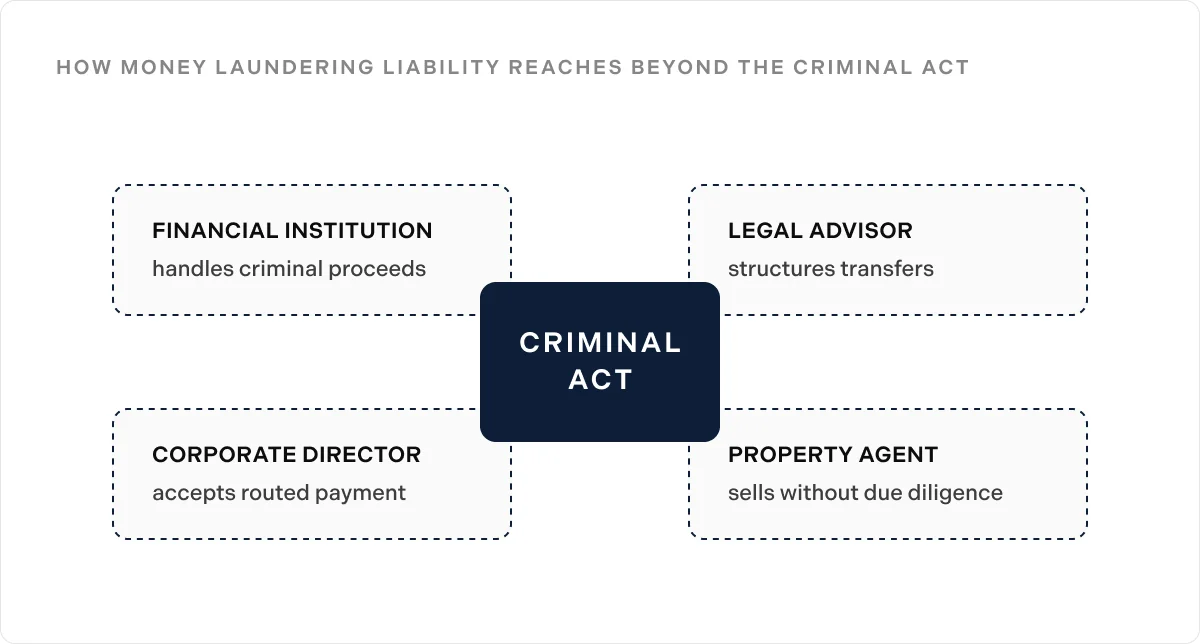
Money laundering describes any transaction or arrangement used to conceal the origin of criminal proceeds, regardless of who carries it out. The offense extends beyond the criminal who generated the money. Under UK law, the Proceeds of Crime Act 2002 criminalizes anyone who conceals, converts, transfers, acquires, uses, or possesses property they know or have reasonable grounds to suspect represents the proceeds of crime. Third-party liability reaches widely, and it can affect:
- A lawyer who structures an asset transfer on behalf of a client
- A corporate director who accepts payment routed through a shell company
- A property agent who completes a sale without conducting adequate due diligence
 FATF's 40 Recommendations define money laundering as the processing of criminal proceeds to disguise their illegal origin. In the United States, 18 U.S.C. § 1956 establishes the federal offense for financial transactions involving the proceeds of specified unlawful activity, covering three categories of criminal intent:
- To hide or misrepresent the nature, source, ownership, or control of the funds
- To promote the underlying criminal activity
- To evade reporting obligations under federal law
Money laundering vs. terrorist and proliferation financing
Compliance frameworks group money laundering, terrorist financing, and proliferation financing under AML/CFT/CPF, but each term describes a distinct offense, with a different funding source and a different criminal purpose. Here’s how they compare:
- Money laundering converts criminal proceeds into money that can be spent, invested, or declared without detection. The funds must originate from a predicate offense, an underlying crime, which legally distinguishes it from the other two.
- Terrorist financing channels funds toward terrorist activity or organizations. Unlike money laundering, the source may be entirely legitimate, including charitable donations, and individual transaction amounts are often small.
- Proliferation financing supports the acquisition or development of weapons of mass destruction. It moves through sanctions evasion, falsified trade documentation, and front-company networks, and UN Security Council resolutions and national sanctions regimes govern it separately.
KYC, transaction monitoring, sanctions screening, and suspicious activity reporting each serve multiple purposes across all three, which is why regulators now treat them as a single compliance obligation rather than parallel frameworks.
How money laundering works
Money laundering moves through three stages: placement, layering, and integration, though they don’t always occur in strict sequence in practice. Modern payment infrastructure has compressed what once took weeks into a process that can be completed in hours across multiple jurisdictions. Read more: The 3 Stages of Money Laundering Explained
Predicate offenses: Where the money comes from
Every laundering scheme starts with a predicate offense, the underlying crime that generates the funds. Which predicate is involved shapes the typology, transaction patterns, and jurisdictions at play. The most common categories financial institutions encounter are:
| Predicate offense | Why it generates large volumes of laundered funds |
| Drug trafficking | Generates high cash volumes through established criminal distribution networks spanning multiple countries |
| Fraud and cybercrime | Produces large proceeds rapidly through automated schemes targeting financial accounts and payment systems |
| Corruption | Diverts public funds through public officials, often using complex offshore structures to conceal origin |
| Human trafficking | Collects cash through exploitation, often laundered through cash-intensive legitimate businesses |
| Tax evasion | Creates large undeclared sums that need quiet integration into the legitimate economy |
| Sanctions evasion | Moves value across borders through trade manipulation and front company networks |
Drug trafficking and corruption proceeds follow different paths. Trafficking generates high-volume cash deposits through intermediaries, while corruption funds tend to move through wire transfers, shell companies, and real estate. The predicate offense also determines the typology code on a suspicious activity report, which shapes how institutions document and escalate their findings.
Common money laundering methods
Money laundering methods follow the path of least resistance, shaped by whichever financial infrastructure is available and hardest to monitor. The mechanism varies, but every method’s goal is to put enough distance between funds and their origin that the connection becomes difficult to trace. Here are the most common methods:
| Method | How it works | Compliance signal |
| Shell companies | Legal entities with no real operations are used to hold assets or receive payments, obscuring beneficial ownership | Complex ownership chains, nominee directors, jurisdictions with weak transparency requirements |
| Structuring (smurfing) | Large sums are broken into smaller deposits to stay below currency transaction reporting thresholds (US: $10,000, EU: €10,000) | Repeated deposits just below the reporting threshold, multiple accounts at different institutions |
| Trade-based laundering | Import/export invoices are manipulated to over- or under-value goods, moving value across borders through commercial transactions | Invoice amounts inconsistent with market prices; unusual trade routes |
| Real estate | Property is purchased with illicit funds, sometimes through shell companies, then sold to generate clean proceeds | Cash purchases, rapid resale, third-party funding with no clear relationship to the buyer |
| Cash-intensive businesses | Dirty cash is commingled with legitimate revenues of businesses like restaurants, car washes, or retail shops | Revenue inconsistent with location, footfall, or industry benchmarks |
| Cryptocurrency and digital assets | Virtual assets are used for rapid cross-border transfers; mixing services and decentralized protocols obscure transaction trails | Transactions through unhosted wallets, use of mixers or privacy coins, rapid conversion |
| Professional gatekeepers | Complex structures are established, or transactions are facilitated on behalf of clients by lawyers, accountants, and company formation agents | Third-party payments, structures created in secrecy jurisdictions, reluctance to disclose the principal |
Why money laundering is a financial institution problem
Banks, fintechs, and payment firms are the infrastructure through which laundered funds move, and the law holds them accountable for detecting and reporting suspicious activity before the funds clear their systems. Inadequate controls trigger penalties, but the longer-lasting consequences are often operational. Institutions risk losing correspondent banking access and facing restrictions on new business, while reputational exposure in the press tends to outlast the settlement itself. Three cases show what control failures cost:
- NatWest (UK, 2021): Paid £264.8 million in the UK's first criminal prosecution of a bank under anti-money laundering law, after failing to monitor a commercial customer that deposited £365 million, most of it in cash, over five years
- Danske Bank (Denmark/US, 2022): Paid $2 billion following a U.S. Department of Justice investigation into its Estonian branch, through which $160 billion in transactions flowed on behalf of non-resident customers with little oversight
- HSBC (US, 2012): Paid a total of $1.9 billion for systematic breakdowns in AML controls, including failures that allowed drug cartel funds to move through the US financial system
Regulatory obligations by jurisdiction
Every major AML framework requires customer identification, transaction monitoring, suspicious activity reporting, and recordkeeping, though scope, thresholds, and deadlines vary by jurisdiction. Here’s a general obligations overview:
| Jurisdiction | Primary framework | Core obligations |
| United States | Bank Secrecy Act (BSA) | CDD, CTR filing above $10,000, SAR filing, five-year record retention |
| European Union | AMLR (applies July 10, 2027) | Risk-based CDD, beneficial ownership verification, SAR to national FIUs, central registers |
| United Kingdom | Proceeds of Crime Act 2002 / MLR 2017 (updated 2025) | CDD, enhanced DD for high-risk, SAR to National Crime Agency, five-year records |
| FATF member states | 40 Recommendations | Risk-based approach, CDD, PEP and correspondent banking controls, mutual evaluations |
Full guidance on US obligations is available at FinCEN's BSA/AML resources.
Red flags: What compliance teams watch for
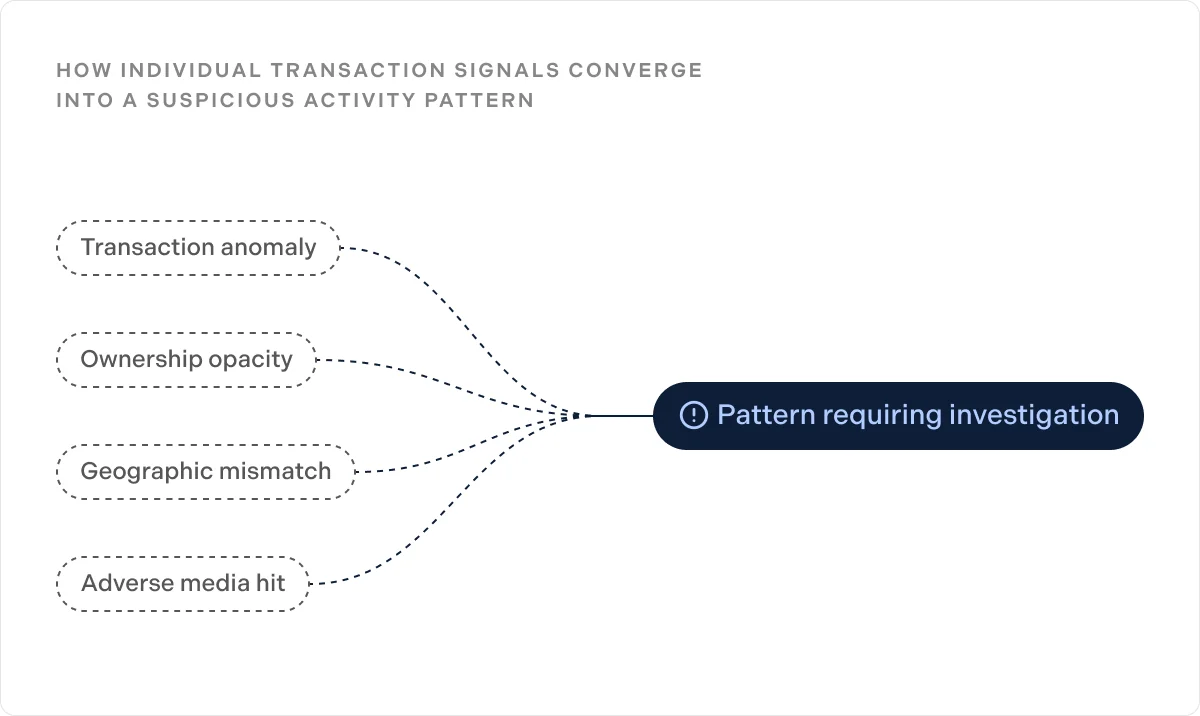
Red flags don’t appear as single data points. The most reliable signal is a pattern of activity that can’t be explained by what a customer's known profile or business would reasonably generate, including:
- Transactions inconsistent with customer profile: Transfers that don't match the customer's stated business, income, or transaction history in size, frequency, or destination
- Beneficial ownership complexity: Ownership structures involving multiple layers, nominee directors, or entities within jurisdictions having weak transparency requirements, particularly where the ultimate beneficial owner can’t be identified
- Structuring patterns: Deposits or transfers in amounts just below reporting thresholds, spread across multiple accounts or time periods to avoid triggering currency transaction reports
- Adverse media: Coverage linking a customer or counterparty to fraud, corruption, regulatory action, or criminal investigation
- PEP and sanctions exposure: Connections to politically exposed persons or sanctioned individuals, including indirect exposure running through associated entities and ownership structures
- Unusual geographic patterns: Fund movements through FATF gray- or black-listed jurisdictions with no clear business rationale for the route or counterparty
How financial institutions detect and stop money laundering
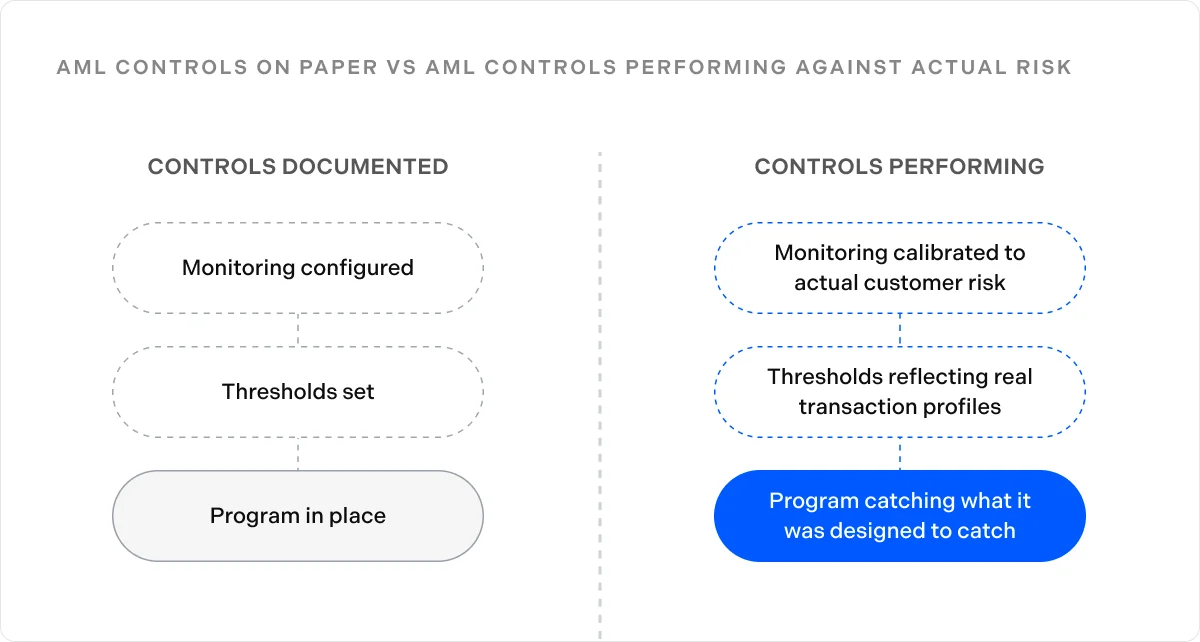
Most enforcement actions trace back to programs that existed but weren’t performing against the actual risk. The standard controls an AML program should include are:
- Customer due diligence (CDD) and KYC: Verifying customer identity at onboarding, establishing the nature of the relationship, and assessing initial risk, with enhanced due diligence applied to high-risk customers, PEPs, and complex ownership structures
- Ongoing transaction monitoring: Reviewing financial activity against expected behavior, using rules-based systems and AI-assisted models to flag anomalies for analyst review
- Sanctions and watchlist screening: Screening customers and counterparties against OFAC, UN, EU, and national sanctions lists, PEP databases, and adverse enforcement records at onboarding and on an ongoing basis
- Adverse media screening: Monitoring global news sources for negative coverage linked to customers or their associates, relevant for detecting integration-stage risk before it appears in enforcement records
- Suspicious activity reporting: Filing SARs or STRs with the relevant financial intelligence unit when a transaction or customer raises suspicion that can’t be resolved through investigation
- Perpetual KYC: Monitoring existing customers continuously, so risk changes are captured as they happen and not deferred to a periodic review cycle
What Sigma360 brings to AML detection
Sigma360 is an AI risk intelligence platform for financial crime compliance, covering screening, investigations, and continuous monitoring in one program. It targets the three points at which AML programs lose the most time (alert overload, fragmented investigation data, and static review cycles) and applies AI to reduce manual workload and keep pace with risk as it changes. Here’s how the platform operates:
- Reducing alert volume: The Match Agent clears easily identifiable false positives automatically, decreasing manual match reviews by 93%. Sanctions and watchlist screening covers OFAC, UN, EU, and national lists with configurable risk tuning that reflects each institution's own risk appetite and regulatory context.
- Accelerating investigations: When an alert warrants further analysis, the Entity Summary compiles a structured case profile from KYC records, watchlist hits, corporate registry data, and ownership indicators. The Adverse Media Summary consolidates related news coverage into a single narrative, so teams can assess the full picture of a risk story without working through individual articles. Both feed into AML investigations workflows built to compress time to decision.
- Continuous monitoring: Perpetual KYC tracks existing customers continuously instead of waiting for a scheduled review cycle, picking up ownership shifts, sanctions additions, and new adverse media as they happen. Adverse media screening runs across global news sources and flags risk signals before they appear in enforcement records.
Request a demo to see what Sigma360 finds that your current program misses. Read more: AI in Financial Crime Compliance: Benefits and Use Cases
FAQ
Can a bank face criminal charges, not just a fine, for AML failures?
Yes. The NatWest prosecution in 2021 was the UK's first criminal conviction of a bank under anti-money laundering regulations, establishing that criminal liability applies to institutions, not just individuals.
What is a money mule, and why does it matter for compliance programs?
A money mule transfers illegally obtained funds on behalf of a criminal, often through their own bank account. Mule accounts are hard to detect because they mimic ordinary retail activity, with real customer profiles and small individual transfers.
What is the difference between AML and KYC?
KYC is one component of AML, not a synonym. KYC covers customer identification and continuous risk assessment. AML is the full program of controls required to prevent the financial system from being used to launder money.
How long must financial institutions retain AML records?
Five years is the standard under the Bank Secrecy Act in the US, the Money Laundering Regulations 2017 in the UK, and the EU's AML framework, running from the end of the customer relationship or the date of the transaction.
Can an institution be liable if it processed laundered funds without knowing?
Yes. Most AML frameworks impose liability for failing to implement adequate controls, not only for knowingly facilitating laundering. If red flags existed and were missed, enforcement action is possible regardless of intent.

