
Choosing the wrong sanctions screening tool is a compliance problem, but the more immediate cost shows up in analyst time. Research consistently puts false positive rates at 90–95% in conventional AML and sanctions screening systems, meaning most of a compliance team’s day goes to clearing alerts that lead nowhere.
This workload problem has a regulatory dimension too. OFAC updated the SDN list multiple times per week throughout 2025, and a Sidley Austin review of 2025 enforcement trends found that total US sanctions penalties exceeded $265 million, up from around $49 million in 2024.
The pace of list changes has not slowed, and a platform that buries true matches under thousands of irrelevant alerts creates exposure the moment a new designation drops.
This comparison benchmarks Sigma360 against four common alternatives and explains where each approach creates tradeoffs.
Key takeaways:
- Tool type determines fit
Full platforms, data-only providers, and API-first tools are not interchangeable. Picking the wrong category means going back to market later.
- Name-only screening misses a significant share of real risk
Sanctioned entities operating through layered ownership structures, indirect counterparty chains, and secondary sanctions exposure will not appear on a standard watchlist. UBO analysis and network-level screening are what close those gaps.
- Deployment speed separates modern platforms from legacy ones
Enterprise tools can take months to configure before going live. Modern platforms are designed to deploy in weeks, not months. Sigma360 is built for rapid deployment, with low-code configuration that lets compliance teams go live without extended implementation cycles.
- The EU AMLR deadline is closer than most teams have planned for
The regulation applies from 10 July 2027, with AMLA publishing technical standards throughout 2026. Institutions need to confirm their current screening infrastructure can produce audit trails and explainability outputs before the window closes.
- Sigma360 consolidates what most tools handle separately
Chartis Research ranked Sigma360 #1 in technical capability for both Name and Transaction Screening and Adverse Media Monitoring, independently validated for enterprise-grade compliance at global and top-tier financial institutions. The alternatives in this comparison each handle part of that picture, but Sigma360 is built to handle all of it.
How we evaluated the alternatives
Sanctions screening tools range from full compliance platforms to lightweight APIs, and they are not interchangeable. A Tier 1 bank evaluating its compliance infrastructure has different requirements than a fintech embedding screening into an onboarding flow.
The four alternatives benchmarked here represent the most common categories compliance teams evaluate alongside Sigma360: a legacy AI overlay for enterprise banks, a mid-market configurable platform, a network intelligence platform for indirect exposure, and an API-first tool for technical buyers.
Five criteria shaped the evaluation:
- Data coverage and refresh cadence (30%): Coverage of OFAC, UN, EU, HMT, and regional lists, and the speed at which new designations reach live screening after publication
- Match quality and false positive performance (25%): Entity resolution methodology, multilingual and cross-script matching capabilities, and client-reported false positive rates in production rather than vendor demonstrations
- Configurability and AI explainability (20%): Ability to tune alert logic and thresholds without engineering support, and the ability of AI-assisted decisions to produce auditable outputs that satisfy regulatory examination
- Deployment speed and integration (15%): Realistic time to go live and compatibility with existing case management, KYC, and payment infrastructure
- Segment fit (10%): Assessed against enterprise readiness, security and governance standards, network intelligence capability, and independent validation. Vendor positioning alone is not treated as evidence of buyer fit
The 5 best sanctions screening tools
The tools below cover Sigma360 and four alternatives, evaluated by type and primary buyer fit.
| Tool | Type | Best for |
| Sigma360 | Full platform | Tier 1 banks, global financial institutions, fintechs, payments firms, and regulated corporates |
| SymphonyAI | Legacy-stack AI overlay | Large financial institutions augmenting existing screening infrastructure with AI |
| Napier AI | Full platform | Mid-sized institutions and fintechs wanting configurable screening without enterprise overhead |
| Quantexa | Graph-first decision intelligence | Organizations screening for indirect sanctions exposure through network and ownership analysis |
| Sanctions.io | Lightweight embedded API | Fintechs and technical teams embedding screening directly into their own product |
1. Sigma360
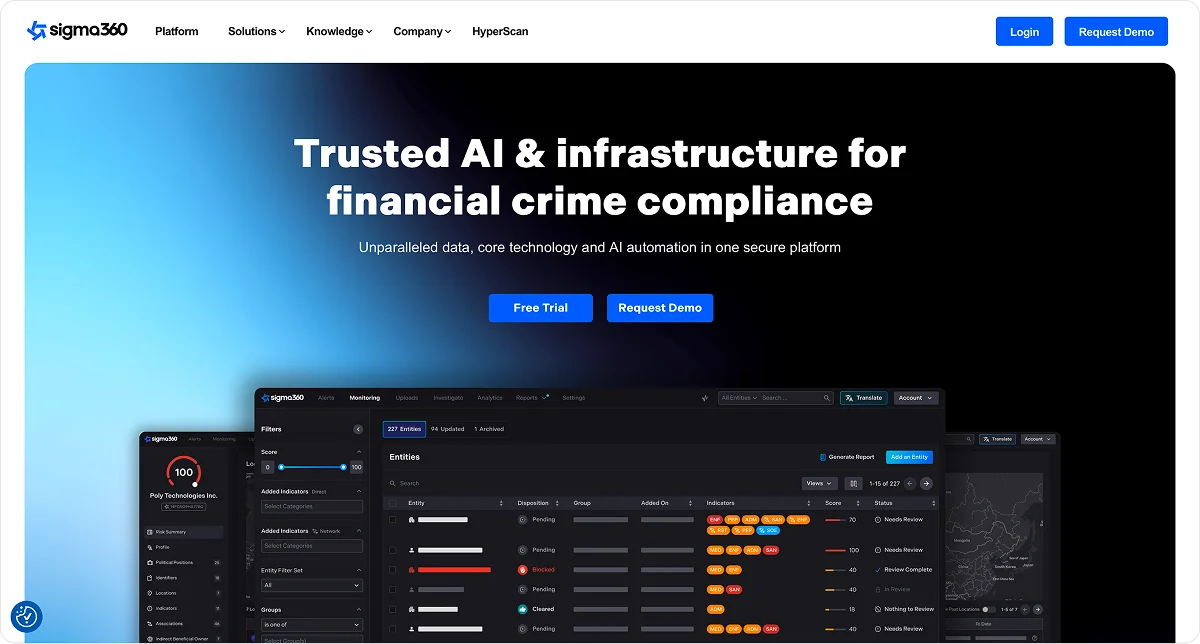
Sigma360 helps compliance teams at Tier 1 banks, global financial institutions, fintechs, payments firms, and regulated corporates screen for sanctions exposure, adverse media risk, PEPs, ownership connections, and network risk through a single platform.
The client base includes a Top 10 Global Financial Institution. The platform protects more than $2 trillion in assets and company value and supports billions in monthly transaction value.
Because all workflows operate from one shared entity record, a sanctions alert and an adverse media hit on the same entity appear together rather than in separate tools.
Key features
- Match Agent reduces manual match reviews by up to 90% by automatically clearing false positives with explainable recommendations.
- Adverse Media Agent eliminates up to 95% of irrelevant news and saves up to 99% of manual adverse media review time through materiality scoring and AI summarization.
- EDD Agent aggregates and summarizes case data with consistent structure, reducing repetitive investigation work across enhanced due diligence workflows.
- Entity Summary compiles KYC data, watchlist results, registry information, and adverse media signals into a standardized risk profile in seconds.
- Perpetual KYC monitors the live client portfolio continuously, surfacing alerts when a risk status changes on an onboarded entity.
- Configurable premium data sources, including UBO data and offshore leaks datasets, can be added without engineering support.
- Audit log captures every alert, analyst decision, and AI recommendation in a timestamped, exportable record for regulatory examination.
Who it is built for
Sigma360 is built for regulated organizations of every scale, including top-tier global financial institutions, payments leaders, fintechs, asset managers, and globally exposed corporations that need enterprise-grade screening and investigation workflows.
The platform carries SOC 2 Type II certification and 99.9% uptime, meeting the security and availability standards required by regulated financial institutions at tier 1 scale.
Read more: Sigma360 sanctions and watchlist screening
Worth knowing before you choose
Teams looking for a standalone data feed to plug into an existing system might find Sigma360 broader than they need.
2. SymphonyAI

SymphonyAI’s financial crime prevention suite is built around SensaAI for Sanctions, an AI overlay that the company positions as deployable on top of existing screening infrastructure without replacing it.
It may fit institutions whose primary requirement is preserving legacy infrastructure while adding an AI capability layer. The tradeoff is that an overlay approach retains existing system dependencies and the fragmented workflows that come with them.
Key features
- It screens against 350+ global watchlists in 60+ languages, with new watchlists vendor-reported as deployable enterprise-wide in as little as 15 minutes.
- SymphonyAI reports that SensaAI reduces false positives by up to 80% while retaining 100% of true positives, using predictive and generative AI to analyze and structure unstructured screening data.
- Sensa Investigation Hub centralizes case management with an AI assistant that surfaces contextual risk signals and supports faster alert adjudication.
- NetReveal Transaction Screening processes name and transaction checks in as little as 40 milliseconds, the company reports, supporting real-time payments compliance.
Who it is built for
SymphonyAI was named a Leader in the Forrester Wave for AML Solutions in Q2 2025, reflecting its positioning as an AI augmentation layer for established financial crime compliance infrastructure.
Worth knowing before you choose
The platform’s enterprise footprint means implementation requires planning and internal coordination across compliance, technology, and operations. Mid-market institutions and fintechs will typically find the overhead disproportionate to their needs.
3. Napier AI
Napier AI’s Continuum platform is built around pre-production testing and configurable alert logic, with a no-code sandbox that lets analysts validate rule changes against real data before they go live.
Its matching engine uses advanced fuzzy-matching and natural language processing to catch name synonyms and transliterations that exact-match systems miss, reducing false positives without sacrificing genuine matches, the company claims.
Napier states that deployments can go live in as little as 21 days, compared with the months of configuration enterprise platforms typically require before production use.
Key features
- Client and transaction screening across sanctions, PEPs, and adverse media in real-time and batch processing modes
- AI advisory feature for alert review, with clear reasoning to support analyst decisions on each flagged match
- Automated list updates with support for private lists alongside standard public sanctions sources
- Graphical dashboard for team leaders, with visibility into screening activity, alert backlogs, and workflow performance
Who it is built for
Napier AI fits compliance teams that need tighter control over screening configuration than basic list-matching tools offer, but without the implementation scope of a full enterprise platform.
Worth knowing before you choose
Organizations that need deep adverse media analysis, EDD workflows, or network intelligence beyond entity-level screening may need to supplement Napier AI with additional data sources.
4. Quantexa
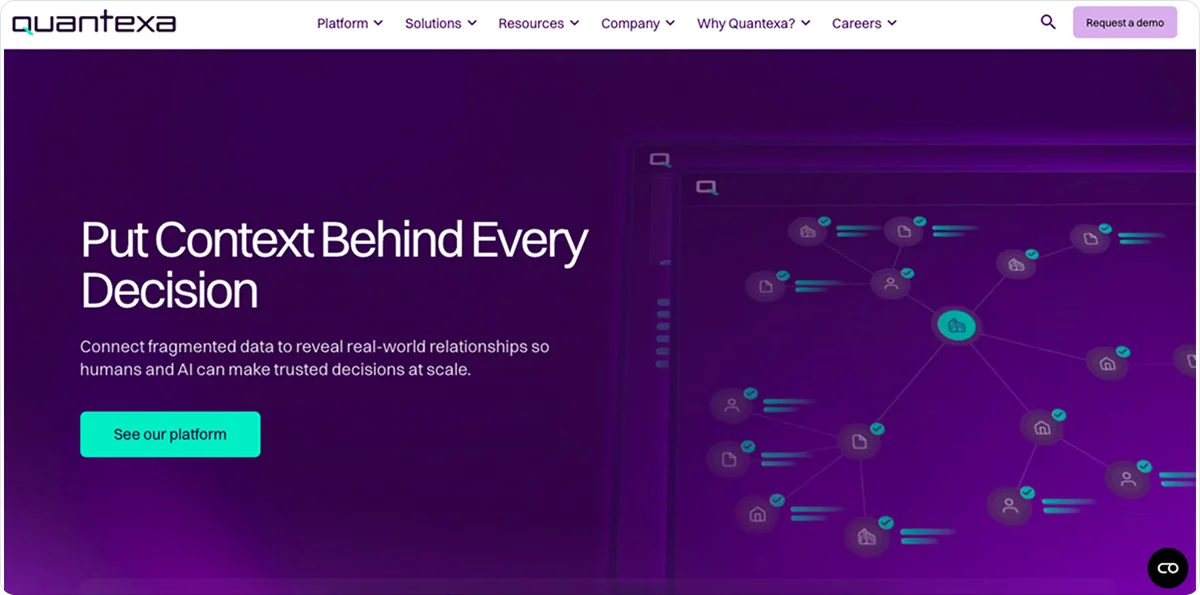
Quantexa’s Decision Intelligence Platform is built from the ground up on graph analytics, designed to map entity relationships across ownership structures, transactions, shared addresses, and known associations at enterprise scale.
Its primary differentiator is the breadth of that network—connecting internal data, third-party sources, and transactional history to identify indirect sanctions exposure that conventional list-matching misses.
Key features
- Contextual risk scoring based on network position and associated signals, not only direct list matches
- Unified entity view built from internal and external data sources across jurisdictions
- AI-driven analytics identifying behavioral patterns associated with sanctions evasion and financial crime networks
- Enterprise-scale architecture supporting 60B+ records, per Quantexa, with hybrid, cloud, and on-premises deployment options
Who it is built for
Quantexa has its strongest footprint among large financial institutions and globally exposed corporations that need to screen for indirect sanctions exposure and hidden network connections.
Worth knowing before you choose
Deploying Quantexa’s full capability requires significant data integration and configuration work upfront, which makes it a poor fit for organizations that need fast deployment or standard watchlist checks.
5. Sanctions.io
Sanctions Homepage
Sanctions.io is an API-first sanctions screening tool for technical buyers who need fast, lightweight checks embedded directly into their own product or workflow.
It covers 75+ sanctions and watchlists from 30+ jurisdictions, the company reports, updated every 60 minutes, alongside PEP screening and adverse media monitoring, with results returned in an average of 350 milliseconds. Usage-based pricing keeps costs tied to actual screening volume, with no minimum commitments.
Key features
- Adverse media screening across 60,000+ global news sources, according to Sanctions.io, tagged by risk theme including financial crime, regulatory action, and reputational harm
- Developer-friendly documentation, integration guides, and a full sandbox environment for pre-launch testing
- Continuous monitoring API with alerts triggered when a screened entity’s risk status changes
- SOC 2 certification and 99.99%+ uptime, the company reports, for deployment in regulated environments
Who it is built for
Sanctions.io fits technical teams that need a lightweight API screening component and are prepared to build or source the analyst workflows, case management, and broader risk intelligence around it.
Fintechs and payments firms with those requirements already in place elsewhere may find it a practical starting point.
Worth knowing before you choose
Case management, analyst workflows, and investigation tooling are outside its scope and will need to be sourced or built separately.
How to choose the right sanctions screening tool
The right choice comes down to your compliance operation and where your sanctions risk falls:
- Banks and regulated financial institutions that run screening alongside adverse media, PEP checks, EDD, and ongoing monitoring need a full compliance platform. Evaluate on false positive performance, AI explainability, and how quickly your team can configure it without engineering support.
- Sigma360 is built for this profile, while SymphonyAI suits institutions whose primary requirement is augmenting legacy infrastructure with an AI layer.
- Fintechs and payments firms should evaluate whether they need a lightweight embedded API or a platform that also covers explainable matching, monitoring, and investigation workflows.
- Sanctions.io addresses the API layer only. Buyers that also need explainable matching, continuous monitoring, and investigation workflows in one platform will find Sigma360 a more complete fit as compliance requirements grow.
- Organizations with an existing screening platform that need stronger data quality should evaluate dedicated data feeds from providers like LSEG World-Check or Dow Jones as a supplement. Legacy data providers often carry the same false positive and configurability limitations as legacy platforms.
- Institutions with indirect sanctions exposure through ownership networks, correspondent relationships, or counterparty chains need network-level analysis, beyond entity name matching.
- Quantexa is graph-first decision intelligence built around that architecture. Sigma360 integrates network risk directly into end-to-end financial crime screening and investigations, including adverse media, EDD, and monitoring, for organizations that need both network intelligence and a complete compliance workflow.
For most regulated institutions, indirect exposure is one risk among several, and managing separate tools for each creates compliance gaps and audit complexity. Sigma360 addresses this by running sanctions, adverse media, EDD, and monitoring from one platform with a shared entity record.
The regulatory calendar also matters here. The EU’s AML Regulation applies from 10 July 2027, with AMLA publishing binding technical standards throughout 2026. Compliance teams in scope need to confirm their screening infrastructure can produce the audit trails, explainability outputs, and CDD documentation the regulation requires before the deadline arrives.
Before committing to any platform, ask any vendor these questions:
- What is the average false positive rate your clients experience in production, and how is it measured?
- How quickly are new sanctions designations reflected in live screening after they are published?
- Can our compliance team configure match thresholds and add data sources without opening an engineering ticket?
- How does the platform document AI-assisted decisions in a format that satisfies regulatory examination?
How Sigma360 approaches sanctions screening
Sigma360 protects more than $2 trillion in assets across banking, payments, and fintech, and was independently ranked #1 by Chartis Research in technical capability for both Name and Transaction Screening and Adverse Media Monitoring. That ranking reflects a data foundation of 100B+ data points, 150+ corporate registries, and 225M+ articles from 730K+ publishers across global news sources.
Unlike the alternatives on this list, Sigma360 runs the full compliance workflow from one platform. Sanctions screening, adverse media, PEPs, EDD, and perpetual monitoring share one entity record and one audit trail, allowing clients to report up to a 93% reduction in false positives without managing multiple vendor relationships.
Sigma360 is designed to meet the operational and regulatory requirements of tier 1 institutions:
- Explainability is a core part of the architecture, with every AI-assisted decision logged, timestamped, and exportable for regulatory examination.
- Deployment is low-code and goes live in weeks, integrating with existing case management, KYC, and payment infrastructure.
- Auditability is built for AMLR, AMLD6, and US bank examination standards without additional tooling.
For organizations that have outgrown point solutions and need one platform to run sanctions, adverse media, EDD, and monitoring in one place, Sigma360 is the strongest option on this list.
See the full risk intelligence platform overview for more detail, or request a demo to see how Sigma360 handles sanctions and watchlist screening.
FAQ
What is the OFAC 50 Percent Rule, and why does it matter for screening?
Under the OFAC 50 Percent Rule, any entity owned 50% or more in aggregate by sanctioned parties is itself treated as blocked, even if it never appears on the SDN list by name.
A screening tool that only matches names against lists will clear these entities without an alert, which is why integrated UBO analysis is necessary alongside watchlist matching.
What is the difference between sanctions screening and transaction monitoring?
Sanctions screening checks whether a customer or counterparty appears on a prohibited list at onboarding or at the point of payment. Transaction monitoring analyzes payment behavior over time to detect suspicious patterns.
While both are required components of an AML program, they operate at different points in the compliance workflow.
How does PEP screening relate to sanctions screening?
Politically Exposed Persons (PEPs) carry elevated financial crime risk due to their access to public funds or influence, but PEPs are not the same as sanctioned individuals. Most compliance programs run both checks simultaneously, and most full-platform sanctions screening tools include PEP databases alongside watchlists.
What will the EU’s AML Regulation require for sanctions screening?
The EU AMLR, applying from 10 July 2027, requires obliged entities to maintain documented, risk-based screening processes with explainable outcomes. Institutions will need to evidence that alerts are adjudicated with documented reasoning and that AI-assisted decisions can be traced and reviewed by a regulator.
What is secondary sanctions risk?
Secondary sanctions target non-US entities that conduct business with sanctioned parties, even when those transactions do not involve US persons, dollars, or territory. Name-level screening against primary lists does not capture this exposure, which is why network-level analysis across ownership structures and counterparty chains matters.

