
Most financial crime compliance programs still run on the platform that won the procurement process three years ago. In practice, the choice between financial crime compliance solutions comes down to alert volumes that overwhelm analyst capacity, investigation workflows split across three separate systems, and audit examinations a platform cannot explain.
Regulators on both sides of the Atlantic are now formalizing what good looks like. FinCEN’s April proposed rule replaces the US technical compliance standard with a demonstrable effectiveness requirement, with the Federal Reserve issuing a parallel proposal on 9 July 2026.
The EU is moving on the same timeline. AMLR applies as a directly binding regulation across all member states from 10 July 2027. Platforms that cannot produce explainable decisions and documented audit trails create exposure under both regimes.
This article gives compliance teams a clear basis for evaluating the leading solutions in 2026, so the next procurement conversation starts from an accurate picture of what each platform can and cannot do.
Key takeaways:
- Platform type determines fit
Risk intelligence platforms, list data providers, point screening tools, and enterprise GRC suites each solve a different problem, and choosing the wrong category creates issues that show up at audit time.
- Independent analyst recognition is the most reliable evaluation signal
Evaluations from Chartis, Celent, Forrester, and Everest Group are based on structured vendor assessments and verified production data, which makes them a stronger basis for comparison than self-reported metrics or demonstration results.
- Every platform on this list has a different ideal buyer
Tier-1 banks, mid-market institutions, fintechs, and globally exposed corporates have distinct compliance operations, and the limitations section of each entry is where that distinction is most visible.
- The right vendor questions reveal more than feature lists
False positive rates in production, AI decision documentation, implementation ownership, and threshold configurability are where platform quality most visibly diverges.
- Sigma360 covers the broadest FCC workflow from a single shared entity record
With Sigma360, sanctions screening, adverse media, perpetual KYC, EDD, and AML investigations run from one connected data foundation, so analysts spend less time reconciling signals across disconnected tools.
How we selected the best financial crime compliance solutions
Selection depends on what your compliance program needs to do and where it is underperforming. Each solution was evaluated on five dimensions:
- Independent analyst recognition (30%): Chartis RiskTech Quadrant, Forrester Wave, Everest Group PEAK Matrix, and Celent evaluations based on verified buyer outcomes, not marketing positioning
- False positive performance and AI explainability (25%): Client-reported production outcomes with documented decision logic that satisfies regulatory examination
- Regulatory alignment (20%): AMLR readiness, EU AI Act transparency requirements, and FinCEN effectiveness-based program standards
- Platform completeness (15%): Coverage across screening, adverse media, ongoing monitoring, and EDD without requiring a second vendor to complete the workflow
- Deployment realism (10%): Time to go live, API availability, and compatibility with existing KYC and case management infrastructure
5 best financial crime compliance solutions in 2026
Each of the five solutions below serves a different compliance operation. Here is how they compare.
| Solution | Platform type | Best for | Analyst recognition | Deployment |
| Sigma360 | Risk intelligence platform | Banks, fintechs, payments, corporates | Chartis #1 screening and adverse media 2026 | Enterprise, fast setup |
| Comply Advantage | AI-native screening platform | Fintechs and mid-market | Chartis Category Leader 2026 | API-first, fast |
| LexisNexis Risk Solutions | Risk data and workflow platform | Large enterprise, standardized on LexisNexis | Chartis FCC50 top three 2026 | Enterprise |
| NICE Actimize | Enterprise AML suite | Tier-1 banks | Celent Leading Luminary 2026 | Enterprise, long timeline |
| Napier AI | Configurable screening platform | Mid-sized banks and fintechs | Celent Technology Standout 2024 | Mid-market, rapid |
1. Sigma360
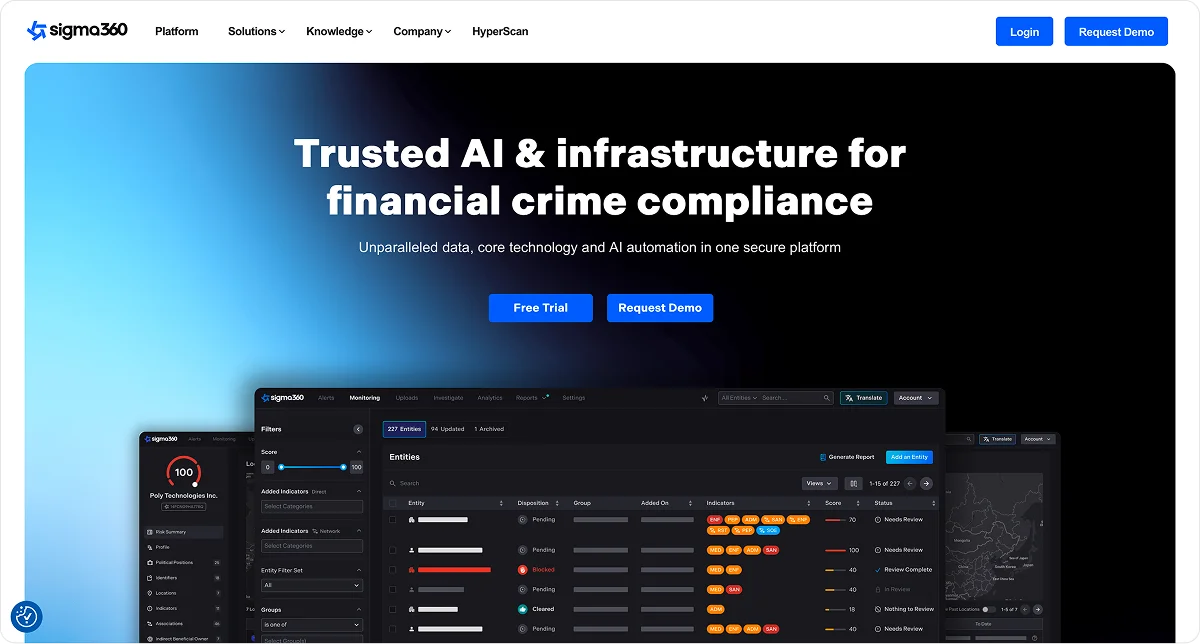
Sigma360 runs sanctions and watchlist screening, adverse media, perpetual KYC, enhanced due diligence, AML investigations, and third-party risk from a single shared entity record, so every signal on a counterparty appears in one investigation view without analysts pulling data from separate systems.
That record draws on 100B+ data points, 150+ corporate registries, 1.7M PEPs across 232 jurisdictions, and a network graph of 1.6B records and 2.5B relationships. Sigma360 has also flagged 7M+ non-sanctioned entities connected to sanctions risk, indirect exposure that name-level watchlist checks do not reach.
Chartis Research ranked Sigma360 first on technical capability across both screening and adverse media in its 2026 evaluation, achieving the highest technical capability score in each quadrant, ahead of every other assessed vendor.
Key features
- Automates false positive clearance via the Match Agent, reducing manual match reviews by 90%
- Compiles watchlist status, registry data, KYC records, and adverse media into a structured risk profile through the Entity Summary
- Flags risk status changes on already-onboarded entities continuously, so portfolio monitoring does not rely on periodic reviews
- Logs every alert, analyst decision, and AI recommendation in an exportable audit trail for regulatory examination
Best for: Sigma360 is the strongest fit for tier 1 banks, fintechs, payments firms, and globally exposed corporates that need integrated coverage across onboarding, continuous monitoring, investigation, and regulatory reporting.
Limitations: Sigma360 is a full compliance platform, not a data feed. Teams whose only requirement is additional list data on top of an existing screening tool are buying a narrower product than Sigma360 is built to deliver.
2. ComplyAdvantage
ComplyAdvantage positions Mesh as a financial crime risk platform built around risk data ingested directly from source (sanctions lists, PEP registers, and adverse media), which the company says it refreshes continuously.
The data is organized into a continuously updated knowledge graph, mapping relationships between entities rather than matching names against flat lists.
The platform covers customer screening, ongoing monitoring, payment screening, and transaction monitoring in a single environment. Chartis placed ComplyAdvantage in the Category Leader for both Name and Transaction Screening and Adverse Media Monitoring, a quadrant placement that reflects coverage and market presence across both categories.
Key features
- Delivers results via API with developer documentation designed for fast product integration
- Applies dynamic risk scoring that updates customer and counterparty profiles as new information arrives
- Provides configurable alert thresholds and risk-based alert frequencies, adjustable within the platform
- Offers adverse media filtering by risk category, jurisdiction, and publication date
Best for: ComplyAdvantage works best for fintechs, payment firms, and mid-market institutions where speed of deployment and API-first architecture take priority over deep investigation tooling. Investigations and case handling are typically managed in a separate system.
Limitations: There is no standalone enhanced due diligence product and no native investigation workflow, so teams that document case decisions or run EDD escalations generally add a second system to cover it.
Organizations with complex global counterparty profiles or high adverse media volumes should test false positive rates on their own data before signing rather than relying on configuration to close the gap afterward.
3. LexisNexis Risk Solutions
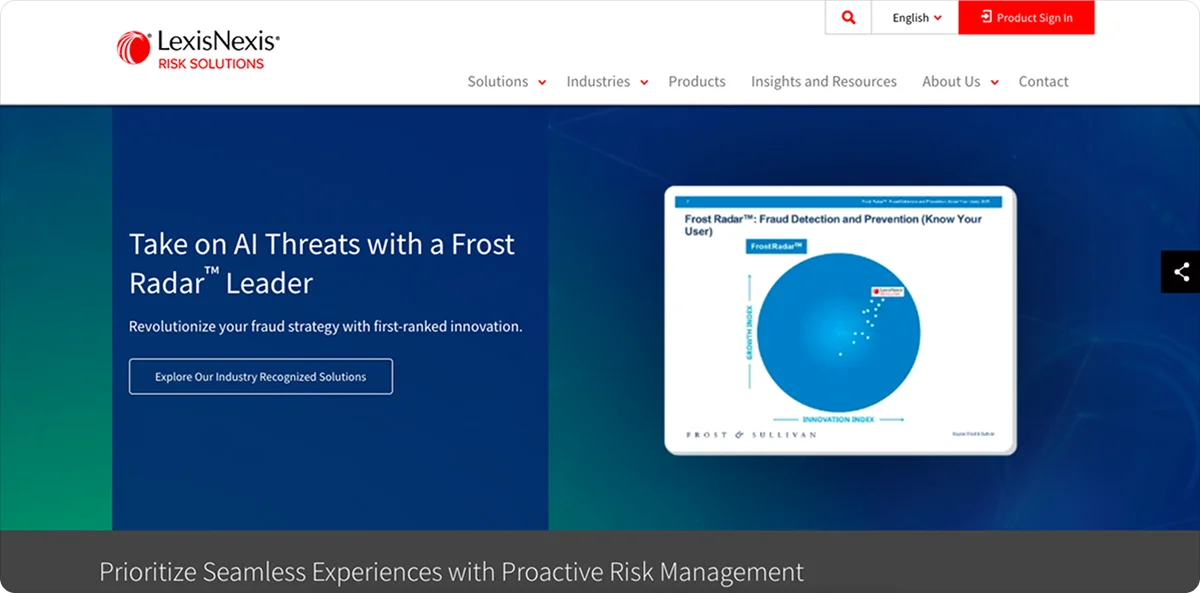
LexisNexis Risk Solutions centers its financial crime offering on WorldCompliance, a curated risk dataset covering sanctions, PEPs, adverse media, and enforcement actions across more than 50 risk categories, with updates delivered up to four times daily within 24 hours of designation at the source.
In the FCC50 2026, Chartis placed LexisNexis among the top financial crime compliance technology providers globally, citing strength in proprietary data and contextual transaction screening.
Key features
- Supports KYC workflow management through Client Lifecycle Management and AML Insight, covering CIP, BSA, and enhanced due diligence
- Connects screening, monitoring, and case management through RiskNarrative, a no-code orchestration layer accessible via a single API
- Applies location-based sanctions risk detection through Financial Crime Digital Intelligence, identifying exposure tied to transaction geography rather than named entities alone
- Provides structured adverse media coverage across global publications in multiple languages via WorldCompliance
Best for: Organizations already standardized on LexisNexis infrastructure will find the most value here, as will those needing the broadest curated risk content through a single vendor relationship.
Limitations: The platform spans multiple products, including Bridger Insight XG, WorldCompliance Data, AML Insight, Client Lifecycle Management, Compliance Lens, and RiskNarrative. Buyers need to clarify which components they need before they can understand what it will cost.
Read more: Sigma360 vs. LexisNexis Risk Solutions
4. NICE Actimize
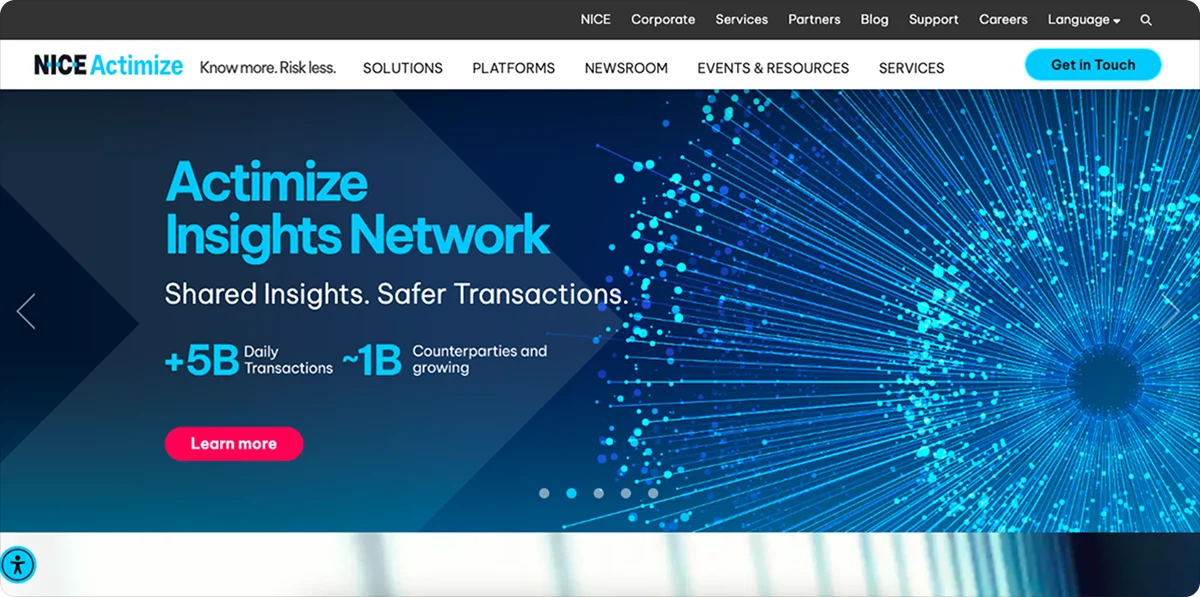
NICE Actimize built its X-Sight Enterprise suite around entity-centric AML, behavioral analytics, and case management for large financial institutions. NICE Actimize cites internal figures of up to 70% faster SAR filing through X-Sight AI Narrate and a 50% or greater reduction in investigation time through InvestigateAI. Both are vendor-reported and not independently verified.
Independently of those figures, Celent named NICE Actimize a Leading Luminary in its 2026 KYC Solutionscape, citing its configurable rules engine, event-based risk triggers, and perpetual KYC support that keeps risk profiles current without manual intervention.
Key features
- Detects suspicious behavioral patterns and entity relationships using AI and machine learning across customer, transaction, and counterparty datasets
- Provides prebuilt scenario libraries covering a broad range of AML and financial crime typologies
- Monitors customer risk continuously through event-based triggers, updating risk profiles as new information arrives
- Supports multi-jurisdictional regulatory reporting with audit trails built into the platform architecture
Best for: NICE Actimize is purpose-built for Tier 1 banks with dedicated financial crime transformation programs, high volumes, and internal teams capable of managing complex implementation and ongoing configuration.
Limitations: Implementation timelines are substantial, and pricing reflects enterprise transformation scope. Mid-market institutions and fintechs will find the overhead proportionate only if they have the internal capacity to match it.
5. Napier AI
Napier AI’s Continuum platform is created for risk teams that need modern screening without a multi-year implementation. Configuration is handled by business users rather than engineering teams, and rule changes can be tested against real data in a pre-production sandbox before going live.
The matching engine covers 25+ languages, including Simplified Chinese and Arabic, catching name variants and transliterations, a capability Celent cited when evaluating Napier AI as a Technology Standout for its multilingual matching architecture and screening speed in Celent’s 2024 watchlist screening evaluation.
Key features
- Supports client and counterparty screening across sanctions, PEPs, and adverse media in both real-time and batch modes
- Enables risk and compliance staff to configure and test alert logic without engineering support, using a pre-production sandbox
- Covers private watchlists alongside standard public sanctions sources, with automated list update management
- Provides team-level visibility into alert volumes, screening activity, and workflow performance through configurable dashboards
Best for: Napier AI is a strong choice for mid-sized banks, fintechs, and asset managers that need configurable screening with low implementation overhead and fast deployment.
Limitations: Organizations that need deep adverse media analysis, EDD workflows, or network intelligence beyond entity-level screening will need to supplement with additional tooling.
What the regulatory environment requires of your software
The US and EU now expect the same thing from financial crime compliance programs. Both require demonstrated effectiveness, not just technical implementation. The EU AI Act’s Annex III deadline was pushed to 2 December 2027 following the Digital Omnibus amendment adopted by the EU Council on 29 June 2026.
The table below maps both US and EU developments to what they require of any platform on your shortlist.
| Regulation | Region | Key date | What it requires of your software |
| FinCEN AML/CFT Program Rule (proposed) | US | 12 months after final rule | Effectiveness-based, risk-focused programs with demonstrable outcomes |
| Federal Reserve AML/CFT Proposal | US | Comment deadline 8 September 2026 | Risk-based efficacy standards aligned with FinCEN framework |
| EU AI Act, Annex III high-risk obligations | EU | 2 December 2027 | Explainability, human oversight, and documented AI decision logic for screening and monitoring systems |
| AMLR | EU | 10 July 2027 | Harmonized CDD, 25%-or-more UBO threshold, suspicious transaction reporting across all member states |
| AMLA direct supervision | EU | Full powers 1 July 2027 | Enhanced supervisory reviews for the largest EU obliged entities |
A platform that cannot produce explainable AI recommendations, documented decision trails, or evidence of program effectiveness creates regulatory exposure across both regions. Any vendor on the shortlist should be able to answer these questions without hesitation:
- What false positive rates do your clients experience in production, and how do you measure them?
- How does the platform document AI-assisted decisions in a format a regulator can examine?
- What does the implementation timeline look like in practice, and what does your team own versus ours?
- Can compliance teams adjust alert thresholds and add data sources without opening an engineering ticket?
Read more: How to choose the right screening software solution
How Sigma360 addresses all four questions
Sigma360 addresses all four questions directly. Its adverse media coverage reaches 225M+ articles from 730K publishers across 124 languages, with the Adverse Media Agent grouping related articles by impact level and match strength into structured, auditable summaries.
The global payments case study documents $1M saved annually through automated screening, and a top-10 global financial institution transformed its adverse media review on the same platform.
The platform is SOC 2 Type II and ISO 27001 certified, aligned with ISO 27017, ISO 27018, and ISO 420001, and maintains 99.9% uptime, making it deployable in regulated environments where security and reliability standards are non-negotiable.
Request a demo to see how Sigma360 handles financial crime compliance.
FAQ
What is the difference between a risk intelligence platform and a data provider in financial crime compliance?
A risk intelligence platform combines screening, adverse media, investigation workflows, ongoing monitoring, and AI-assisted triage in one environment. A data provider supplies structured risk data but leaves alert handling, case management, and decision documentation to the buyer. A data feed alone does not constitute a compliance program.
Does financial crime compliance software cover transaction monitoring?
Not by default. Most platforms reviewed here focus on customer screening, adverse media, ongoing monitoring, and EDD. Transaction monitoring is typically a separate system or module. Confirm with any vendor whether it is included or requires an additional product.
What is the difference between perpetual KYC and periodic review?
Periodic review checks a customer’s risk profile at fixed intervals. Perpetual KYC monitors continuously and triggers an alert when a specific change occurs, catching risk as it happens instead of waiting for the next scheduled review.
How should compliance teams evaluate false positive rates when comparing vendors?
Ask for client-reported rates from live production environments, not demonstration results. Specify how the rate is calculated and what configuration was applied. The difference between a vendor demonstration and a live deployment is where most comparisons break down.
What is the difference between financial crime compliance software and GRC software?
GRC platforms cover broad enterprise risk and compliance frameworks, including audit, policy management, and operational risk. Financial crime compliance software is purpose-built for AML, sanctions screening, adverse media, and CDD workflows that regulators examine directly. Most institutions need both.

