
Financial crime compliance teams increasingly expect more from screening technology than access to sanctions, politically exposed person (PEP), and adverse media data.
A sanctions or watchlist screening program must identify potential risk accurately, but institutions also need to investigate alerts, understand indirect relationships, document decisions, manage changing risk, and demonstrate how those decisions were reached.
LSEG World-Check remains one of the most established risk intelligence providers in the market, with extensive sanctions, PEP, enforcement, and adverse media coverage. For many financial institutions, it has served as a foundational source of compliance data for years.
However, changing requirements around real-time screening, AI-assisted investigations, perpetual monitoring, entity resolution, ownership risk, and operational efficiency are leading some institutions to evaluate alternatives or complementary platforms.
The best choice depends on what an organization is trying to improve.
Some providers specialize in curated risk intelligence, while others focus on graph analytics, transaction monitoring, or configurable screening infrastructure. Platforms such as Sigma360 take a broader approach by combining risk data, screening technology, investigations, adverse media, AI-assisted decisioning, and continuous monitoring within one environment.
This guide compares five World-Check alternatives based on the different problems compliance teams may be trying to solve.
Disclaimer: This guide is published by Sigma360 and includes Sigma360 among the platforms evaluated. Comparisons are based on publicly available vendor information, independent analyst research, and differences in product architecture and intended use cases. Buyers should validate capabilities, coverage, pricing, and implementation requirements directly with each provider.
Key takeaways:
- There is no universal replacement for World-Check
The right alternative depends on whether the priority is better data, fewer false positives, ownership intelligence, transaction monitoring, investigations, or broader platform consolidation.
- Risk data and compliance operations are different capabilities
Dow Jones and Quantexa are data and intelligence providers. They improve what you screen against but leave the investigation, the decision, and the audit trail to other systems.
- Ownership and network risk are becoming increasingly important
Under the OFAC 50% Rule, entities owned 50% or more in the aggregate by blocked persons are themselves blocked even if they are not separately named on a sanctions list.
- Speed matters in transaction screening
Institutions processing real-time or high-volume payments should evaluate how quickly sanctions updates reach active screening environments.
- AI governance should be part of vendor evaluation
As AI takes a larger role in alert prioritization and investigation, explainability, human oversight, decision history, and auditability become increasingly important. Regulatory expectations are evolving, including requirements under the EU AMLR and U.S. FinCEN effectiveness standards.
- Sigma360 is particularly well suited to organizations seeking platform consolidation
Sigma360’s strongest use case is not simply replacing one screening database with another. It is consolidating screening, risk intelligence, adverse media, investigations, AI-assisted workflows, and ongoing monitoring around a shared view of an entity.
How we evaluated the best World-Check alternatives
Each platform was assessed against five criteria, weighted to reflect the specific limitations a data-only provider creates for regulated institutions:
- Operational layer completeness (30%): Coverage of investigation workflows, case management, alert decisioning, and an audit trail beyond returning a match
- Indirect and network risk coverage (25%): Ability to detect exposure through ownership structures, UBO chains, and entity relationships that do not appear on published watchlists by name
- Data freshness and source control (20%): Speed at which new sanctions designations reach live screening after publication, and how fully the vendor controls the data pipeline rather than licensing from intermediaries
- Deployment realism and configurability (15%): Time to go live, and the ability for compliance teams to tune thresholds and add data sources without vendor involvement
- Regulatory readiness (10%): Capacity to produce explainable AI decisions and audit-trail documentation that satisfies examination under AMLR, FinCEN effectiveness standards, and equivalent regulatory regimes
The 5 best World-Check alternatives in 2026
Each alternative below addresses a different reason compliance teams look beyond a data-only provider. The table maps each one:
| Platform | Primary strength | Particularly suited for | Considerations |
| Sigma360 | Unified financial crime compliance platform | Organizations seeking screening, adverse media, investigations, entity intelligence, AI automation, and monitoring in one platform | Broader platform evaluation than purchasing a standalone data subscription |
| Dow Jones Risk & Compliance | Curated risk intelligence and adverse media | Organizations prioritizing researched risk content and sanctions ownership data | Institutions may use separate systems for broader investigations and workflow |
| Quantexa | Entity resolution and graph analytics | Large organizations analyzing complex relationships across internal and external datasets | More extensive data integration may be required |
| Napier AI | Configurable AML and screening infrastructure | Institutions prioritizing configurable AML workflows and transaction monitoring | Broader EDD and adverse media requirements should be evaluated separately |
| ComplyAdvantage | AI-native screening and payment screening | Organizations prioritizing modern screening architecture and real-time payments | Buyers should evaluate investigation depth relative to their operating model |
1. Sigma360
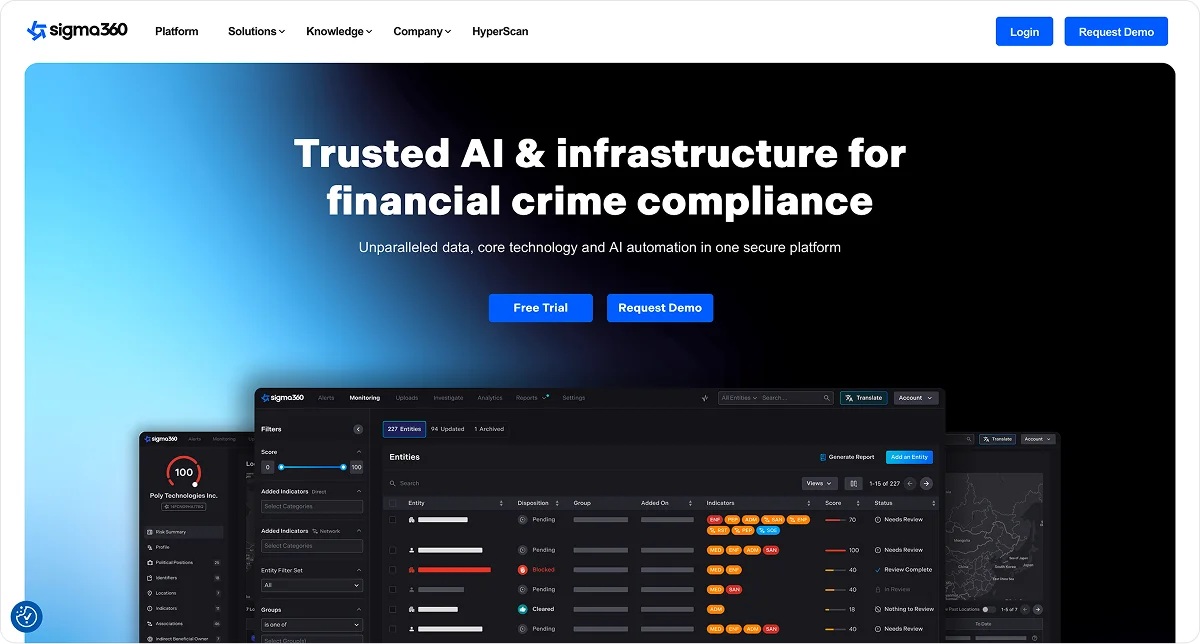
Best for: Consolidating screening, risk intelligence, investigations, and monitoring
Sigma360 is the strongest fit on this list for organizations whose objective extends beyond replacing one risk database with another.
The platform brings together global risk intelligence, sanctions and watchlist screening, transaction screening, adverse media, entity intelligence, investigations, AI-assisted workflows, and perpetual monitoring within a unified environment.
The architecture addresses an increasingly common compliance problem: Information may exist across multiple systems, but analysts still have to reconcile the results before making a decision.
Sigma360 instead centers workflows around the entity being evaluated, allowing screening results, corporate information, adverse media, relationships, investigative evidence, and decision history to contribute to a common risk view.
Chartis Research’s 2026 RiskTech Quadrant placed Sigma360 at the top on technical capability across both screening and adverse media, and the FCC50 2026 ranked it first in Adverse Media Solution and Adverse Media Data for the second year running.
Key capabilities
- Clearing false positive alerts through the Match Agent, applying entity resolution across the same data layer that ran the original screen
- Compiling watchlist status, corporate registry data, KYC records, and adverse media into a structured risk profile through the Entity Summary
- Running continuous portfolio monitoring through Perpetual KYC, rescreening onboarded entities automatically when new designations or risk-relevant events occur
- Capturing every alert, analyst decision, and AI recommendation in an exportable, timestamped record through the AI360 Oversight Dashboard for regulatory examination
- Tuning match thresholds, filter sets, and data source selections within the platform, with no coding required
Sigma360 vs. World-Check
World-Check is primarily a risk intelligence and structured profile provider. Sigma360 combines risk intelligence with the technology required to screen, investigate, monitor, and manage decisions.
Institutions whose compliance infrastructure is settled and whose primary need is an established external risk dataset will find World-Check adequate for that scope. Those trying to consolidate multiple systems, reduce manual investigations, introduce AI-assisted workflows, identify relationship-based risk, or continuously monitor their customer population are evaluating a different kind of problem, one where the data layer alone does not resolve it.
The procurement question in those cases changes from: “What data should we screen against?” to: “How should we detect, investigate, decide, and continuously monitor financial crime risk?”
2. Dow Jones Risk & Compliance
Best for: Curated risk intelligence
Dow Jones Risk & Compliance is another established provider of sanctions, PEP, ownership, and adverse media intelligence. One of its major differentiators is its access to a substantial global news operation and curated risk information.
For institutions operating in emerging markets or jurisdictions where reliable structured information may be difficult to obtain, human-researched intelligence can be particularly valuable.
Key capabilities
Dow Jones provides sanctions intelligence, PEP coverage, adverse media, ownership and control data, and risk and compliance research. Its Sanctions Control and Ownership dataset is particularly relevant to organizations examining entities that may be owned or controlled by sanctioned parties.
Dow Jones vs. World-Check
The two providers compete most directly as established sources of financial crime risk intelligence. The decision may therefore depend on geographic coverage, adverse media requirements, research methodology, PEP coverage, ownership intelligence, and existing technology infrastructure.
Organizations should also distinguish between risk intelligence and the broader investigation environment where alerts are resolved. Those that already have mature screening and case-management infrastructure may be comfortable using either provider as an intelligence source. The ones looking to consolidate data, screening, investigations, and monitoring may want to evaluate broader platforms alongside them.
Read more: Sigma360 vs. Dow Jones Risk & Compliance
3. Quantexa
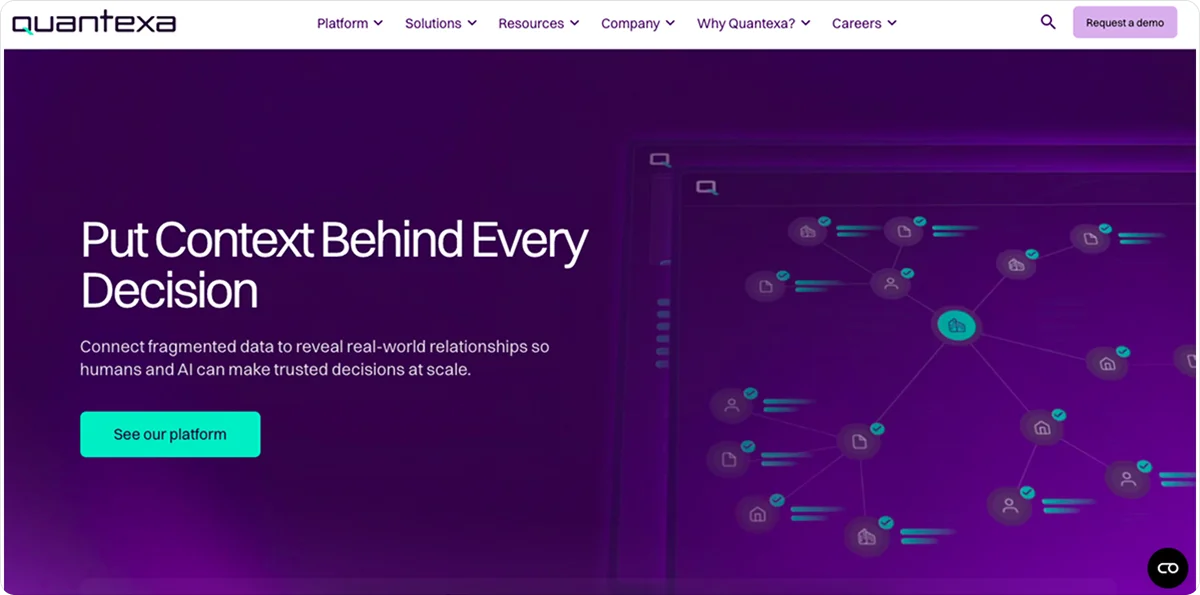
Best for: Complex entity and relationship analytics
Quantexa approaches financial crime risk from a different direction. Its Decision Intelligence Platform uses entity resolution and graph analytics to identify relationships across large internal and external datasets.
This approach can be valuable for institutions where risk cannot be understood through a single customer or counterparty record. For example, a relationship may only become significant when an organization connects corporate ownership, trade activity, transactions, accounts, individuals, addresses, counterparties, and other internal data.
Key capabilities
Quantexa emphasizes entity resolution, network analytics, graph visualization, relationship intelligence, contextual decisioning, and investigation support. These capabilities can be especially useful for sanctions circumvention, complex ownership structures, fraud networks, and sophisticated financial crime investigations.
Quantexa vs. World-Check
Quantexa’s graph analytics identify connections to risk that never reach any published list, which is the dimension World-Check’s structured profiles were not built to address. Full capability requires significant data integration upfront, making it a stronger fit for institutions with mature internal data assets.
4. Napier AI
Best for: Configurable screening and AML infrastructure
Napier AI provides a modular financial crime compliance platform covering areas such as client screening, transaction monitoring, and transaction screening. A central part of its proposition is configurability.
Compliance teams can configure risk logic and test changes without relying heavily on engineering resources, which can be particularly valuable for institutions whose AML programs evolve frequently.
Key capabilities
Napier AI offers capabilities including client screening, transaction screening, transaction monitoring, risk scoring, configurable matching, workflow management, and audit trails. Its Perpetual Client Risk Assessment capability also reflects the broader industry movement away from static customer risk reviews toward more continuous assessment.
Napier AI vs. World-Check
Where World-Check demands specialist resources to configure and maintain, Napier’s no-code sandbox and modular deployment model remove that overhead for mid-sized compliance teams. Programs that require deep adverse media analysis, EDD, or network-level ownership intelligence will need additional tooling alongside it.
5. ComplyAdvantage
Best for: Modern screening architecture
ComplyAdvantage has built its position around an AI-native approach to financial crime screening and monitoring. Its platform covers areas including sanctions, PEPs, adverse media, customer screening, and payment screening.
The company’s architecture emphasizes direct ingestion of risk data and rapid updates, making it particularly relevant to organizations operating high-speed payment environments.
Key capabilities
ComplyAdvantage offers capabilities including customer screening, sanctions screening, PEP screening, adverse media, payment screening, risk categorization, and automated alert remediation. Its payment screening capabilities are particularly relevant to banks, payment providers, remittance companies, fintechs, and other institutions where transaction authorization occurs in real time.
ComplyAdvantage vs. World-Check
For institutions on real-time payment rails, designation timing determines exposure, and World-Check’s update pipeline runs on analyst capacity. ComplyAdvantage’s direct-ingest architecture means new designations reach live screening in minutes. EDD workflows and complex multi-entity investigations require separate tooling outside Mesh.
Read more: Sigma360 vs. ComplyAdvantage
Questions to ask before replacing World-Check
Not every evaluation starts with the same problem. The questions below help compliance teams identify what they actually need from a replacement before shortlisting vendors.
1. Is the organization replacing a data source or a compliance system?
These are fundamentally different procurement projects.
If the primary requirement is access to sanctions, PEP, and adverse media intelligence, traditional data providers remain relevant.
If, on the other hand, the objective is to reduce alert volumes, consolidate investigations, monitor customers continuously, or automate repetitive analyst work, a broader compliance platform may be more appropriate.
2. How important is indirect risk?
Organizations exposed to complex corporate structures should determine whether direct list matching provides sufficient coverage. Ownership, control, network relationships, and associated entities may require additional corporate and relationship intelligence.
3. How much investigation happens manually?
Screening accuracy is only one component of total compliance cost. Organizations should measure how much analyst time is spent gathering supporting information, searching corporate records, reviewing adverse media, resolving identity ambiguity, documenting decisions, preparing case reports, and rescreening existing customers.
Reducing these activities can have as much operational impact as improving match accuracy.
4. How will AI be governed?
AI capabilities should be evaluated based on more than automation rates. Financial institutions should understand where AI is used, what information supports its recommendations, when human review occurs, how overrides work, and what evidence is retained.
5. Does the platform support the organization’s future operating model?
A platform chosen today may remain part of a compliance architecture for years. Buyers should therefore evaluate not only current screening requirements but also future needs around perpetual KYC, adverse media, EDD, transaction screening, entity intelligence, AI-assisted investigations, network risk, regulatory reporting, and global expansion.
Which World-Check alternative is right for you?
The right alternative depends on what World-Check is failing to provide. The table below maps each problem to the platform built for it:
| If your problem is | Best fit | Key limitation |
| No investigation workflow or audit trail | Sigma360 | Higher implementation scope than a data-only subscription |
| Adverse media quality on emerging market entities | Dow Jones Risk & Compliance | Data provider only, no operational layer |
| Indirect exposure through ownership structures | Quantexa | Graph-first and data-integration-heavy; does not include end-to-end investigation workflow |
| Enterprise implementation overhead | Napier AI | No adverse media depth or EDD workflows |
| Designation timing on live payment rails | ComplyAdvantage | Limited EDD and investigation depth |
Organizations whose screening requirements are stable and well-served by an established risk database may find World-Check continues to meet their needs. Where the problem is operational (too many alerts, too much manual work, too many disconnected systems), a better risk database does not solve it.
Compliance teams now have to connect data from multiple sources, identify relationships between entities, investigate high volumes of alerts, document why decisions were made, monitor customers continuously, and introduce AI without sacrificing governance.
The criteria for evaluating financial crime technology have shifted accordingly. Instead of asking only which provider offers the largest risk database, organizations may also need to ask:
- How much analyst work occurs outside the platform?
- How many systems are required to resolve an alert?
- Can indirect ownership and relationship risk be identified?
- Can investigators understand why an alert was generated?
- Can AI recommendations be reviewed and overridden?
- Does the system retain a defensible decision history?
- Can existing customers be monitored as their risk changes?
- Can compliance teams configure the platform without engineering support?
Sigma360 is particularly well positioned for organizations where these questions are becoming more important because the platform combines the intelligence layer with the operational layer used to act on that intelligence.
Independent Chartis research reinforces this positioning. Sigma360 has been recognized for its screening data methodology, workflow, adverse media capabilities, reporting and auditing, deployment, configurability, and performance, making it a particularly strong option for institutions looking to modernize more than a single component of their compliance stack.
Request a demo to see how Sigma360 handles sanctions and watchlist screening in your environment.
FAQ
Is LSEG World-Check the same as Refinitiv World-Check?
Yes. Refinitiv was acquired by LSEG in 2021, and World-Check is now marketed under the LSEG brand with the same underlying database and research methodology.
Does World-Check include investigation workflows or case management?
No. World-Check returns structured risk profiles. Investigation workflows, case decisions, and audit trail documentation happen in a separate system.
How often does World-Check update its data?
World-Check On Demand, launched in September 2025, delivers data updates in real time via API as records are created, per LSEG. Institutions screening live payment rails should verify update latency against their payment authorization requirements.
What will the EU AMLR require of screening platforms from July 2027?
The EU AML Regulation requires obliged entities to maintain explainable, auditable AI-assisted compliance decisions that can be traced and reviewed by a regulator.
What is the difference between sanctions screening and sanctions monitoring?
Sanctions screening checks an entity against published watchlists at a point in time. Sanctions monitoring, on the other hand, runs continuously, triggering alerts when a cleared entity’s risk status changes after onboarding.
Does World-Check publish pricing?
World-Check One offers self-service packages starting at £300 per month. Enterprise and API contracts are sales-quoted with no public pricing on the LSEG website.
Does World-Check cover ultimate beneficial ownership?
UBO data is available in World-Check One as an optional add-on, powered by Dun & Bradstreet, and is not part of the core World-Check database.

