Financial crime compliance costs institutions in the US and Canada $61 billion annually, according to a Forrester study commissioned by LexisNexis, and a growing share of that cost comes from managing the tools themselves.
LexisNexis Risk Solutions is the incumbent platform across much of the financial sector. Its curated risk database, WorldCompliance, gives teams broad sanctions, PEP, adverse media, and enforcement coverage in one dataset.
Putting it to work, however, means navigating six separate products (WorldCompliance Data, Bridger Insight XG, AML Insight, Client Lifecycle Management, Compliance Lens, and RiskNarrative), each carrying its own implementation scope, commercial track, and learning curve.
If LexisNexis is on your shortlist, or if you are already using it and questioning the fit, this article covers the five strongest LexisNexis Risk Solutions alternatives in 2026 from Sigma360’s perspective as a platform in the same market.
Key takeaways:
- Sigma360, ComplyAdvantage, LSEG World-Check, Dow Jones, and Moody’s each serve a different compliance use case
Picking the wrong platform category creates problems that only become visible at audit time, so matching the tool to the actual problem is the most important decision for your business.
- LSEG World-Check and Dow Jones are data providers, not replacement platforms
Both supply curated risk content into existing screening infrastructure rather than replacing it, making them the right fit only for teams that already have a screening environment in place.
- Data pipeline ownership affects how many vendor relationships a compliance team has to manage
Some platforms source risk data through licensed third-party feeds, adding commercial and operational dependencies. ComplyAdvantage reports building and maintaining its own data pipeline end-to-end.
- Sigma360 is the alternative that covers the full compliance workflow in one environment
Sigma360 consolidates screening, adverse media, perpetual KYC, EDD, and investigations into one environment, so compliance teams spend time managing risk instead of managing tools.
How we selected the best LexisNexis Risk Solutions alternatives
Each platform below was evaluated against the criteria compliance teams use in real procurement decisions. The weighting reflects where platforms differ most in practice:
- Data coverage and refresh cadence (30%): We assessed breadth across sanctions, PEPs, adverse media, and enforcement actions, and the speed at which new designations reach live screening after publication.
- False positive performance and AI explainability (25%): We examined entity resolution methodology, client-reported false positive rates in production, and the ability of AI-assisted decisions to produce auditable outputs that satisfy regulatory examination.
- Platform completeness (20%): We evaluated coverage across screening, adverse media, ongoing monitoring, and EDD without requiring a second vendor to complete the workflow.
- Deployment realism (15%): We reviewed time to go live, API availability, and compatibility with existing KYC and case management infrastructure.
- Enterprise readiness and security governance (10%): We reviewed deployment scale, uptime standards, SOC 2 or equivalent certification, audit trail completeness, and AI decision explainability as markers of production-grade compliance infrastructure.
The 5 best LexisNexis Risk Solutions alternatives in 2026
The five platforms below cover different parts of the financial crime compliance market. Here’s how they compare:
| Platform | Type | Best for | Primary strength |
| Sigma360 | Unified AI-powered risk intelligence platform | Banks, fintechs, payments firms, corporates | Unified screening, adverse media, pKYC, EDD, and investigations from one entity record |
| ComplyAdvantage | AI-native screening platform | Fintechs, mid-market, API buyers | Screening, risk data, and API-based deployment |
| LSEG World-Check | List data provider | Large enterprises, regulated institutions | Watchlist, sanctions, PEP, and risk intelligence data |
| Dow Jones Risk & Compliance | Risk data and due diligence platform | Third-party risk, corporate compliance, EDD | Adverse media, risk intelligence, and due diligence |
| Moody’s | Corporate entity intelligence platform | KYB, UBO analysis, counterparty credit risk | Corporate entity, ownership hierarchy, and relationship intelligence |
1. Sigma360
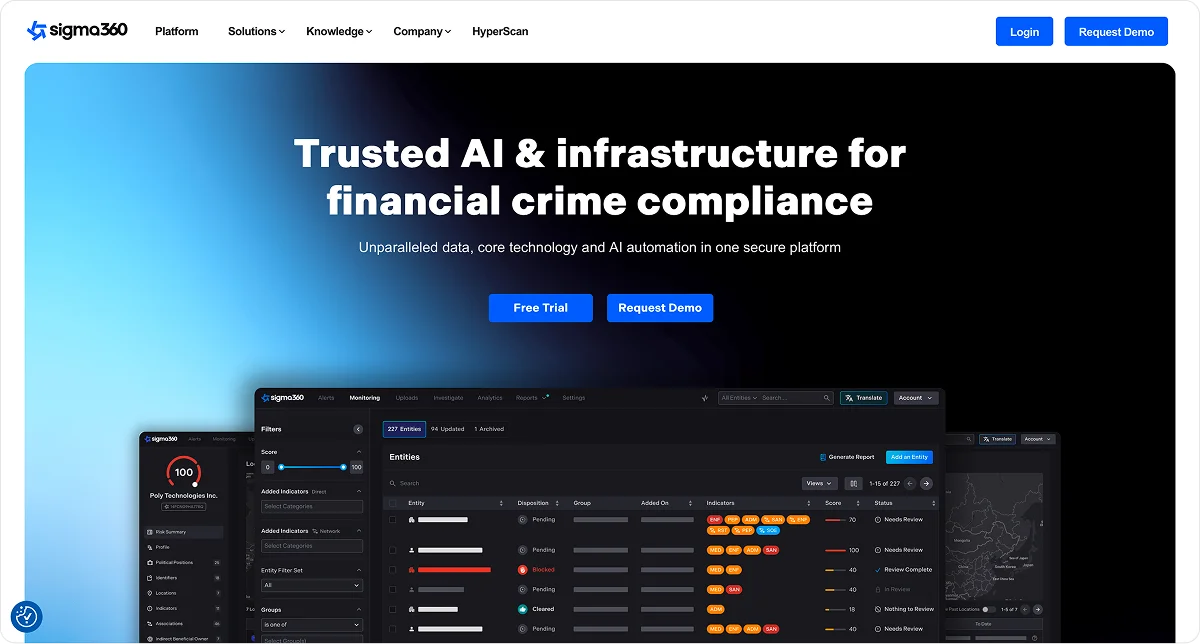
Sigma360 is a unified AI-powered risk intelligence platform built for institutions consolidating a multi-product compliance stack. Chartis Research placed this platform at the top of its 2026 technical capability rankings across both name and transaction screening and adverse media monitoring, the only platform assessed to lead in both categories simultaneously.
Its data foundation spans 100B+ data points, 1.7M PEPs across 232 jurisdictions, and a network graph of 1.6B records across 2.5B relationships, positioning it as a direct replacement for teams currently split across LexisNexis’s separate products.
Key features
- Clears false positive alerts automatically through the Match Agent, applying entity resolution and AI scoring to reduce manual match reviews by up to 90%
- Generates structured risk summaries on any entity through the Entity Summary, drawing on watchlist, registry, KYC, and adverse media data from 225M+ articles across 124 languages
- Flags indirect sanctions exposure across 7M+ non-sanctioned entities connected to sanctioned parties through ownership and network relationships, including UBO chains and indirect ownership structures
- Produces a timestamped, exportable audit trail on every alert, analyst decision, and AI recommendation for regulatory examination
Best use case
Sigma360 is best suited to compliance teams at banks, fintechs, payments firms, and globally exposed corporates that need a single environment to manage every stage of the compliance lifecycle.
It is the right fit when teams need sanctions screening, adverse media, perpetual KYC, EDD, and AML investigations on a shared data foundation.
Why Sigma360 is the strongest LexisNexis Risk Solutions alternative
LexisNexis delivers broad risk content but splits it across six products that compliance teams must assemble, configure, and maintain independently. Sigma360 consolidates that coverage into one environment, so analysts move from alert to decision without switching systems.
A leading identity verification provider put this to the test by launching a fully white-labeled KYC product on Sigma360 with minimal implementation effort, going live in a fraction of the time a multi-product deployment would have taken.
Read more: Sigma360 vs LexisNexis Risk Solutions
2. ComplyAdvantage
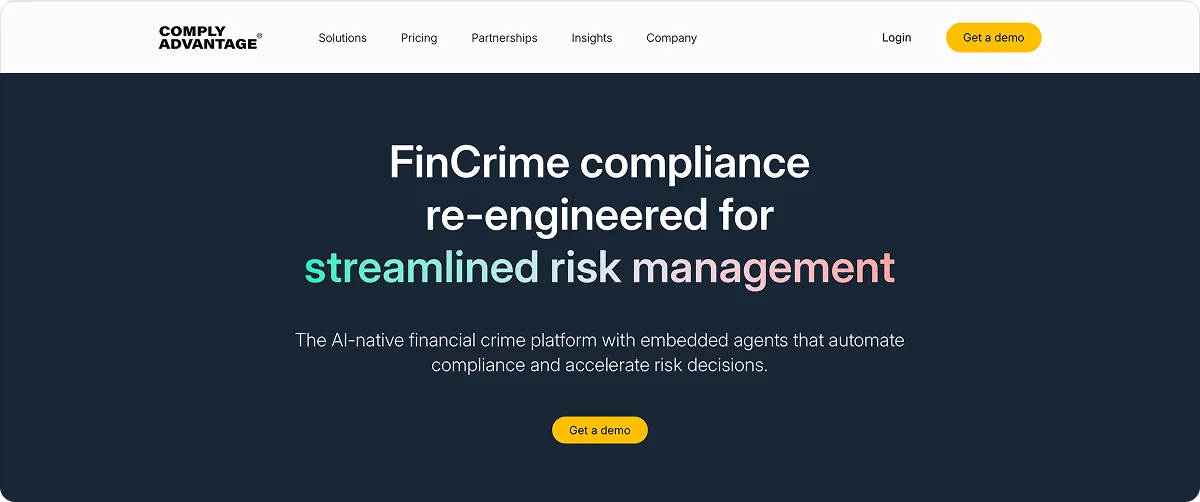
ComplyAdvantage Mesh ingests risk data directly from the source (sanctions lists, PEP registers, adverse media) and organizes it into a continuously updated knowledge graph without routing through licensed third-party feeds.
End-to-end data ownership means one contract and one integration point, with no layered supplier relationships to manage.
Key features
- Maps relationships across what ComplyAdvantage reports as 23 million+ entities through a proprietary knowledge graph, surfacing connections that flat-list matching misses
- Refreshes sanctions and PEP data within minutes of publication at source, faster than most legacy providers
- Delivers screening results via API with developer documentation designed for direct product integration
- Applies dynamic risk scoring that updates customer and counterparty profiles as new information arrives
Best use case
Fintechs, payment firms, and mid-market compliance teams get the most value from ComplyAdvantage when simplifying vendor relationships is as important as screening performance, particularly where LexisNexis’s layered product structure creates procurement or integration overhead.
Why ComplyAdvantage is a good LexisNexis Risk Solutions alternative
Every LexisNexis product comes with its own contract, configuration cycle, and update schedule, creating a management overhead that grows as compliance operations scale.
ComplyAdvantage runs on one platform with one data pipeline, so teams spend their time acting on alerts rather than coordinating vendor relationships. Investigation workflows, EDD, and case management sit outside the platform and will need to be sourced or built separately.
Read more: The #1 ComplyAdvantage alternative in 2026
3. LSEG World-Check
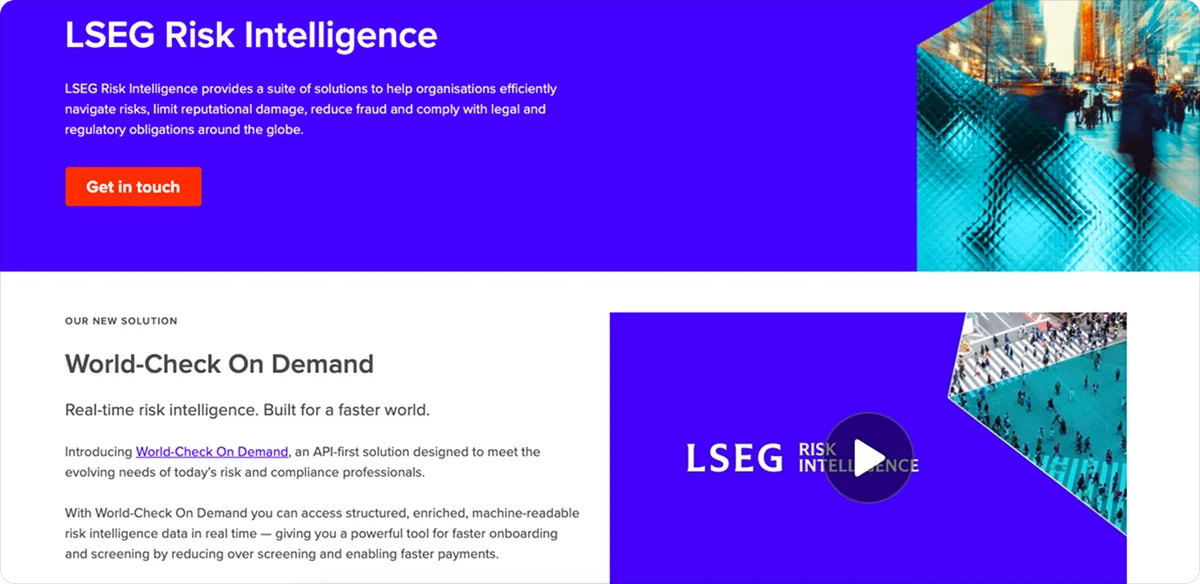
World-Check is a human-curated risk database, not a screening platform. Per LSEG, 500+ researchers and analysts maintain content across 900+ sanctions, regulatory, and law enforcement lists in 158 jurisdictions, producing structured risk profiles that large institutions feed into their own screening tools.
As a data layer with a single integration point, it offers a cleaner procurement decision than a multi-product stack.
Key features
- Aggregates sanctions, PEP, adverse media, and enforcement action content into a single structured feed, with human researchers verifying and enriching profiles continuously
- Structures adverse media into profiles verified by in-house researchers, reducing the volume analysts must review manually
- Supports API-driven deployment through World-Check On Demand, delivering real-time screening with provenance data and granular risk categorization in JSON format
- Applies entity disambiguation through multi-source cross-referencing, reducing false match rates on common names and transliterated aliases
Best use case
World-Check might be the cleanest fit for large institutions that already run their own screening infrastructure and need a trusted, human-curated data layer to feed into it.
Why LSEG World-Check is a good LexisNexis Risk Solutions alternative
Organizations using LexisNexis specifically for risk data will find World-Check a simpler commercial relationship with strong coverage across sanctions, PEPs, and adverse media.
The human-verified profile model produces the structured documentation regulators expect in investigation records, with source attribution and update timestamps on every profile.
4. Dow Jones Risk & Compliance
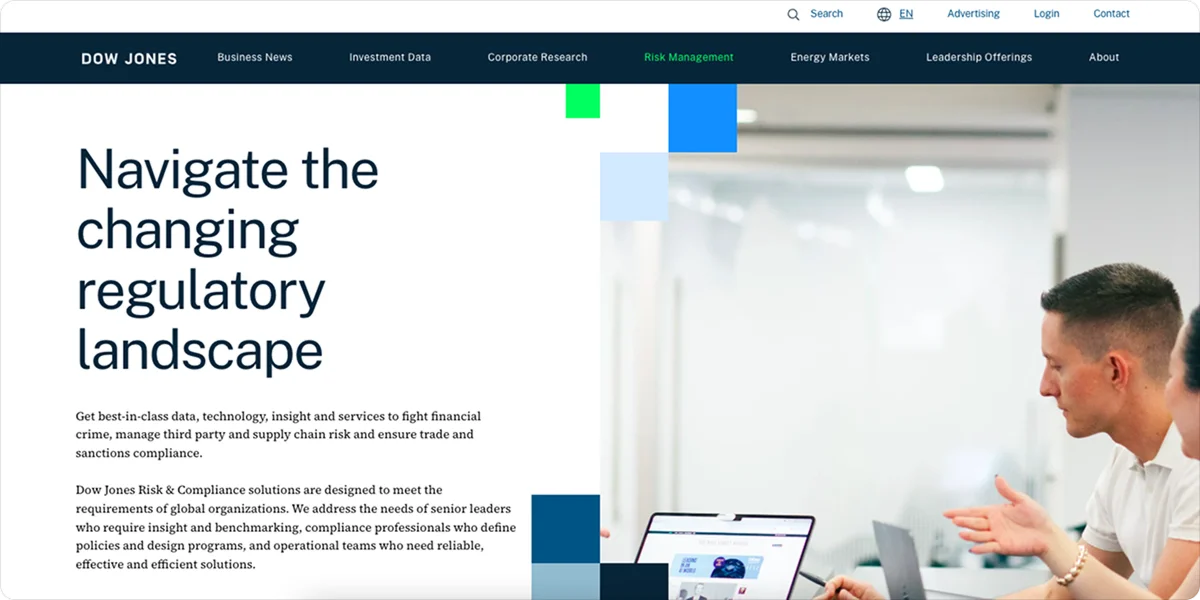
Dow Jones Risk & Compliance is built on the editorial infrastructure of the Dow Jones newsroom. Content covers sanctions, PEPs, watchlists, and adverse media drawn from 33,000+ news sources across 240 countries, according to Dow Jones and verified by a 450-person multilingual research team.
Dow Jones produces much of its risk content in-house, which the company says gives it particular depth on less-common and non-English-language entities that aggregated data feeds often underrepresent.
Key features
- Maintains secondary identifiers on 98% of profiles, supporting disambiguation across common names and multilingual variants
- Sources adverse media from curated premium publications, reducing irrelevant alert volume compared to broad open-web crawl approaches
- Integrates sanctions, PEP, and watchlist content with structured due diligence workflows in a single product, removing the need for separate data feeds
- Provides API access for embedding risk data into onboarding and monitoring systems
Best use case
Dow Jones Risk & Compliance is a natural fit for corporate compliance teams and legal firms where third-party due diligence, supplier screening, and investigative research are the core of the program, and where adverse media quality matters as much as list coverage.
Why Dow Jones Risk & Compliance is a good LexisNexis Risk Solutions alternative
Both Dow Jones and LexisNexis are legacy data originators, but Dow Jones argues its newsroom heritage produces stronger profile depth on less-common and non-English-language entities.
Teams replacing LexisNexis on cost or interface grounds get the same sanctions, PEP, and adverse media scope through a single vendor relationship
Read more: Sigma360 vs. Dow Jones Risk & Compliance
5. Moody’s
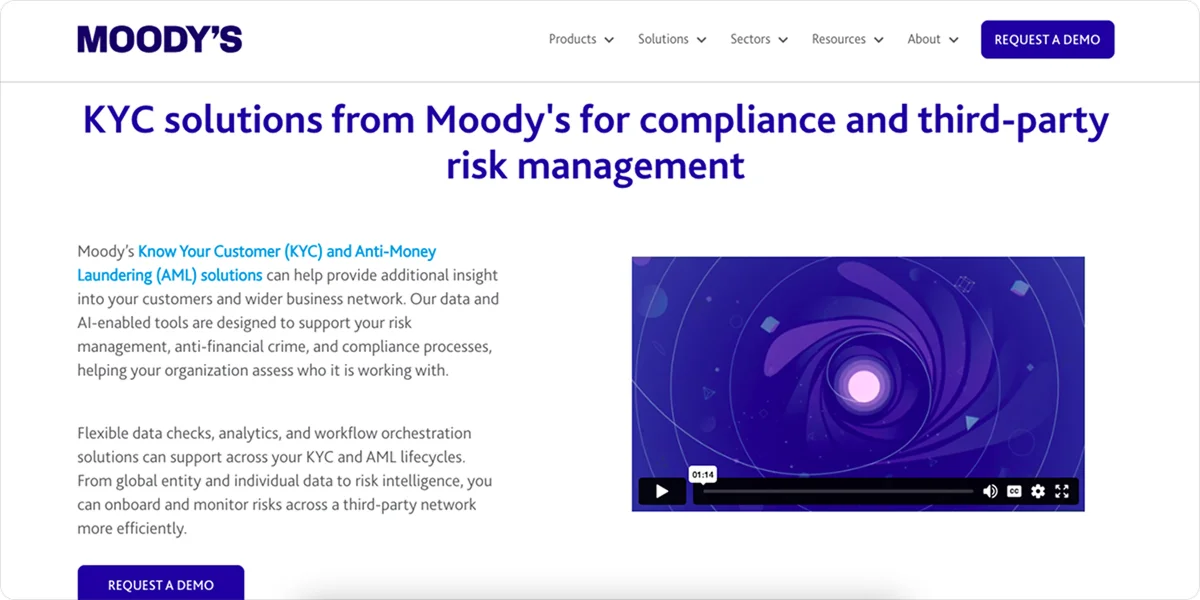
Moody’s approaches financial crime compliance through corporate entity intelligence. Its Compliance Catalyst platform pairs the Orbis entity database (covering 400M+ private and public companies) with Grid, a risk database of adverse media, sanctions, watchlists, and PEPs.
Key features
- Maps beneficial ownership structures across multiple jurisdictional layers, tracing indirect ownership and control chains beyond standard watchlist name matching
- Combines entity resolution with Grid’s risk profiles for screening and due diligence in a single interface without switching tools
- Delivers network graph visualizations of ownership, control, and relationship risk to support KYB investigation and EDD workflows
- Supports API integration for embedding KYC and onboarding data directly into product or compliance infrastructure
Best use case
Moody’s is the strongest fit when KYB, UBO analysis, and counterparty credit risk are the primary requirements and corporate entity data depth is more important than end-to-end compliance workflow coverage.
Why Moody’s is a good LexisNexis Risk Solutions alternative
For teams using LexisNexis primarily for corporate entity research and KYB, Moody’s Orbis database offers deep private company coverage, particularly in emerging markets.
However, Moody’s is an entity intelligence platform rather than an end-to-end compliance environment, and teams that also need screening, adverse media, and investigations will need to source those capabilities separately.
Read more:
Which LexisNexis Risk Solutions alternative is right for you?
The right alternative depends on what is driving the re-evaluation:
- If the problem is operational (configuration locked behind vendor involvement, alert volume that outpaces analyst capacity, or an investigation trail fragmented across several products), the answer is consolidation, not a data swap. Sigma360 replaces the entire LexisNexis stack with one environment.
- If the problem is commercial (cost, contract complexity, or needing curated risk data without assembling a multi-product relationship), LSEG World-Check and Dow Jones Risk & Compliance offer the same coverage categories through a single vendor contract.
- If the priority is speed of deployment (procurement cycles are short, or the environment is API-first), ComplyAdvantage and Sigma360 are both fast routes to production, with Sigma360 maintaining a 100% implementation record across its client base. ComplyAdvantage covers screening and monitoring well, though investigation workflows, EDD, and perpetual KYC are where Sigma360 extends further within the same environment
- If the need is entity research (KYB, UBO mapping, or counterparty credit risk rather than screening volume), Moody’s Orbis and Compliance Catalyst offer deep corporate entity data. Sigma360 also covers UBO and indirect ownership detection within its end-to-end platform, with the distinction being that Moody’s is entity-data-first while Sigma360 integrates those signals directly into screening and investigation workflows.
Compliance teams with the broadest requirements will find Sigma360 the most complete replacement.
SOC 2 Type II and ISO/IEC 27001:2022 certified, maintaining 99.9% uptime, and protecting over $2 trillion in assets across banking, payments, and fintech, it earned Chartis Research’s top technical capability ranking across both screening and adverse media in 2026.
It is also the only option on this list that handles both risk data and the investigation workflow within a single environment.
Request a demo to see how Sigma360 performs in your environment.
FAQ
What is LexisNexis Risk Solutions used for?
LexisNexis Risk Solutions provides risk data and compliance tooling for sanctions screening, PEP checks, adverse media monitoring, and KYC workflows across regulated financial institutions globally.
Is LexisNexis Risk Solutions the same as LexisNexis Legal?
No, they are separate divisions of RELX Group. LexisNexis Risk Solutions covers financial crime compliance and risk data, while LexisNexis Legal covers legal research.
Does LexisNexis Risk Solutions publish pricing?
No. Costs vary by product, data volume, and contract scope, and are disclosed only through a formal sales process.

