
Automated sanctions screening is a compliance control that checks customers, counterparties, and transactions against government watchlists. It is designed to catch restricted parties before they enter a business relationship or move money through it.
However, a program that runs the check and a program that passes regulatory examination are not the same thing.
FATF Recommendation 6 requires countries to implement targeted financial sanctions regimes that freeze designated assets without delay, but the lists those regimes generate change constantly. An institution screening against one authority’s list carries uncovered exposure in every jurisdiction where a different regime applies.
Beyond list complexity, a peer-reviewed study on sanctions screening accuracy published in PMC found that false positive rates in rule-based systems exceed 90%, meaning most compliance teams spend the majority of their alert-handling time on matches that require no action.
This guide explains what effective automated sanctions screening requires in practice, where most programs break down, and what a defensible program looks like under regulatory scrutiny.
Key takeaways:
- Screening the customer name is only the starting point
A compliant program covers beneficial owners, directors, counterparties, vessels, and payment parties. Entities blocked through ownership chains never appear on a published list.
- Most violations trace back to configuration, not missing technology
Scope that is too narrow, list coverage that stops at one jurisdiction, thresholds that are not calibrated, and monitoring that ends at onboarding account for the majority of documented enforcement findings.
- A correct result without a documented decision record is not defensible
Regulators and banking partners evaluate list coverage, match quality, review process, and audit trail. A program that cannot demonstrate all four is weaker than its technical configuration suggests.
- Automation changes how much analyst time goes to each alert, not who decides
AI-assisted triage clears low-confidence mismatches before they reach the queue, but analysts retain responsibility for escalation, blocking, and final determination.
- Sigma360 addresses the failure points most programs leave unresolved
With Sigma360, you get multi-list coverage, AI-assisted alert triage, ownership chain mapping, continuous monitoring, and audit-ready decision trails in a single configurable platform.
What automated sanctions screening covers
Automated sanctions screening compares structured entity data against the official lists maintained by government authorities. The most widely referenced include:
- The OFAC Specially Designated Nationals List
- The UN Security Council Consolidated List
- The EU Consolidated Financial Sanctions List
- The UK Sanctions List
Each is maintained on a separate update cycle, with OFAC updating its SDN list several times a week on average. Institutions with cross-border exposure need coverage across all of them.
Most programs screen the customer name alone, but a compliant program covers considerably more ground:
- Entity level: Directors, beneficial owners, authorized signatories, and agents
- Transaction level: Originating and beneficiary banks, intermediaries, SWIFT codes, IBANs, and payment corridors
- Asset level: Vessels, aircraft, crypto wallets, registration numbers, and known aliases
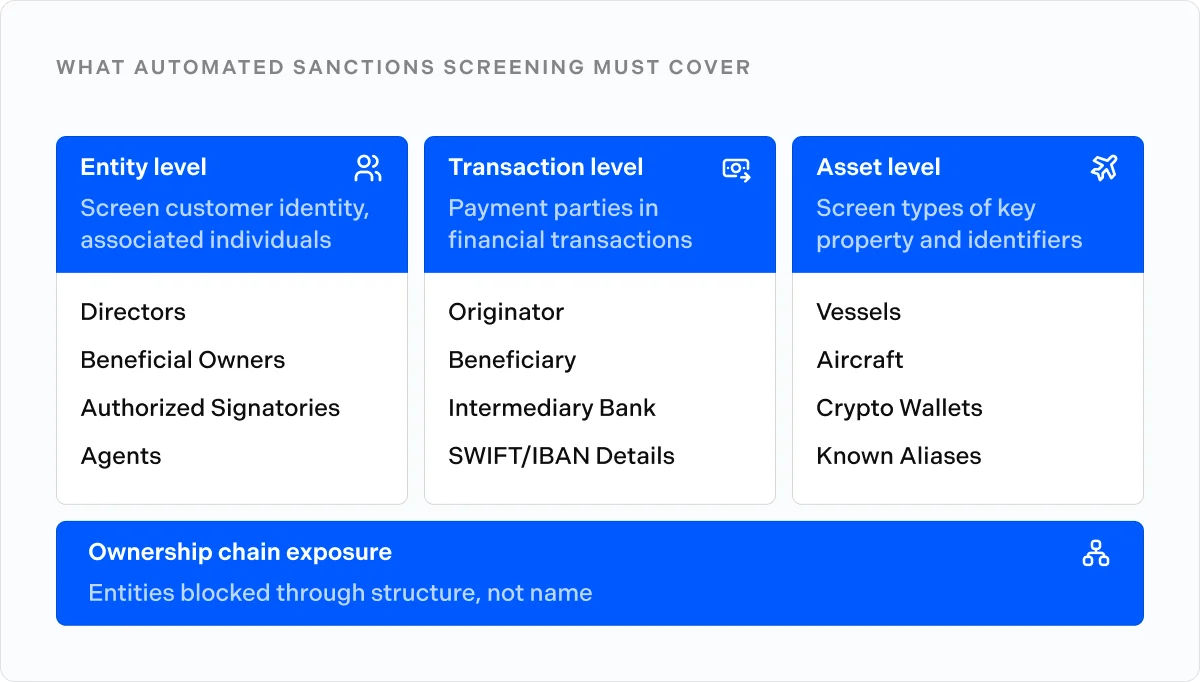
The dimension that most consistently creates undetected exposure is beneficial ownership.
Under OFAC’s 50% Rule, any entity owned 50% or more in the aggregate by one or more blocked persons is itself considered blocked, even without appearing on any published list. A sanctioned party can reach that threshold through layered corporate structures across multiple jurisdictions, which is why ownership chain mapping is a screening requirement, not an enhancement.
FATF’s 2023 guidance on beneficial ownership reinforces the same principle internationally, requiring competent authorities to maintain accurate, up-to-date records on the true owners of legal entities. An entity cleared at the name level may still carry sanctions exposure through its ownership chain, and name matching alone cannot close that risk.
When automated sanctions screening should run
Sanctions risk does not enter a business at onboarding and remain fixed. For instance, a counterparty that cleared screening last quarter may carry new exposure today, or a payment may route through a correspondent bank with its own obligations.
This means screening should happen at three distinct points in the relationship:
Customer onboarding and KYC refresh
Onboarding is the earliest point in the relationship where a restricted party can be identified and stopped. Screening at this stage covers the customer and all associated entities captured during intake.
Complete data collection at onboarding is what makes this check reliable. Records submitted without date of birth, nationality, or ownership details produce missed matches at the screening stage that no downstream control can recover.
Transaction initiation and payment processing
At the point a transaction is initiated, the check shifts to payment parties: the originator, beneficiary, intermediary bank, IBAN, and SWIFT code. When a prohibited payment settles before the alert is reviewed, the violation already occurred, regardless of what the screening result eventually shows.
Ongoing monitoring
Ongoing monitoring is where most programs carry the most uncovered exposure. Counterparties that were clean at onboarding can become designated weeks or months later, and a program that only screens at intake has no way to catch that change.
Rescreening the full portfolio whenever a list updates, and not waiting for a periodic batch cycle, is what a risk-based program requires.
However, rescreening captures only what regulators have already formalized. Adverse media can flag elevated risk before a designation arrives, while programs that treat watchlist screening as their only control miss that signal.
Read more: The nuances of effective sanctions screening
The automated sanctions screening process
Most sanctions screening platforms follow the same underlying sequence. The difference between a program that holds up under examination and one that does not comes down to how reliably each step performs.
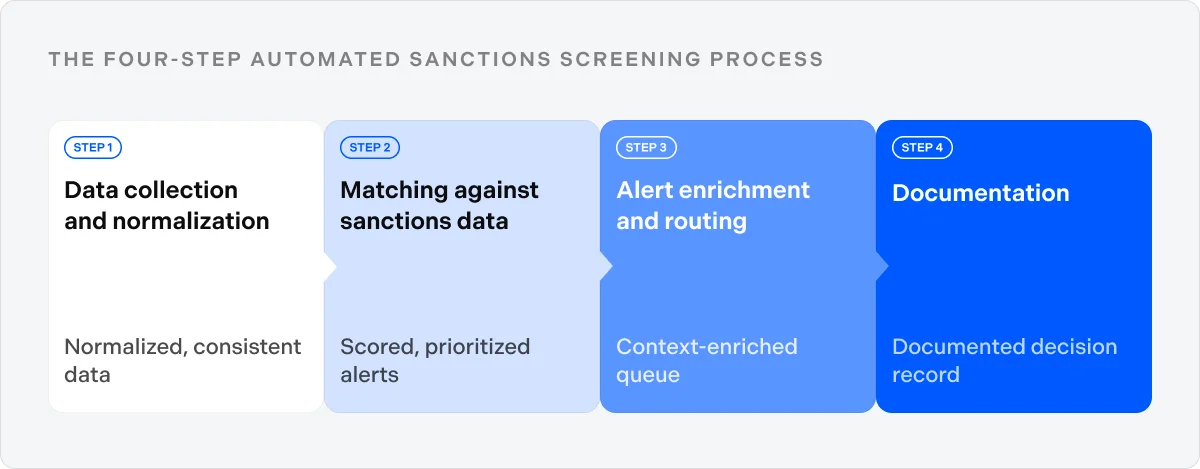
1. Data collection and normalization
Most missed matches originate here. Something as routine as a blank date-of-birth field or an inconsistently recorded name across source systems is enough to reduce matching accuracy before any list is consulted.
The downstream effect runs in both directions: Formatting mismatches drive false positives, while records that were never properly standardized fail to match against a list entry they should have caught.
2. Matching against sanctions data
Matching quality determines what the system can detect. Rule-based engines apply uniform thresholds to every entity regardless of context, giving a common name in a low-risk market the same treatment as a complex corporate structure initiating a high-value transfer through a sanctioned corridor.
Fuzzy matching, phonetic similarity scoring, alias handling, and date-of-birth filtering all improve detection accuracy, but only when thresholds are calibrated to the institution’s actual risk profile.
Three configuration failures account for most of the missed detections:
- Thresholds set too tight, letting near-matches pass unchallenged
- Thresholds set too broadly, flooding the analyst queue with coincidental hits
- Thresholds applied as a single global setting, treating every customer segment and corridor identically
3. Alert enrichment and routing
A name match is a starting point, not a compliance determination. AI-assisted systems score each match against contextual signals:
- Entity type and customer risk profile
- Geographic indicators and payment corridor
- Date-of-birth alignment with the list entry
- Ownership links and network relationships
Rather than receiving a bare flag, analysts see the reasoning the system applied and the confidence level it assigned to each match.
4. Documentation
Every screening event, list version, alert, analyst action, and outcome needs to be preserved and retrievable on demand.
Since March 2025, OFAC’s ten-year recordkeeping requirement has extended the window in which any transaction subject to a sanctions program must be fully documented, aligned with the updated statute of limitations for civil and criminal violations.
A correct screening result with no decision record created at the time carries no weight in an enforcement proceeding.
The four most common failure points
Regulators investigating sanctions violations rarely cite missing technology as the root cause. It is almost always a program that was scoped too narrowly, configured incorrectly, or never updated to reflect how the business actually operates.
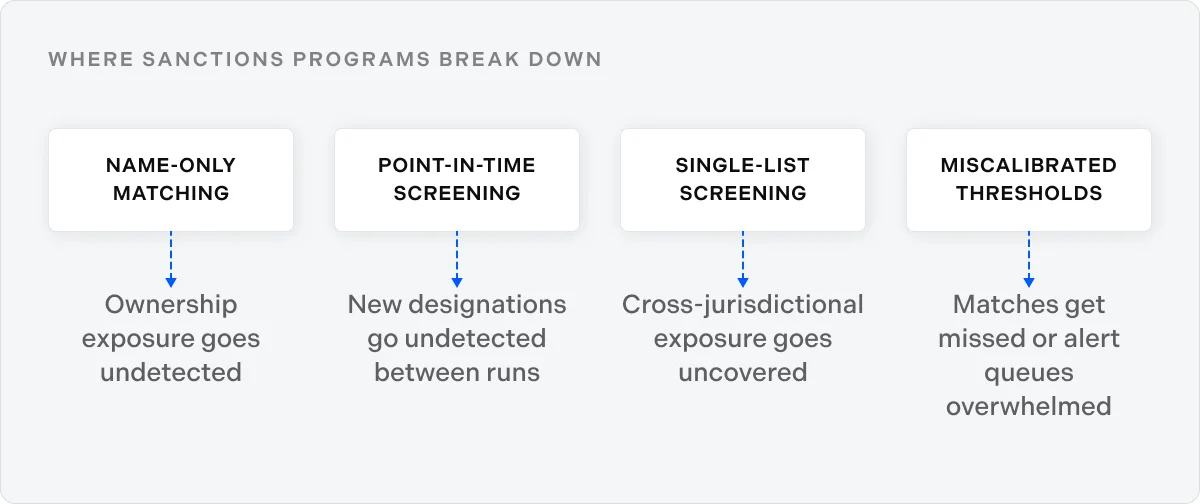
Screening only the primary customer name
The entities behind the customer go unscreened when programs rely on name-only matching. Screening the account holder alone misses the structures most commonly used to conceal sanctions exposure:
- Directors and authorized signatories
- Beneficial owners and holding structures
- Known counterparties and associated entities
Under the OFAC 50% Rule, entities blocked through aggregate ownership never appear on any published list by name. Programs that screen names but not ownership chains carry a deficiency regulators have consistently identified in enforcement proceedings.
Relying on a single list
Regulated institutions with cross-border activity must meet obligations across multiple sanctions regimes simultaneously. Single-list screening against OFAC alone, while ignoring EU, UN, or UK designations, leaves exposure that banking partners and correspondent banks will identify during due diligence.
List coverage needs to reflect the institution’s actual risk profile across:
- The jurisdictions it operates in
- The currencies and payment rails it processes
- The correspondent banking relationships it maintains
Using matching thresholds that are too broad
Overly broad thresholds generate alert volumes that overwhelm analyst capacity. The typical response is to widen suppression rules, which introduces true miss risk. Risk-based matching thresholds, calibrated by customer segment and payment corridor rather than applied globally, reduce alert volume without reducing coverage.
Treating screening as a point-in-time exercise
Screening at a single point in time cannot account for what happens next. Designations arrive without notice, and in a batch-based program, the lag between a new designation and its entry into the screening queue can stretch to days.
Between scheduled runs, newly designated parties can transact freely, access services, and move funds through a program that last checked them at onboarding. Periodic batch screening alone cannot close that window.
Read more: Why automated sanction screening is likely not enough
What a defensible automated sanctions screening program looks like
The OFAC Framework for OFAC Compliance Commitments identifies five essential components of a sanctions compliance program:
- Management commitment
- Risk assessment
- Internal controls
- Testing and auditing
- Training
Automated screening is primarily an internal controls and testing function, but the framework’s emphasis on documentation and accountability runs across multiple components.
In practice, that evaluation comes down to four things a program must be able to demonstrate:
- Coverage: Which lists are screened, at what frequency, and across which entity types. Single-jurisdiction screening or name-only matching is among the deficiencies most frequently identified in enforcement findings.
- Match quality: How thresholds are set, documented, and tested, and what controls exist for false-positive suppression. A program with undocumented threshold settings has no way to show its configuration was deliberate or risk-based.
- Review process: How alerts are routed, who reviews them, what documentation analysts produce, and how escalation works. Informal review processes leave no evidence trail that a human applied judgment to the result.
- Audit trail: Whether the system produces a complete, timestamped record of every screening event, list version, alert, decision, and override. A 2025 KPMG analysis of financial crime regulatory risk found that regulators are pushing back against outputs that cannot be interrogated, tested, and traced at audit.
A program that screens thoroughly but cannot demonstrate these four dimensions to an examiner is materially weaker than its technical configuration would suggest.
Read more: AI governance frameworks in financial compliance
What to look for when evaluating automated sanctions screening software
Not all platforms handle these requirements with equal depth. When evaluating a vendor, compliance teams should be able to get clear answers to the following:
- Which lists does the platform cover, and how frequently are they updated? A platform that covers OFAC but not EU, UN, or UK designations leaves jurisdictional exposure.
- How does the matching engine handle aliases, transliterations, and name variations? Exact-match-only systems miss the matches that carry the most risk.
- Does the platform screen ownership structures, not just named entities? Beneficial ownership mapping is required to cover entities blocked under the OFAC 50% Rule.
- Can thresholds be configured by customer segment and risk profile? A single global threshold applied across all customers is neither risk-based nor defensible to regulators.
- What does the audit trail capture? The record needs to show which list version was active, what matched, who reviewed the alert, and what decision was made.
Sigma360’s approach to automated sanctions screening
Most programs run the check but stop short of producing a documented, auditable record of every decision behind it. Sigma360’s sanctions and watchlist screening is built around the four dimensions regulators and banking partners evaluate when reviewing a program:
- Multi-jurisdictional list coverage: Screens against OFAC, UN, EU, the UK Sanctions List, and other major watchlists from a single configurable dashboard, with list updates deployed automatically. Perpetual KYC rescreens the full portfolio as new designations arrive, closing the window batch-based programs leave open.
- AI-assisted alert scoring: The AI Investigator Agent scores each alert against contextual signals, auto-clearing low-confidence mismatches and escalating genuine risk cases. Sigma360 reports an up to 93% reduction in false positives, which for a global payments firm translated into $1M in annual savings.
- Analyst-ready case documentation: Every alert reaches the analyst with a complete explanation of what matched, which signals the system weighed, and what confidence score it assigned. For high-risk relationships, screening data flows into enhanced due diligence workflows covering ownership, relationships, and adverse media.
- Timestamped decision records: Every screening event, list version, alert, analyst action, and outcome is logged automatically at the time of the decision and is retrievable on demand, meeting the ten-year recordkeeping standard OFAC introduced in March 2025.
Request a demo or speak to a compliance expert to see how Sigma360 performs against your current sanctions screening program.
FAQ
What happens when a sanctions screening alert fires?
An alert is a potential match, not a confirmed violation. The analyst reviews it against the match analysis and entity data, makes a documented determination (cleared, escalated, or blocked), and records the reasoning regardless of outcome.
What is the difference between sanctions screening and transaction monitoring?
Sanctions screening checks whether a customer, counterparty, or transaction involves a restricted party on a government watchlist. Transaction monitoring looks for suspicious patterns in payment behavior (unusual volumes, structuring, or layering activity) to detect potential money laundering. The two controls are complementary but serve distinct compliance purposes.
Can sanctions screening software integrate with existing onboarding and payment systems?
Yes. Most platforms offer API-based integration that runs screening within existing onboarding workflows and payment rails without manual data re-entry. The critical factor is whether the integration supports real-time screening at the point of transaction or only scheduled batch processing.
How long does it take to implement a sanctions screening solution?
Implementation timelines vary by integration complexity, but cloud-based platforms with API access can be operational within weeks. The longer lead time is usually on the institution’s side, covering data mapping, threshold configuration, and internal testing, rather than the platform itself.
How does the EU AI Act affect sanctions screening programs?
The EU AI Act is likely to apply to AI-assisted sanctions screening tools, though the precise classification depends on how the system is configured and which decisions it influences. Institutions using AI for screening should document model validation, maintain audit logs for AI decisions, and ensure clear human override processes well before the December 2027 compliance deadline for high-risk AI systems.

