
Adverse media screening in foreign languages means monitoring public sources (news, court records, regulatory filings, and investigative reporting) in non-English languages to catch financial crime risk before it reaches a formal watchlist.
Most compliance programs are built as though financial crime risk will eventually reach English. A corruption case involving a counterparty in Southeast Asia or a fraud investigation tied to a beneficial owner in the Gulf often appears first in local-language press, and by the time the same story reaches an English-language outlet (if it ever does), the window for early action has already closed.
This guide covers where English-only screening creates real regulatory exposure, and what programs built for genuine global coverage look like.
Key takeaways:
- Translation-based screening is not the same as multilingual screening
Most programs claiming multilingual coverage run translation workflows that lose the idioms, script-specific phrasing, and dialect nuances; details that native-language NLP would catch.
- Name matching across non-Latin scripts creates false negatives, not just false positives
Transliteration inconsistencies mean a customer’s name in Cyrillic or Arabic may never match the corresponding record in the database, producing a miss with no visible trace in the alert queue.
- Language coverage is a regulatory proportionality question, not a vendor feature
FATF, the EU AML Regulation, and MAS Notice 626 all expect source coverage to reflect real geographic exposure, and English-only programs serving cross-border books struggle to demonstrate that under examination.
- Scoping language coverage requires deliberate decisions, not defaults
Which languages, scripts, and high-risk relationship types to include are documented program configuration choices that regulators can and do examine.
- Sigma360 covers 120+ languages with native-language NLP and cross-script entity resolution
Sigma360 processes 225M+ articles from 730K+ publishers daily, and it’s built to close the detection gaps that translation-first approaches leave open.
Why language coverage decisions shape compliance program design
Language coverage determines which risk signals a compliance program can reach. The adverse media monitoring tools deployed at an institution tend to reflect its home market, and when source coverage is configured primarily around English-language outlets, the program is blind to reports published anywhere else.
For example, corporate customers with operations in Germany, Brazil, and South Korea generate risk signals in German, Portuguese, and Korean. Similarly, beneficial owners with business interests in the Gulf may appear in Arabic-language investigative reporting years before any English-language outlet covers the same story.
In both cases, the risk is publicly documented, and the institution has no access to it.
Where English-only programs create defensibility problems
Compliance programs built on English-language monitoring fail in consistent ways, and the failures map to geography. Three patterns illustrate where the blind spots tend to appear:
- Corruption investigations and fraud allegations in Southeast Asia and Latin America are routinely covered in depth by domestic outlets but never reach international press unless the entities involved are globally prominent.
- Beneficial ownership changes and legal disputes in Eastern Europe frequently appear through local registries and investigative publications in Cyrillic script. They are publicly documented but invisible to programs unable to ingest that content.
- PEP-linked risk in the Middle East and North Africa often appears first in Arabic-language regional media, leaving institutions without that coverage unaware of reporting that may have been available for months.
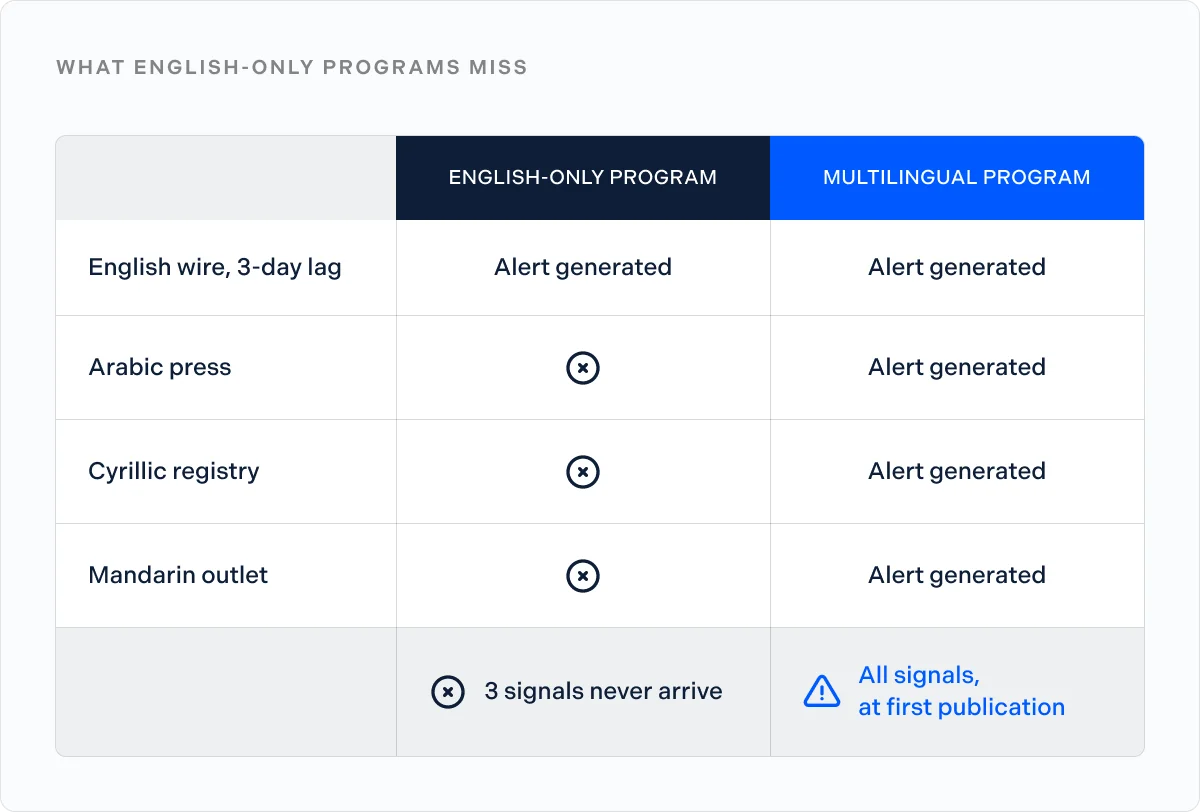
A FinTech Global analysis published in March 2026 found that programs designed to detect criminal or reputational exposure can miss signals that were publicly available throughout the entire duration of a customer relationship.
Regulators examining adverse media programs apply a proportionality standard, asking how closely a program’s coverage reflects the institution’s genuine geographic exposure. Programs monitoring primarily English-language sources for client books spread across multiple continents are not proportionate to the risk they are designed to manage.
Major supervisory frameworks are consistent on source coverage as a compliance obligation:
- FATF Recommendation 10 requires ongoing customer due diligence drawing on reliable, independent sources of information, a standard the FATF’s own guidance interprets to include open-source media in all languages relevant to a customer’s operating environment.
- The EU AML Regulation, applying from July 10, 2027, explicitly requires publicly available information to be factored into customer risk assessments with no carve-out for language.
- MAS Notice 626 guidelines go further still, explicitly addressing foreign-language documents in the screening process and requiring institutions to account for the limitations of tools that do not support non-Latin scripts.
The technical problem: Translation is not screening
Many programs claiming multilingual adverse media coverage run a translation-then-search workflow, which implies machine-translating foreign-language content into English before running keyword matching or standard NLP on the output.
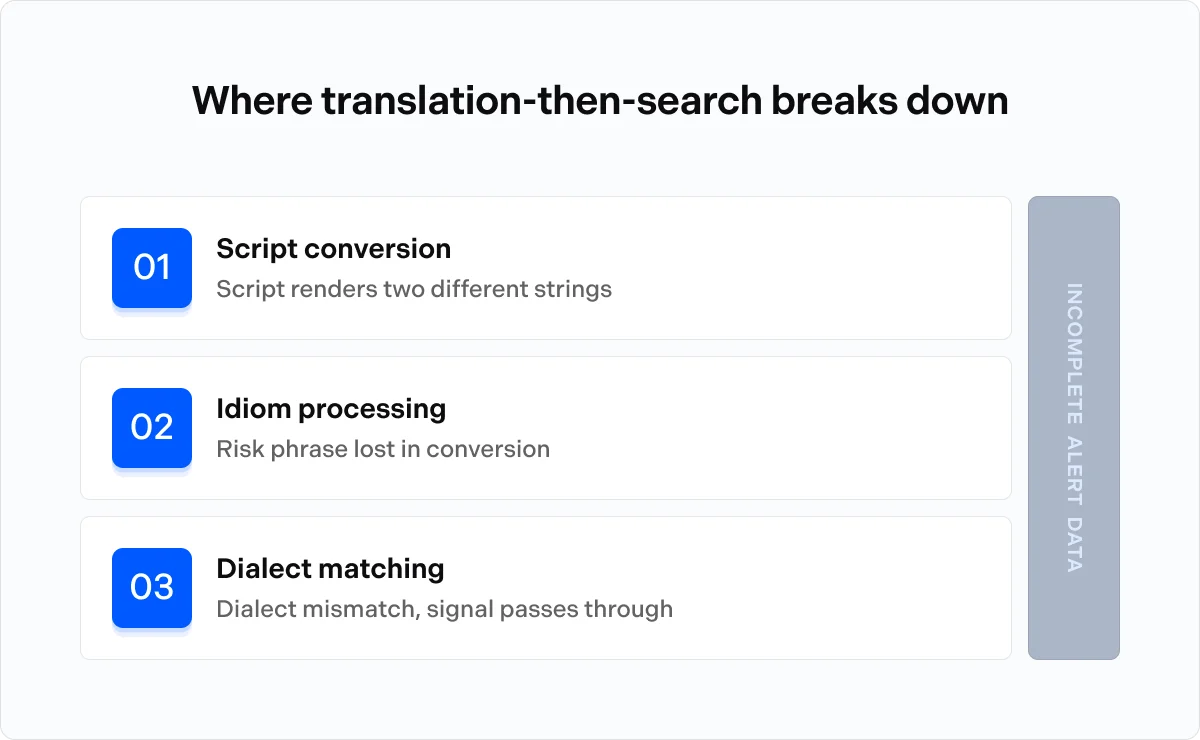
Three failure points explain where this approach breaks down:
Named entity recognition breaks across scripts
Arabic, Cyrillic, Mandarin, Japanese, Korean, Hebrew, Thai, and Devanagari each follow distinct character systems, grammatical structures, and naming conventions that cannot be reliably mapped to Latin-script equivalents through translation alone.
A Cyrillic name transliterated by one system produces a different Latin-script string than the same name processed by another (both renderings are valid), and a keyword-matching system trained on one will miss the other.
Idioms and indirect language carry risk signals that translation strips out
Local investigative journalism frequently uses legally protective phrasing and indirect constructions to describe criminal conduct without stating it explicitly.
The literal words pass through translation intact, but the risk signal they carry depends on culturally embedded meaning that only a model trained on that specific press environment can recover.
Dialect variation within languages creates a further blind spot
Arabic as written in Egypt differs materially from Arabic as written in Morocco, and Simplified and Traditional Chinese use different writing systems and diverge significantly in vocabulary and idiom. A uniform language model trained on one variant will fail to recognize risk-relevant reporting published in another, generating false negatives that leave no footprint in the alert queue. Native-language NLP is the minimum technical standard for programs covering cross-border customer relationships.
Name matching across scripts and languages
Name transliteration is where that technical requirement becomes most acute. Non-Latin scripts create a specific false-negative problem in adverse media screening, separate from the false-positive challenge most compliance programs are designed to address.
When a customer’s name appears in a non-Latin script and adverse media covering that customer is published in a local-language source using the same script, a system relying on transliteration may generate multiple plausible Latin-script equivalents, none of which match the record in the customer database.
No alert is generated, and the miss goes undetected until enforcement exposes it. Unlike a false positive, which an analyst can review and clear, a false negative leaves no trace in the queue.
The Wolfsberg Group’s Negative News Screening FAQ identifies multi-script name matching as a primary technical requirement for programs covering cross-border customer relationships, noting that most standard screening configurations do not address it adequately.
Matching complexity across scripts breaks down across three specific failure modes:
- Transliteration inconsistency: The same name can map to multiple valid Latin-script renderings depending on the system used, the source language, and regional conventions.
- Nickname and alias conventions: Local press routinely uses informal names, shortened forms, and culturally specific titles that keyword-based systems do not connect to the relevant entity without a taxonomy accounting for them.
- Multi-part name structures: Arabic, Chinese, Korean, and many South Asian naming conventions order name components differently from Western conventions, meaning records using one ordering will not align with source material using another.
Entity resolution that draws on secondary identifiers, network connections, and contextual signals across scripts gives programs a path to resolving these cases. Without it, the match either fails silently or lands in an analyst’s queue with no actionable basis for a decision.
How to scope language coverage for your program
No program is expected to monitor every language. Regulators expect coverage to reflect genuine geographic exposure, and the decisions behind it to be documented and defensible.
Language scoping under a risk-based approach covers six factors:
| Factor | What to assess |
| Customer operating jurisdictions | Which countries and territories does the customer’s business activity touch? |
| Beneficial ownership geography | Where are the UBOs and key controllers domiciled or active? |
| Primary language of local press | What language does investigative and regulatory reporting use in those jurisdictions? |
| Script complexity | Does coverage require non-Latin character recognition and native-language NLP? |
| PEP and high-risk relationship density | Do elevated-risk relationships increase the expected volume of non-English signals? |
| Regulatory jurisdiction | What do the primary supervisors for this customer segment expect to be documented? |
Institutions operating across Europe, the Middle East, Latin America, and APAC will find that most of these questions point toward material non-English coverage requirements.
Across all major supervisory frameworks, coverage must match the geography of the risk, not the language preferences of the screening stack.
Documenting the scoping decision is as important as making it. The Wolfsberg Group’s Negative News Screening FAQ is explicit that institutions should record the rationale for source inclusion and exclusion decisions, meaning language coverage choices need the same defensibility as any other program configuration.
How Sigma360 supports adverse media screening in foreign languages
The three failure modes this article addresses each correspond to a distinct capability in Sigma360’s adverse media screening platform:
120+ language native-language coverage
Sigma360 processes 225M+ articles from 730K+ publishers daily, with native-language NLP running on source-language content rather than translated output. Arabic, Cyrillic, Mandarin, and other non-Latin scripts are handled directly, so signals appearing in regional outlets reach the platform as reliably as reporting from major international wires.
Entity resolution across scripts and transliteration variants
When a customer name in the database uses one Latin-script rendering and adverse media about that customer appears in Cyrillic, the platform’s entity resolution cross-references secondary identifiers, network connections, and contextual signals rather than relying on a name-string match.
Entity resolution across scripts closes the false negative problem that name-string matching alone cannot address.
AI-driven consolidation across multilingual sources
The Adverse Media Agent groups related coverage of the same event from outlets publishing in different languages into a single structured narrative.
When a story breaks in regional press and is later picked up in international media, analysts see one consolidated risk event instead of a separate alert for each language the story appeared in.
In enhanced due diligence and AML investigations, this consolidated view carries the most weight. Foreign-language coverage of a counterparty is often the only available signal, and a blank result carries real regulatory consequences.
Compliance teams can request a demo to see how Sigma360 performs across their specific geographic and linguistic exposure, or explore HyperScan to screen entities across global sources.
FAQ
Is English-only adverse media screening sufficient for a globally active institution?
No. For institutions with customers or counterparties in non-English-speaking markets, English-only coverage leaves a documented portion of the risk landscape outside the program’s reach, and regulators applying a proportionality standard will expect evidence that coverage reflects real geographic exposure.
How often should language coverage decisions be reviewed?
Language coverage should be reviewed whenever the customer book expands into new markets or a regulatory framework change affects supervisory expectations in a covered region. At minimum, it should be assessed annually alongside other program configuration decisions.
What is transliteration and why does it affect adverse media screening?
Transliteration converts a name from one script into another, for example, a Cyrillic name rendered in Latin characters to match a customer record. The same name can produce multiple valid Latin-script renderings depending on the system used, so a keyword match trained on one version will miss articles using another.
Can compliance teams screen for adverse media in non-Latin scripts manually?
Manual screening requires analysts with native-language proficiency and direct access to local media sources in each relevant language, a standard most teams cannot sustain across a global customer book. Automated platforms with native-language NLP handle character recognition, entity resolution, and materiality scoring before results reach the analyst.
Do regulators audit language coverage as part of AML examinations?
Yes, and the expectation is growing. Examiners assess whether source coverage is proportionate to real geographic exposure, and the Wolfsberg Group’s Negative News Screening FAQ recommends documenting source inclusion rationale as a record examiners can request during any AML review.

